Where An Bàng sits on the coast
Hội An sits a few kilometres inland from the South China Sea on the south bank of the Thu Bồn River. Ride east from the Ancient Town along Hai Bà Trưng Road for fifteen minutes and the road ends at sand. That sand is An Bàng. It runs roughly four kilometres north-south along the coast, bounded by the Cẩm Hà / Cửa Đại area to the south (where the Thu Bồn meets the sea) and by a long undeveloped stretch heading toward Đà Nẵng to the north. Administratively it sits inside Cẩm An ward of Hội An. Coordinates: 15.9054° N, 108.347° E.
Unlike the Ancient Town, which is heritage-protected and largely frozen, An Bàng has changed visibly within living memory. The road that today brings visitors from Hội An to the beach was, forty years ago, a rough track through paddies; the beachfront cafe where they stop for breakfast was, in the 1990s, a fisherman's house.
The character of the neighbourhood
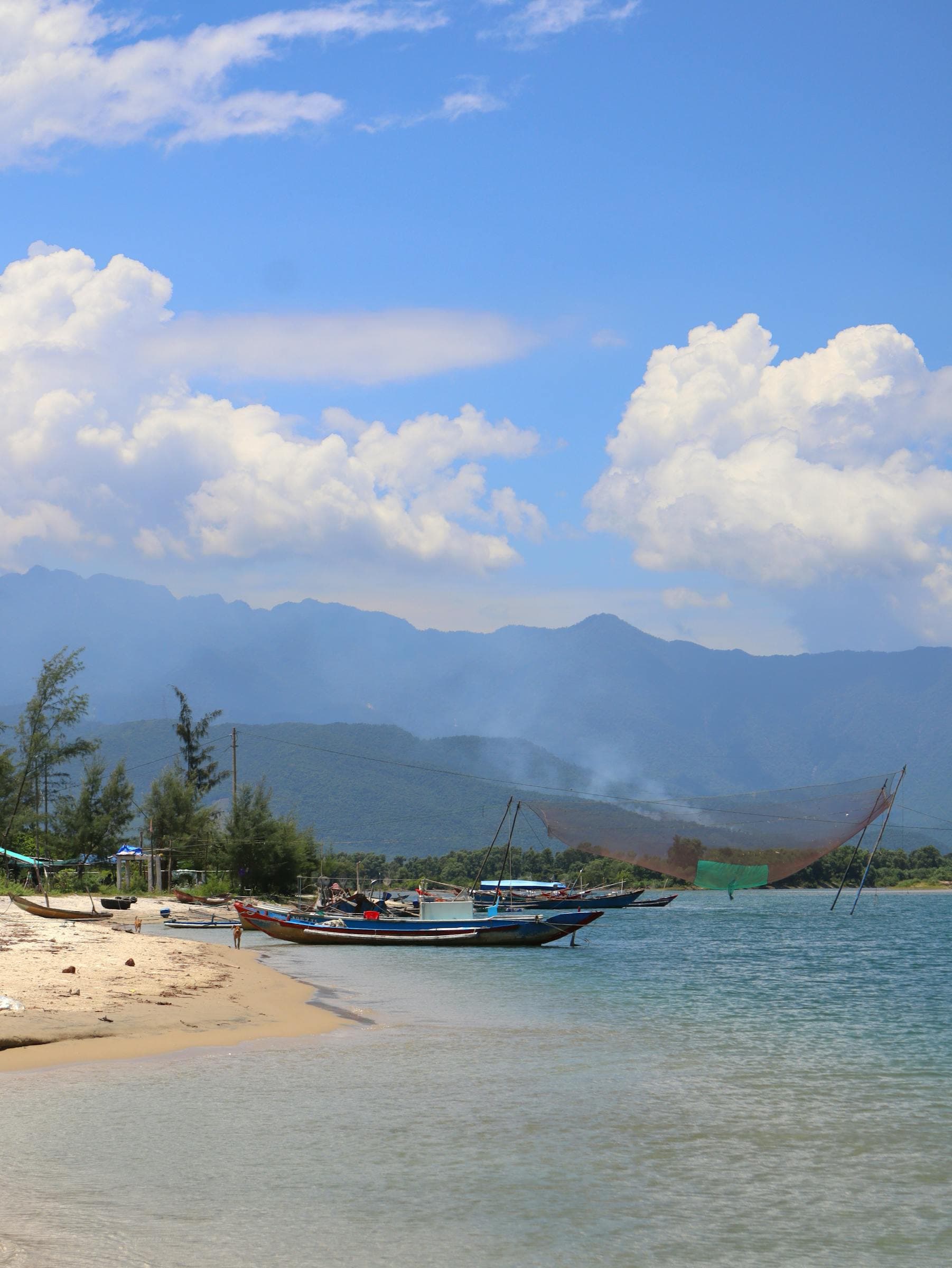
An Bàng is, in 2026, an alive coastal village. The fishing fleet still works: round bamboo basket boats (thuyền thúng) put out before dawn, and weathered men come back at sunrise with the day's catch — squid, mackerel, snapper. The same beach is then dressed for the visitor day. By 09:00 the sunbeds are out. By 10:00 the cafes are open. By noon the surf instructors are in the water.
Walk one block back from the sand and the village changes again. The lanes behind the beachfront are dense with small homestays, family restaurants, yoga shalas, surf schools, and the houses of the people who run them. The architecture is low — most buildings are two storeys — and the lanes are narrow. There is no large hotel block. The hospitality is almost entirely family-scaled, and the result is a neighbourhood that still feels like a village rather than a resort strip.
From fishing village to beach destination
Through the twentieth century An Bàng was a working coastal village — fishing, a little salt-making, vegetable gardens on the dunes. The road from Hội An was poor; the village was effectively isolated. Through the 1980s and into the early 1990s, life ran on the rhythm of the tide.
The 1999 UNESCO inscription of Hội An's Ancient Town changed the calculus for everywhere within a bicycle ride. International visitors began arriving in the Old Town and, within a few years, exploring outward — first to Cửa Đại beach immediately south, and then to An Bàng. Cửa Đại was larger and had the early infrastructure; An Bàng was quieter. Through the 2000s a small number of beachfront cafes opened, run by families who had previously fished or farmed. Through the 2010s the cafes were joined by homestays, villas, yoga studios, and surf schools — almost all family-owned, almost all built on the household's own land.
The pivot was around 2012. That year An Bàng was promoted as a destination in its own right, and the number of restaurants and rental properties grew quickly: by the late 2010s the village counted thirty-five restaurants and around a hundred villas and homestays along the beach stretch. CNN listed An Bàng among the top 100 beaches in the world in 2016. TripAdvisor placed it among the top 25 in Asia. The fishing fleet kept going alongside all of it.
What's there now
- The beach itself. Roughly 4 km of fine sand. The central settled stretch — about a kilometre — is the busiest, with sunbed concessions, restaurants right on the sand, and the village's small lifeguard service. Walk north or south fifteen minutes and the beach empties.
- Beachfront cafes and restaurants. Mostly family-run, offering Vietnamese seafood, international breakfasts, and end-of-day cocktails. The Soul Kitchen, Sound of Silence, La Plage and similar long-standing operators anchor the central stretch.
- Homestays and villas. A hundred-plus small properties in the lanes behind the sand — typically 2 to 8 rooms, family-run, with breakfast included.
- Yoga and wellness. Drop-in classes from sunrise yoga shalas; small-format spa studios on the village lanes.
- Surf and SUP schools. Surf is best September to March (north-east monsoon); the rest of the year is for stand-up paddle and swimming.
- The fishing fleet. Still going. Walk to the central beach at 05:30 and you can watch the boats come in.
- Cooking classes. Several beachfront cooking classes use seafood from the morning catch.
Where to stay at An Bàng
An Bàng accommodation falls into three groups. Beachfront villas and small hotels with direct sand frontage — a small number, typically 8 to 20 rooms, premium-priced because of the location. Lane-side homestays and villas one or two blocks behind the sand — many, mostly 2 to 8 rooms, family-run, mid-priced. And a small number of larger resorts immediately south at Cửa Đại (Four Seasons The Nam Hai is the best-known) which are technically not at An Bàng but share the same coastline.
An Bàng suits travellers whose centre of gravity is the beach. If your time budget for the Ancient Town is a 90-minute evening visit each day, An Bàng is the right base. If your time budget for the Ancient Town is a full day, a riverside or south-bank base is more efficient — see Cẩm Nam for the closest residential alternative to the Old Town.
How to get to and from the Ancient Town
- Bicycle: 15-20 minutes along Hai Bà Trưng Road. Mostly flat, lightly trafficked, the most popular option. Bicycles are included with most An Bàng homestays and with every Nghê Prana room.
- Taxi or Grab: 10 minutes, 80,000-120,000 đồng one way. Common for evening visits.
- Motorbike: 8 minutes. Parking is available at the Ancient Town's perimeter lots.
- Shuttle: Many An Bàng accommodations include a complimentary evening shuttle to the Old Town and a pickup later in the night.
Who An Bàng suits
- Beach-first travellers who want the sand directly outside the door.
- Families with younger children who need a calm gradient and lifeguarded sections.
- Surfers visiting between September and March.
- Yoga and slow-stay travellers who want a daily rhythm built around sunrise on the water.
- Longer-stay visitors (a week or more) who will mix beach days with Ancient Town evenings.