Where Cẩm Thanh sits
East of Hội An's Ancient Town the land flattens out and the Thu Bồn River begins to fan into its estuary. The freshwater slows and meets the tide, the channels multiply, and the river-bank vegetation shifts from rice paddy to nipa palm. This estuarine belt — roughly between the Old Town and the Cửa Đại river mouth — is the commune of Cẩm Thanh. It is low, brackish, and intersected by water in every direction. The road from the Old Town to An Bàng passes through it; from the saddle of a bicycle you can see the palms rising out of the channels on both sides.
Cẩm Thanh is approximately 5 km from the Ancient Town and 4 km from An Bàng beach. The community is a working rural one: rice farming, brackish-water fishing, a little vegetable growing on the sandier ground, and — since the 2000s — basket-boat tourism along the palm channels.
The character of the neighbourhood
Cẩm Thanh is rural and estuarine. It is not a tourist district in the way that the Old Town or An Bàng are districts — it is a working village with a major attraction in the middle of it. The houses are single-storey, set on raised earth platforms because the ground floods seasonally. Cattle and ducks share the lanes with bicycles. Most of the economic activity is still farming and fishing rather than hospitality, although the basket-boat tour economy has grown significantly since 2010 and now employs a meaningful share of working-age villagers — boatmen, tour guides, dock attendants, food vendors at the village tour entrances.
The pace is slow. Outside of the central two or three docks that handle the basket-boat tour traffic, the lanes are quiet, especially before 09:30 and after 16:30 when the tour buses have come and gone.
The nipa palm forest, the basket boats, and the war
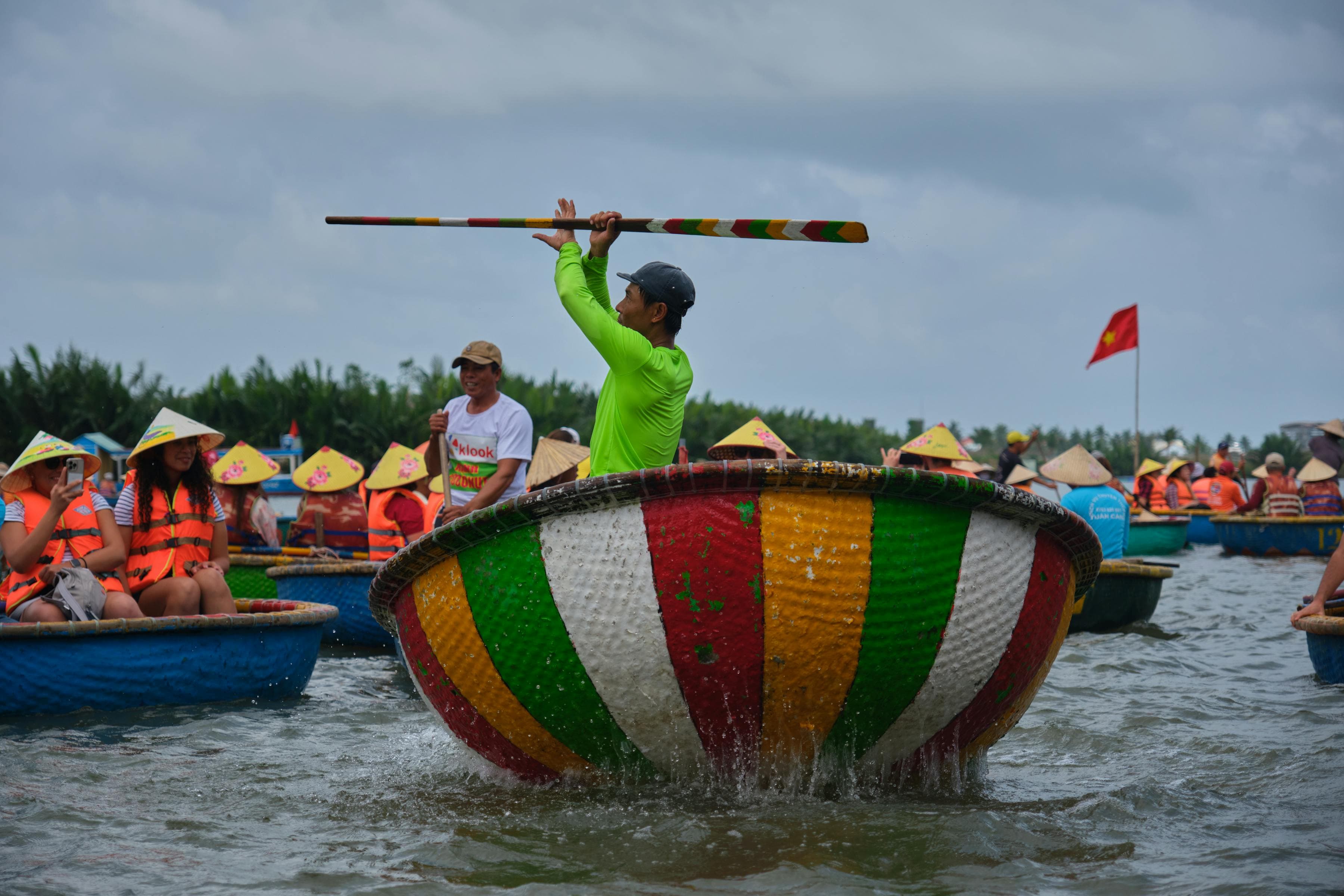
Cẩm Thanh's defining feature is the Bảy Mẫu rừng dừa nước — the 'seven-acre water-coconut forest.' Around two centuries ago, according to local oral history, settlers from southern Vietnam brought nipa palm (dừa nước) seedlings to this brackish estuary and planted them along the channels. The palms thrived in the salty-fresh water and gradually spread to cover roughly 100 hectares. The 'seven mẫu' name records the original 7-hectare planting; the forest is now an order of magnitude larger. The palms grow in dense rows out of the water itself, their fronds arching over narrow channels too tight for any boat with a keel.
This geography mattered during the Vietnam War. From 1965, the nipa palm channels — invisible from the air, impassable to vehicles, navigable only by basket boat — became a resistance base. Local villagers and Việt Cộng fighters used the cover of the palms to move men, supplies, and messages between hidden outposts. Bamboo basket boats glided silently at night carrying wounded soldiers, medical supplies, and food; women and children paddled routes that conventional boats could not reach. In 1966 and 1967 the area became a target of American operations. Cẩm Thanh is, today, officially recognised as a revolutionary site — the basket-boat tours that visitors enjoy are part of a craft tradition that doubled as resistance infrastructure within living memory.
What's there now
- Bảy Mẫu coconut forest tours. The main attraction. Basket boats depart from village docks throughout the day. 45-60 minutes on the water; net-fishing demonstration; palm-leaf folding; sometimes a spinning routine; small-crab catching.
- Rice paddies. Cẩm Thanh's higher ground is rice country. The lanes are bordered with paddies, water buffalo, and herons. Two crops per year, harvested April-May and August-September.
- Cooking classes. Several family-run cooking classes are based in Cẩm Thanh, often combined with a basket-boat ride and a morning market visit.
- Eco-lodges and homestays. A small but growing number of eco-style accommodations — typically a few rooms each, set in rice fields with limited connectivity. Best for travellers wanting rural immersion.
- Cycling routes. The lanes connecting the Old Town, Cẩm Thanh, and An Bàng make a popular flat cycling loop — roughly 12 km total — that includes the palm forest, rice paddies, and the beach.
- War memorials. Small commemorative markers in several parts of the commune note the resistance history. They are not promoted to visitors but are visible from the lanes.
Where to stay in Cẩm Thanh
Cẩm Thanh accommodation is mostly small eco-lodge and homestay format, set in rice fields or near the palm channels. These suit travellers who specifically want rural immersion: birds, frogs, no traffic noise, breakfast on the paddy edge. The trade-off is distance: Cẩm Thanh is 5 km from the Ancient Town and 4 km from An Bàng, and lacks the dense restaurant and cafe culture you find in the Old Town, An Bàng, or Cẩm Nam. Cycling 15-20 minutes to dinner is part of the deal.
For most visitors, Cẩm Thanh is best as a day trip rather than a base. A riverside or south-bank base — for example Cẩm Nam — places you within a 20-minute cycle of Cẩm Thanh, a 20-minute cycle of An Bàng, and 5 minutes from the Ancient Town, with restaurants in every direction.
How to get to and from the Ancient Town
- Bicycle: 15-20 minutes along the Cửa Đại Road. Flat, scenic, the recommended route. Bicycles are included with every Nghê Prana room.
- Taxi or Grab: 10 minutes, around 100,000 đồng one way.
- Tour shuttle: Most basket-boat tour operators include hotel pickup from Old Town and Cẩm Nam properties.
- By boat: Some operators offer a sampan transfer from the Ancient Town quay along the Thu Bồn to Cẩm Thanh — 30-40 minutes by water; more pleasant than the road in good weather.
Who Cẩm Thanh suits
- Day visitors on a basket-boat tour, ideally booked before 09:30 or after 15:30.
- Cyclists riding the Old Town — Cẩm Thanh — An Bàng loop.
- History-minded travellers interested in the area's Vietnam War resistance role.
- Eco-lodge / rural-immersion stayers who want a quiet rice-paddy base and don't mind cycling for dinner.
- Photographers at golden hour in the palm channels.