Traditional Kerala houseboat (kettuvallam) cruising through palm-lined backwaters.

The Honest Comparison

Hoi An vs Kerala for Ayurveda

Kerala is the source. Hoi An is the practical alternative for travellers who want classical Ayurveda — by Kerala-trained practitioners — without committing to monsoon-season India.

Last updated 2026-05-23 · Written by a riverside hotel with resident Kerala-trained Ayurvedic practitioners.

Traditional Kerala houseboat (kettuvallam) cruising through palm-lined backwaters.
Kerala, India — traditional kettuvallam houseboat on the palm-lined backwaters. Photo: Pritam Sengupta / Pexels.

At a glance

Hoi An, VietnamKerala, India
LineageKerala-trained, resident practitionersSource — direct gurukula and government-certified lineages
Typical programme length3 / 7 / 14 days (panchakarma-inspired)14 / 21 / 28+ days (full traditional panchakarma)
Monsoon Ayurveda (karkidakam)Not part of local traditionAuthentic Jun–Aug; pores open under southwest monsoon
Best monthsMar–Aug (dry, stable) · year-round indoorsOct–Mar (dry, cooler) · or Jun–Aug for karkidakam
Daily cost (all-inclusive)$130 – $220 / day$80 – $180 / day
Airport-to-spa35 min from Da Nang (DAD)2–6 hr from Cochin (COK) or Trivandrum (TRV)
Pairing with culture / beachUNESCO town 10 min + beach 25 min by bicycleBackwaters, tea estates, beaches — but 2–4 hr transit each
DietVegetarian, dosha-aware, light on dairy, Vietnamese-herb forwardStrict Ayurvedic — vegetarian, dosha-specific, ghee-heavy
Group size at quality centresSmall — six to twelve guests typicalVaries — six to sixty depending on the centre

Costs and ranges reflect 2026 averages for comparable mid-tier centres. Excludes flights.

Kerala is the source — we say this plainly

Ayurveda is a south-Indian tradition with a five-thousand- year continuous lineage. Kerala specifically holds the state apparatus around it — the government-certified practitioner system, the classical Sanskrit texts in daily use, the gurukula training system, the karkidakam monsoon protocols. Anyone offering Ayurveda outside Kerala is, in some sense, working from a copy. The honest question is whether the copy is faithful and whether the conditions around it support real practice. At Nghê Prana, the practitioners themselves are Kerala-trained, resident, and doing classical work — but we will not claim equivalence with the source. We will claim something more specific: for many travellers, what we offer is the right scale at the right time.

Who Kerala is right for

Choose Kerala if you can give Ayurveda twenty-one to thirty consecutive days. The traditional panchakarma — the seven-stage cleanse that classical Ayurveda was built around — requires that length. It cannot be compressed. Choose Kerala if you specifically want karkidakam, the monsoon protocol that runs roughly June through August. Choose Kerala if Ayurveda is the entire trip and you do not want a cultural or beach overlay competing for attention. Choose Kerala if you have already done shorter Ayurvedic programmes elsewhere and are ready for the deep version.

Who Hoi An is right for

Choose Hoi An if you have three, seven, or fourteen days for an Ayurvedic journey rather than three to four weeks. Choose Hoi An if you want the classical work — warm-oil abhyanga, Shirodhara, Nasya, herbal steam, dosha-adjusted meals — by Kerala-trained therapists, but you also want a walkable UNESCO town, a quiet riverside room, and a beach. Choose Hoi An if you are travelling from East Asia, Australia, or Western Europe and want airport-to-spa under an hour. Choose Hoi An if a previous Kerala trip taught you that you wanted the practice but not the full institutional structure around it.

What classical Ayurveda actually looks like in our spa

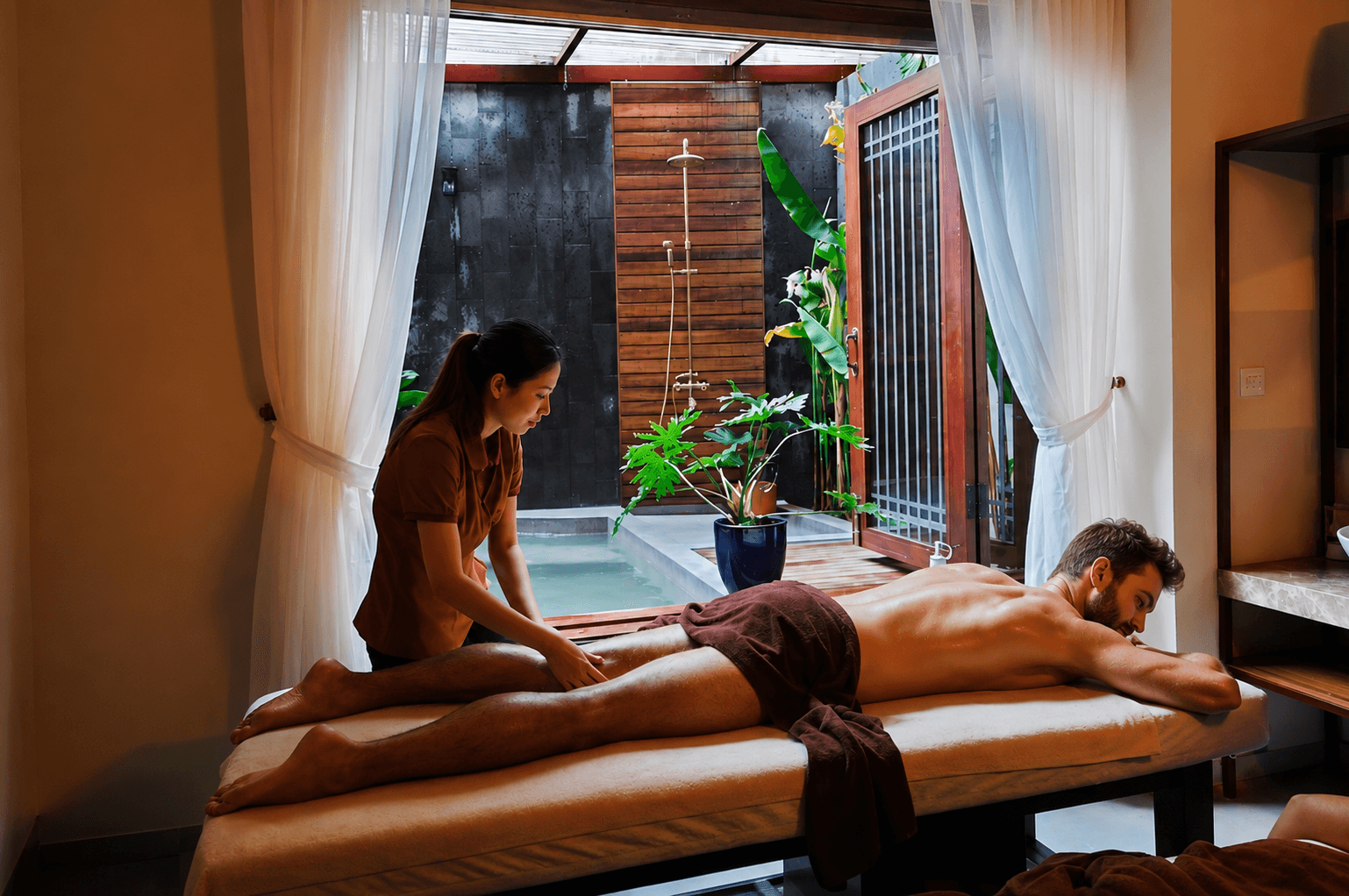
A typical seven-day journey begins with a 45-minute Prakriti (constitution) assessment with the lead practitioner. From that point, your treatments, oils, meals, and daily rhythm are calibrated to your dosha balance. Mornings open with yoga on the terrace. Days include one or two treatments — Abhyanga most days, Shirodhara twice, Nasya and herbal steam interspersed — with rest blocks long enough to let each treatment do its work. Meals are vegetarian, light on dairy, kicheri at midday, herbal teas across the day. Evenings are quiet by design. The arc is sequenced, not assembled.

The Vietnamese herbal tradition, alongside

One thing Hoi An offers that Kerala does not is the Central Vietnamese herbal tradition — lemongrass, ginger, turmeric, and pomelo leaf bundled into the warm túi chườm cloth and pressed along the meridians, herbal baths drawn from Trà Quế village herbs, hot-stone work with local river stones. We do not present this as Ayurveda. We offer it alongside, because both traditions are legitimately deep and the Vietnamese work pairs well with the Ayurvedic arc — particularly on rest days between Shirodhara sessions.

Related reading

Frequently asked

Hoi An or Kerala — common questions

Is Ayurveda in Hoi An comparable to Ayurveda in Kerala?

+

Kerala is the source — it has the lineage, the regulation, the monsoon-season protocols, and the depth for 21-to-30-day panchakarma. Hoi An offers Kerala-trained practitioners running classical protocols at smaller scale: 3-, 7-, and 14-day Ayurvedic journeys, daily warm-oil abhyanga, Shirodhara, and dosha-aware nutrition. For a true initiation or shorter journey, Hoi An is genuinely comparable. For a full traditional panchakarma cleanse, Kerala remains the appropriate choice.

Are your Ayurvedic therapists really Kerala-trained?

+

Yes. Our lead practitioners trained in Kerala in the classical tradition. The treatments — warm-oil abhyanga, Shirodhara, Nasya, herbal steam, hot stone — follow traditional protocol including pre-treatment consultation and diet adjustment. We do not run spa-style Ayurveda. Practitioners are resident at the property year-round, not visiting teachers.

How long should I stay for a real Ayurvedic effect?

+

Three days for a reset (we sequence one abhyanga, one Shirodhara, one herbal bath, and adjusted meals). Seven days for a deepening (the body recalibrates around day four). Fourteen days for a panchakarma-inspired programme. For full traditional panchakarma, allow 21–30 days and consider Kerala. Below three nights, Ayurveda becomes a series of treatments rather than a coherent arc.

What about the Ayurvedic monsoon-season tradition (karkidakam)?

+

Kerala's monsoon Ayurveda — karkidakam chikitsa, performed June through August during the southwest monsoon — is a real and specific therapeutic window when humidity opens the pores and herbs absorb more deeply. Hoi An's wet season (September–January) does not map to this tradition. If you specifically want monsoon Ayurveda, go to Kerala. If you want stable weather and Ayurvedic treatment year-round, Hoi An is the better practical choice.

Is Hoi An cheaper than a Kerala Ayurvedic retreat?

+

Comparable mid-tier Kerala retreats run $80–$180 per day all-inclusive. Hoi An's equivalent runs $130–$220 per day, including riverside accommodation, daily treatments, and Ayurvedic meals. Kerala is cheaper in raw price; Hoi An is closer to flights from East Asia, Australia, and East Africa, with airport-to-spa time under an hour from Da Nang versus 4–6 hours from Cochin to Alleppey or Varkala.

Do you offer Ayurvedic meals?

+

Yes. Guests on a multi-day Ayurvedic journey are served a seasonal, dosha-aware menu prepared in our kitchen — vegetarian and largely plant-based, light on dairy, kicheri at midday, herbal teas across the day. The kitchen sources from Trà Quế herb village three kilometres away.

Can I combine Ayurveda with yoga and the rest of the trip?

+

Yes — and this is the case for choosing Hoi An. Morning yoga is included with every stay on the open-air terrace. The Ancient Town is ten minutes by bicycle, An Bàng beach is twenty-five. You can pair a 7-day Ayurvedic deepening with cultural days, beach mornings, and a Silent Dinner without the rigid retreat structure many Kerala centres require.

Will I get a consultation and dosha assessment before treatments?

+

Yes. Every Ayurvedic journey begins with a Prakriti (constitution) assessment with the lead practitioner. Treatments, oils, meals, and pace are then adjusted to your dosha balance. The consultation runs about 45 minutes and happens on arrival day or the morning of the first treatment.

Kerala-trained Ayurveda, on the Thu Bồn River

Three, seven, or fourteen days — a real Ayurvedic journey

Riverside rooms, dosha-aware meals, daily yoga, and classical treatments by Kerala-trained practitioners. Free cancellation on every rate.