The Complete Science of Sleep: What Happens to Your Body and Brain Every Night
Your brain cleans itself of Alzheimer's toxins. Your muscles rebuild. Your immune system reloads. A 2025 OHSU study found sleep predicts lifespan more than diet, exercise, or social connection — second only to smoking. Here is everything science now knows about the most important eight hours of your day.
You spend roughly one-third of your life asleep — about 26 years if you live to 79. For most of human history, we had almost no idea what those hours were for. Sleep looked passive: the body still, the eyes closed, the mind dark. It took until the invention of the electroencephalogram in the 1920s to discover that sleep is not an absence of activity but an entirely different kind of activity — one so essential that evolution preserved it across every species with a nervous system, from fruit flies to blue whales, despite the enormous survival cost of lying unconscious for hours each day. Something so dangerous would only persist if what it provides is irreplaceable. In the last decade, science has finally begun to understand what that something is.
The Architecture of a Night: Sleep Stages Explained
Sleep unfolds in cycles, each lasting roughly 90 minutes, repeating four to six times per night. Each cycle contains distinct stages. Stage 1 (N1) is a brief transition lasting one to five minutes — the drowsy period where your muscles relax and your thoughts begin to drift. Stage 2 (N2) makes up about 50 percent of total sleep time. It is marked by sleep spindles — short bursts of rhythmic brain activity at 12 to 16 Hz — and K-complexes, large slow waves that appear to protect sleep from external disturbance. Sleep spindles are not idle noise: a 2019 study in Current Biology found that the density of sleep spindles directly predicts memory consolidation performance the following day. The more spindles you generate, the better you retain what you learned.
Stage 3 (N3), known as slow-wave sleep or deep sleep, is the most physically restorative phase. Brain waves slow to 0.5 to 4 Hz — massive, synchronized oscillations that sweep across the cortex like slow tidal waves. During this stage, your pituitary gland releases the majority of its daily human growth hormone (HGH) output. Adults typically spend 10 to 20 percent of the night in deep sleep, equaling roughly 40 to 110 minutes for those who get the recommended seven to nine hours.
A landmark UC Berkeley study published in Cell in September 2025 mapped for the first time the exact brain circuits controlling growth hormone release during sleep — revealing that HGH does not merely repair tissue but feeds back to promote wakefulness the next morning.
The researchers found that specific neurons in the hypothalamus regulate HGH release during deep sleep, while a feedback loop through the locus coeruleus in the brainstem keeps the system balanced. 'Sleep drives growth hormone release, and growth hormone feeds back to regulate wakefulness,' the team wrote. 'This balance is essential for growth, repair, and metabolic health.' The discovery helps explain why poor sleep leaves you both physically depleted and cognitively foggy — and why it increases the risk of obesity, diabetes, and heart disease.
REM Sleep: Where Dreams Build Your Mind
Then there is REM sleep — rapid eye movement — the stage most associated with vivid dreaming. During REM, your brain is nearly as active as when you are awake, but your body is paralyzed by a mechanism called atonia that prevents you from acting out your dreams. REM is where emotional memory processing occurs: your brain replays the day's experiences, strips the emotional charge from difficult memories, and integrates new information into existing knowledge structures.
A 2017 study in Neurology found that for every 1% reduction in REM sleep, there was a 9% increase in the risk of developing dementia.
And a March 2026 study published in Current Biology revealed something counterintuitive: people reported the deepest, most refreshing sleep not when their brain was quiet, but after vivid, immersive dreams during REM. Dreaming, it turns out, may be a sign that your brain is doing exactly what it is supposed to do.
The Glymphatic System: How Your Brain Takes Out the Trash
Perhaps the most revolutionary discovery in sleep science this century is the glymphatic system — the brain's dedicated waste-clearance network. First described in mice in 2012 by Maiken Nedergaard's lab at the University of Rochester, the glymphatic system was confirmed in living human brains by Oregon Health & Science University researchers in October 2024, who captured the first images of perivascular spaces — fluid-filled channels running alongside arteries — during brain surgery.
During deep sleep, the spaces between brain cells expand by up to 60 percent, allowing cerebrospinal fluid to flush through the tissue and carry away metabolic waste, including beta-amyloid and tau — the proteins that accumulate in Alzheimer's disease.
A January 2025 study in Nature Communications confirmed that glymphatic clearance during normal sleep significantly increased removal of Alzheimer's biomarkers from the brain, while sleep deprivation reduced clearance.
A companion study published in Cell in January 2025 revealed the mechanism: synchronized oscillations in norepinephrine levels during non-REM sleep drive rhythmic constriction and dilation of arteries — a process called slow vasomotion — which physically pumps cerebrospinal fluid through the brain's drainage system. This slow vasomotion was the strongest predictor of glymphatic clearance, stronger than sleep duration or time in any particular stage. The quality of your deep sleep determines how effectively your brain detoxifies itself each night.
The Brain's Tipping Point: How Sleep Actually Begins
In October 2025, a team from Imperial College London and the UK Dementia Research Institute published a study in Nature Neuroscience that changed our understanding of how sleep begins. Using EEG recordings from over 1,000 participants, they demonstrated that the brain does not drift gradually into sleep, as was long assumed. Instead, it reaches a tipping point — a mathematical bifurcation — where it switches abruptly from wakefulness to sleep.
The researchers could predict the brain's transition into sleep with 98% accuracy. The tipping point occurs approximately 4.5 minutes before conventional sleep onset markers appear.
This is like a stick bending under pressure until it suddenly snaps — and it explains the subjective sensation of 'falling' asleep. The finding has immediate implications for insomnia treatment: if falling asleep is a bifurcation event, then the goal is not to 'try harder' to sleep but to create conditions that bring the brain closer to the tipping point.
Sleep and Lifespan: The Data That Should Change How You Live
In December 2025, researchers from the OHSU Sleep, Chronobiology and Health Laboratory published a county-level analysis in SLEEP Advances comparing average life expectancy across the United States with CDC sleep survey data collected between 2019 and 2025.
Planning a trip around this? See dates at our quiet riverside hotel on the Thu Bồn. Check availability →
Their finding was stark: insufficient sleep — fewer than 7 hours per night — was the second strongest behavioral predictor of decreased life expectancy, surpassed only by smoking. It outranked diet, exercise, and social connection.
Lead researcher Andrew McHill noted that lower sleep insufficiency was associated with longer life expectancy in all but three states. This was not a small study — it used county-level data from the entire United States, making it one of the largest epidemiological analyses of sleep and mortality ever conducted.
What Sleep Deprivation Does to Your Body
The metabolic evidence is equally compelling. A 2022 meta-analysis in Diabetes/Metabolism Research and Reviews documented that sleep deprivation increases daily energy intake by 200 to 500 calories — not because of genuine hunger, but because it disrupts leptin and ghrelin, the hormones that regulate satiety and appetite. Leptin (the 'I am full' signal) drops; ghrelin (the 'I am hungry' signal) rises. The cravings that follow skew heavily toward high-fat, high-carbohydrate foods.
A 2021 review in Communications Biology found that sleep deprivation also alters the circulating numbers and activity of immune cells, elevates pro-inflammatory cytokines, reduces antibody production, and creates a chronic low-grade inflammatory state that increases the risk of cardiovascular disease, autoimmune conditions, and cancer.
Your Environment: Temperature, Light, and Caffeine
Your sleep environment matters more than most people realize. A study analyzing over 3.75 million nights of objectively measured sleep data from 34,096 individuals found that for each 1°F increase in bedroom temperature between 60 and 85°F, sleep efficiency decreased by 0.06 percent. The optimal range was 68 to 77°F (20 to 25°C), with a clinically significant 5 to 10 percent drop in efficiency above that range.
Caffeine's effects are more significant than most regular users appreciate. A 2023 systematic review in Sleep Medicine Reviews found that caffeine consumption reduced total sleep time by 45 minutes, increased sleep onset latency by 9 minutes, and reduced sleep efficiency by 7 percent. The half-life of caffeine varies from 2 to 10 hours depending on genetics. The practical implication: if you go to bed at 11 p.m., your last large coffee should be before 11 a.m.
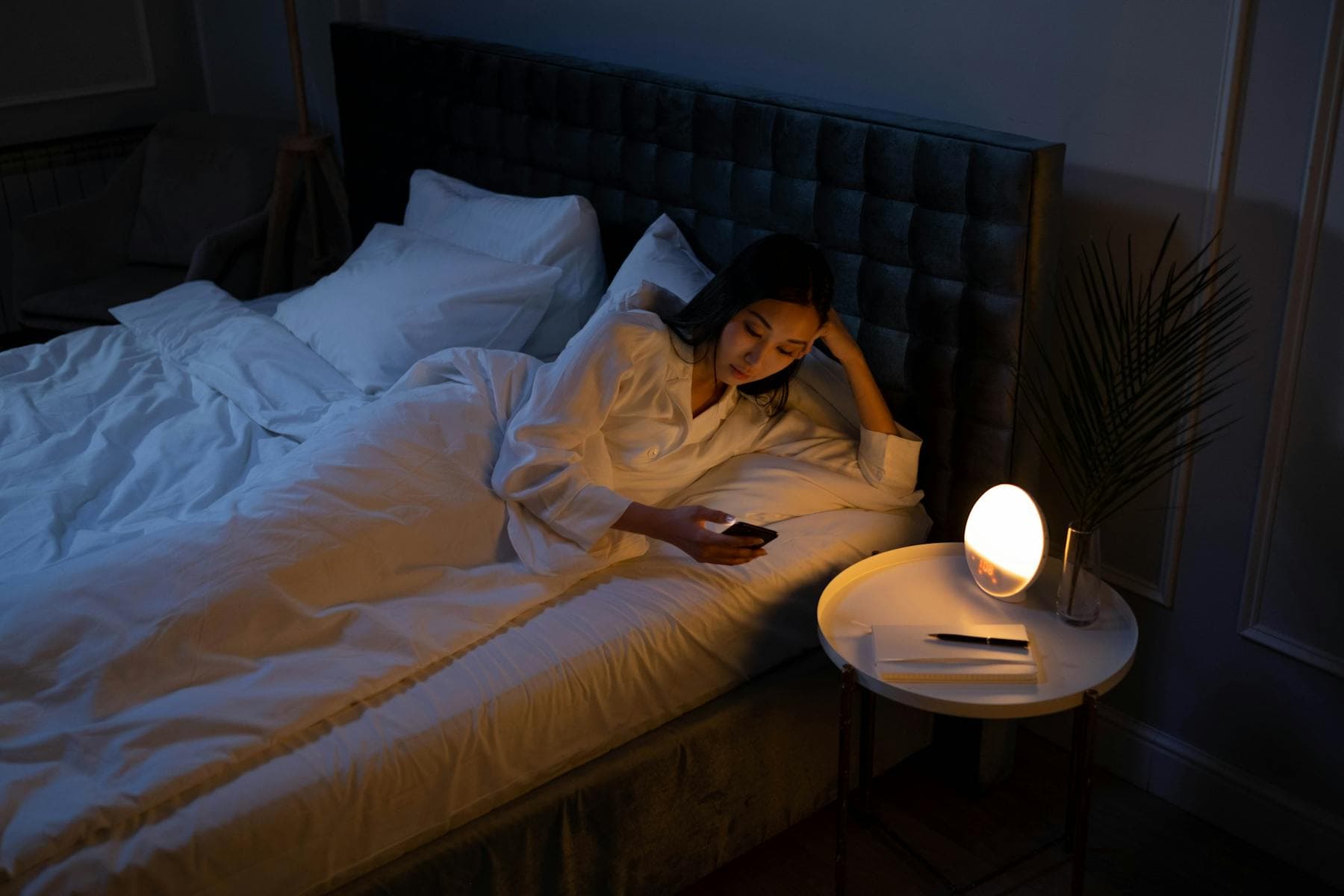
Light exposure follows a similar dose-response pattern. A 2011 study in the Journal of Clinical Endocrinology and Metabolism found that ordinary room lighting before bedtime suppressed melatonin production by up to 50 percent. Conversely, a 2014 study found that workers with window access slept 46 minutes more per night. Morning light exposure within the first hour of waking — ideally 10 minutes outdoors — is the single most powerful tool for anchoring your circadian rhythm.
What We Do at Nghe Prana — and Why
At Nghe Prana, we built a hotel around these findings. Not as a gimmick, but because we believe the research demands it. Every room faces away from road noise and toward the river or garden. Blackout curtains with thermal lining eliminate ambient light. The nightly herbal pillow sachet — lemongrass and lavender — draws from a 2012 Chronobiology International study showing lavender inhalation increased slow-wave sleep by 20 percent. Evening common areas transition to warm amber lighting at sunset. Our signature warm-oil full-body massage — slow, firm strokes with warmed oil — calms the nervous system and helps lower heart rate before sleep, while a Vietnamese herbal steam (xông hơi) with lemongrass and ginger eases the body into the evening.
The science is now unambiguous: sleep is not a passive state. It is an active, orchestrated biological process during which your brain cleans itself of neurotoxic waste, your muscles rebuild, your immune system reloads, and growth hormone repairs every tissue in your body.
Cutting it short does not make you productive — it makes you inflamed, insulin-resistant, cognitively impaired, emotionally reactive, and, according to the latest population-level data, likely to die sooner. The question is no longer whether sleep matters. The question is whether you will treat it as though it does.
Hahn MA, Heib D, Schabus M, Hoedlmoser K, Gruber G (2019). Slow oscillation-spindle coupling predicts enhanced memory formation from childhood to adolescence. Current Biology. View source
Yang D, Herrera CG, et al. (2025). Sleep drives growth hormone release, and growth hormone feeds back to regulate wakefulness. Cell. View source
Pase MP, Himali JJ, Grima NA, et al. (2017). Sleep architecture and the risk of incident dementia in the community. Neurology. View source
Siclari F, Bernardi G, Cataldi J, Tononi G (2026). Vivid, immersive dreaming is associated with deeper perceived sleep quality. Current Biology.
Nedergaard M, Goldman SA (2020). Glymphatic failure as a final common pathway to dementia. Science. View source
Eide PK, Vinje V, Pripp AH, Mardal K-A, Ringstad G (2025). The glymphatic system clears amyloid beta and tau from brain to plasma in humans. Nature Communications. View source
Fultz NE, Bonmassar G, Setsompop K, et al. (2025). Norepinephrine-mediated slow vasomotion drives glymphatic clearance during sleep. Cell. View source
Metzger MJ, Dijk DJ, Sherrill C, et al. (2025). Falling asleep follows a predictable bifurcation dynamic. Nature Neuroscience. View source
McHill AW, Czeisler CA, Shea SA, et al. (2025). Sleep insufficiency and life expectancy at the state-county level in the United States, 2019–2025. SLEEP Advances. View source
Rogers EM, St-Onge MP (2022). The effects of sleep disruption on metabolism, hunger, and satiety. Diabetes/Metabolism Research and Reviews. View source
Irwin MR (2021). Role of sleep deprivation in immune-related disease risk and outcomes. Communications Biology. View source
Minor K, Bjerre-Nielsen A, Jonasdottir SS, et al. (2020). Higher bedroom temperature associated with poorer sleep: data from over 3.75 million nights. SLEEP.
Gardiner C, Weakley J, Burke LM, et al. (2023). The effect of caffeine on subsequent sleep: a systematic review and meta-analysis. Sleep Medicine Reviews. View source
Gooley JJ, Chamberlain K, Smith KA, et al. (2011). Exposure to room light before bedtime suppresses melatonin onset and shortens melatonin duration in humans. Journal of Clinical Endocrinology and Metabolism.
Goel N, Kim H, Lao RP (2012). An olfactory stimulus modifies nighttime sleep in young men and women. Chronobiology International.
Every room at Nghê Prana is designed around the science of sleep. Blackout curtains, nightly aromatherapy turndown, and riverside quiet — experience what real rest feels like.
Riverside hotel rooms on the Thu Bồn, ten minutes by bicycle from the Ancient Town. Whether it's one night between Hue and Da Nang or a full week of doing nothing — we kept your room quiet.
Free cancellation · Direct from the family who built the hotel


 WhatsApp
 Zalo
Zalo