The Fishing Villages Around Hoi An: Whale Worship, Boat Songs and the Cầu Ngư Festival
The coastal communities around Hội An and Đà Nẵng worship the whale as a sea god and bury stranded whales with the rites of a village elder. Their spring festival, Lễ hội Cầu Ngư (the Whale God ceremony, Lễ tế Cá Ông), is national intangible heritage yet barely covered in English. We translate the belief, the rites, and the hát bả trạo rowing-song from Vietnamese sources, with notes from the fishing wards near our riverside hotel on the Thu Bồn.
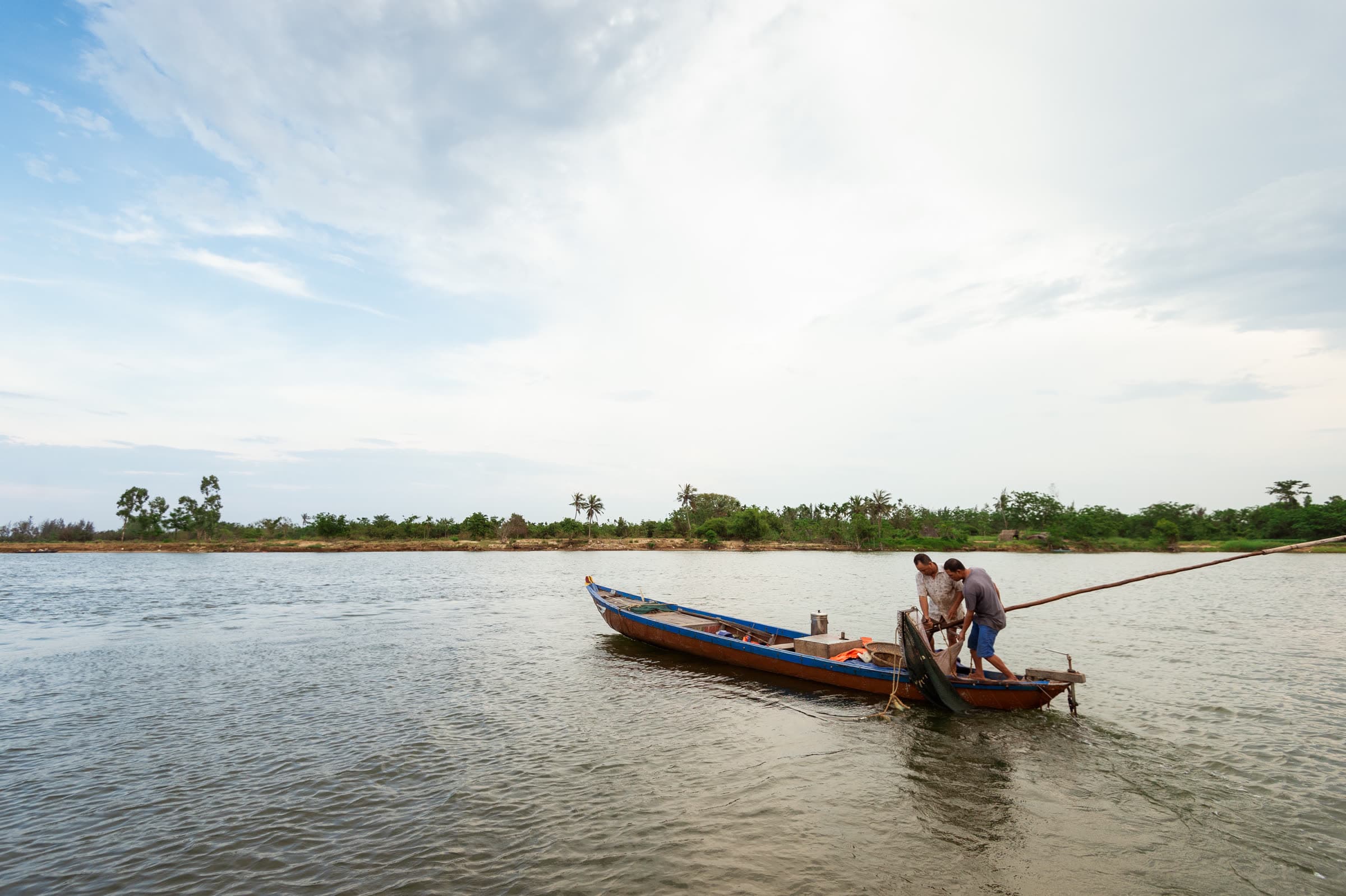
Along the central Vietnamese coast — the beaches and river-mouths around Hội An and Đà Nẵng — the whale is not wildlife. It is a god. Fishing communities here worship Cá Ông, "Sir Whale", as the protector deity of the sea; when a whale dies and washes ashore, the village that finds it holds a funeral with the honours due a respected elder, enshrines the bones, and tends the cult for generations. Their annual festival, Lễ hội Cầu Ngư — literally "the praying-for-fish festival", and also called Lễ tế Cá Ông, the Whale God ceremony — was recognised as national intangible cultural heritage in 2016 and is still barely described in English. This post translates the belief and its rites from Vietnamese sources, including the Đà Nẵng city portal, VietnamPlus, Tuổi Trẻ and Sài Gòn Giải Phóng.
Why do fishermen here worship the whale?
The belief, shared across the coastal communities of central and southern Vietnam, holds that Cá Ông — the whale — is a benevolent sea spirit who rescues boats and crews in storms, and that worshipping him brings calm seas and full nets. Vietnamese sources connect the cult to Thần Nam Hải, the "God of the South Sea". For fishing families whose livelihood and lives depend on a temperamental ocean, the whale that herds fish toward the boats and, in legend, lifts foundering vessels to safety is the most natural of protective deities. The reverence is practical as much as spiritual: it encodes generations of maritime knowledge and mutual aid into a religion of the sea.
When a whale strands and dies on the coast, the community that discovers it is bound to give it a full funeral. The carcass is mourned, buried, and after the flesh decays the bones are exhumed and enshrined in a lăng Ông — a whale shrine — where they become the focus of the village cult. These shrines, and the festival that animates them, are the institutional heart of coastal village life here.
The Cầu Ngư festival belongs to the fishing communities (vạn chài) of the central coast. / Lễ hội Cầu Ngư là của các vạn chài ven biển miền Trung.
What is the Cầu Ngư Festival?
Lễ hội Cầu Ngư is the spring festival of the coastal fishing communities (vạn chài). It opens the fishing year: a ceremony to honour the ancestors and the Whale God, to ask for calm weather and a safe, abundant season, and to bind the crews together before they go back out to sea. It is held in early spring, typically clustered around the middle of the first lunar month and continuing through the first and second lunar months as each fishing ward takes its turn — so the festival is not a single date but a season of observances along the coast. In 2026, Tuổi Trẻ reported the Đà Nẵng celebrations underway in early March.
On 10 March 2016 the Ministry of Culture, Sports and Tourism signed Decision 829/QĐ-BVHTTDL recognising the Cầu Ngư festival of Đà Nẵng as national intangible cultural heritage — the formal acknowledgement that this whale-worshipping tradition is a cultural treasure of the central coast.
What happens at the festival — the rites
At the centre of the festival is the formal sacrifice. A chánh bái — the chief celebrant, an elder chosen by the community — presents the offerings on behalf of the village and reads the văn tế, a ceremonial text that voices the fishermen's gratitude for the Whale God's protection and their wishes for a bountiful, safe season ahead. The rites are conducted at the lăng Ông before the enshrined whale bones, with incense, music, and the whole fishing community in attendance.
The văn tế read by the chánh bái thanks Cá Ông for his protection and asks for a new season of full nets, calm seas, and boats that go out and return safely — the entire moral economy of a fishing village compressed into a single prayer.
The chief celebrant (chánh bái) reads the văn tế before the enshrined whale bones at the lăng Ông. / Vị chánh bái đọc văn tế trước hài cốt Cá Ông tại lăng Ông.
Hát bả trạo: the rowing song
The signature performance of the Cầu Ngư festival is hát bả trạo — a sung, danced re-enactment of a crew rowing out to sea. A line of performers, oars in hand, sing and move in unison to the rhythm of an imagined voyage through the waves, led by figures who play the helmsman and the crew. Vietnamese sources describe it as the most distinctive art form of the festival, and its meaning is explicit: it dramatises the solidarity of men sharing one boat — the idea that on the open sea, a crew survives only by moving together. Alongside bả trạo, the festival carries tuồng and hát bội (forms of classical central-Vietnamese opera) and a programme of seaside folk games: basket-boat spinning, swimming and rowing races, tug-of-war and more.
Planning a trip around this? See dates at our quiet riverside hotel on the Thu Bồn. Check availability →
Where to find it near Hội An
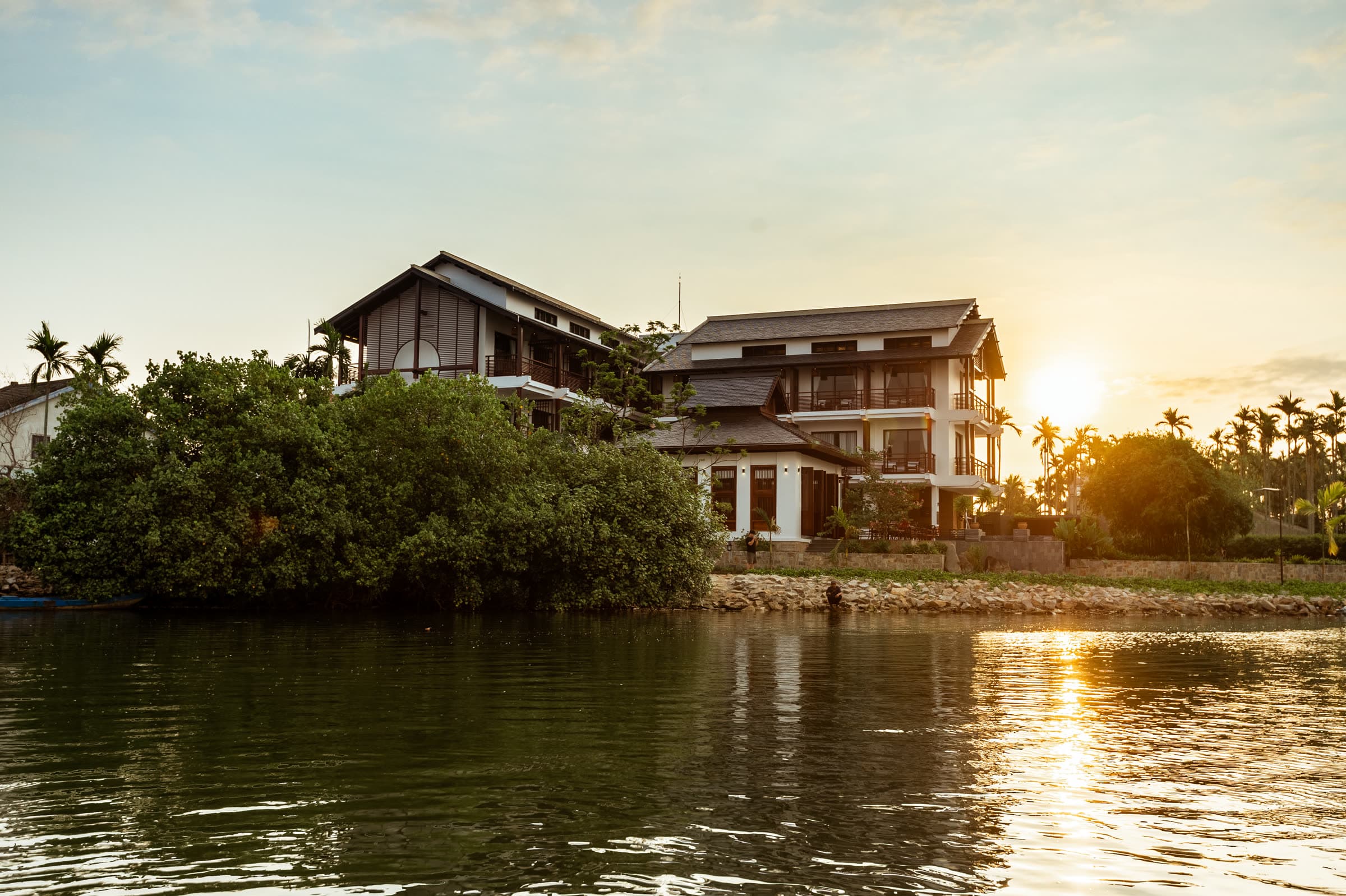
The fishing wards closest to us ring the coast and the river-mouth east of Hội An — the An Bàng and Cửa Đại beach communities, and the boat-fishing households of Cẩm An and Cẩm Thanh — while the largest and best-documented Cầu Ngư celebrations are along the Đà Nẵng coast, from Mân Thái and Thọ Quang on the Sơn Trà side to the Nam Ô community at the northern end of the bay. From our riverside hotel on the Thu Bồn, the Đà Nẵng coastal shrines are roughly 30–45 minutes by road; the nearer Hội An fishing wards are a short ride toward the sea. Because each ward holds its own observance on its own day within the season, the practical move is to ask locally — at the lăng Ông or through the hotel — which community is celebrating during your stay.
Why it matters
The Thu Bồn that runs past our windows reaches the sea at Cửa Đại, and the people who fish that river-mouth and the open coast beyond it carry the whale cult as their oldest institution. The Cầu Ngư festival is where Hội An's heritage stops being about merchant houses and lanterns and becomes about the working sea — the part of central Vietnamese culture that produced the town in the first place. It is also, like the Bà Thu Bồn river goddess festival upriver, a living tradition that Vietnamese institutions have documented carefully and English-language travel writing has almost entirely missed. For a visitor who wants to understand the coast rather than just photograph it, an early-spring morning at a lăng Ông, with the bả trạo singers and the smell of incense off the sea, is the real thing.
How to attend respectfully
This is a working religious festival of a fishing community, not a show staged for visitors. Dress modestly, keep back from the altar and the celebrants during the rites, and ask before photographing the sacrifice. The folk games and the bả trạo performance are public and welcoming; the formal văn tế is not a spectacle. As with the river-goddess festival upriver, the right posture is the one you would bring to any service: quiet, observant, and led by the community whose festival it is. If you are basing in Hội An and want to combine the coast with the river, pair a Cầu Ngư morning with a slow day around the Cẩm Thanh waterways and the river-mouth at Cửa Đại.
About this article
This post synthesises Vietnamese-language coverage of Lễ hội Cầu Ngư / Lễ tế Cá Ông — the Đà Nẵng city portal and VietnamPlus on the 2016 national-heritage recognition (Decision 829/QĐ-BVHTTDL), Tuổi Trẻ on the 2026 celebrations, and Sài Gòn Giải Phóng and the Đà Nẵng tourism portal on the rites and the hát bả trạo performance — together with first-hand familiarity with the fishing wards near Cửa Đại from our riverside hotel on the Thu Bồn. Festival dates vary by ward within the spring season; confirm locally during your stay.
Cổng thông tin điện tử thành phố Đà Nẵng (2016). Lễ hội cầu ngư Đà Nẵng được công nhận di sản văn hóa phi vật thể quốc gia. Da Nang City Portal (danang.gov.vn). View source
VietnamPlus (TTXVN) (2024). Lễ hội Cầu ngư ở Đà Nẵng: Nét đẹp văn hóa, tín ngưỡng của cư dân vùng biển. VietnamPlus. View source
Tuổi Trẻ (2026). Độc đáo lễ hội cầu mưa thuận gió hòa của ngư dân Đà Nẵng. Báo Tuổi Trẻ. View source
Sài Gòn Giải Phóng (2024). Độc đáo lễ hội Cầu ngư ở Quảng Nam và Đà Nẵng. Báo Sài Gòn Giải Phóng. View source
Báo Nhân Dân (2024). Lễ hội Cầu ngư - nơi kết nối truyền thống và dấu ấn văn hóa biển Đà Nẵng. Báo Nhân Dân. View source
Cổng thông tin du lịch thành phố Đà Nẵng (2024). Lễ hội Cầu Ngư Đà Nẵng. Danang Fantasticity (official tourism portal). View source
VietnamPlus (TTXVN) (2025). Bảo tồn và phát huy giá trị Di sản Lễ hội Cầu ngư tại Đà Nẵng. VietnamPlus. View source
Bộ Văn hóa, Thể thao và Du lịch (2016). Quyết định số 829/QĐ-BVHTTDL công nhận Lễ hội Cầu ngư là di sản văn hóa phi vật thể quốc gia. Ministry of Culture, Sports and Tourism decree.
Every room at Nghê Prana is designed around the science of sleep. Blackout curtains, nightly aromatherapy turndown, and riverside quiet — experience what real rest feels like.
Riverside hotel rooms on the Thu Bồn, ten minutes by bicycle from the Ancient Town. Whether it's one night between Hue and Da Nang or a full week of doing nothing — we kept your room quiet.
Free cancellation · Direct from the family who built the hotel


 WhatsApp
 Zalo
Zalo