Hoi An vs Da Nang in 2026: What Actually Changed When the Heritage Sites Merged
On 1 July 2025, Quảng Nam province was dissolved and merged into Đà Nẵng. Hội An became three wards. Mỹ Sơn moved with it. What this actually changes for visitors in 2026 — sourced from Tuổi Trẻ, VnExpress, Báo Đà Nẵng, and on-the-ground checks at the Old Town gates.
If you booked Hội An for 2026 and then read a headline that said "Hội An is no longer a city," you are not the only person who paused mid-checkout. On 1 July 2025, the entire province of Quảng Nam was dissolved and merged into Đà Nẵng under National Assembly Resolution 202/2025/QH15. Hội An, which had been a provincial city since 2008, lost its city designation and was split into three wards plus one island commune. Mỹ Sơn, Vietnam's other UNESCO World Heritage site in the region, moved with it.
This post translates and synthesizes the primary Vietnamese reporting on the move — Tuổi Trẻ, VnExpress, Báo Đà Nẵng, and the central government's policy portal — and answers the question a traveler actually has: does anything change for me on the ground in 2026?
The short answer is: the place name "Hội An" is still on every road sign, every entry ticket, and every coffee menu, and the heritage protocols at the gate work exactly as before. What changed is the masthead at the top of the org chart, and a sharper, narrower remit for the body that now manages the Old Town itself.
What was the 2025 merger, exactly?
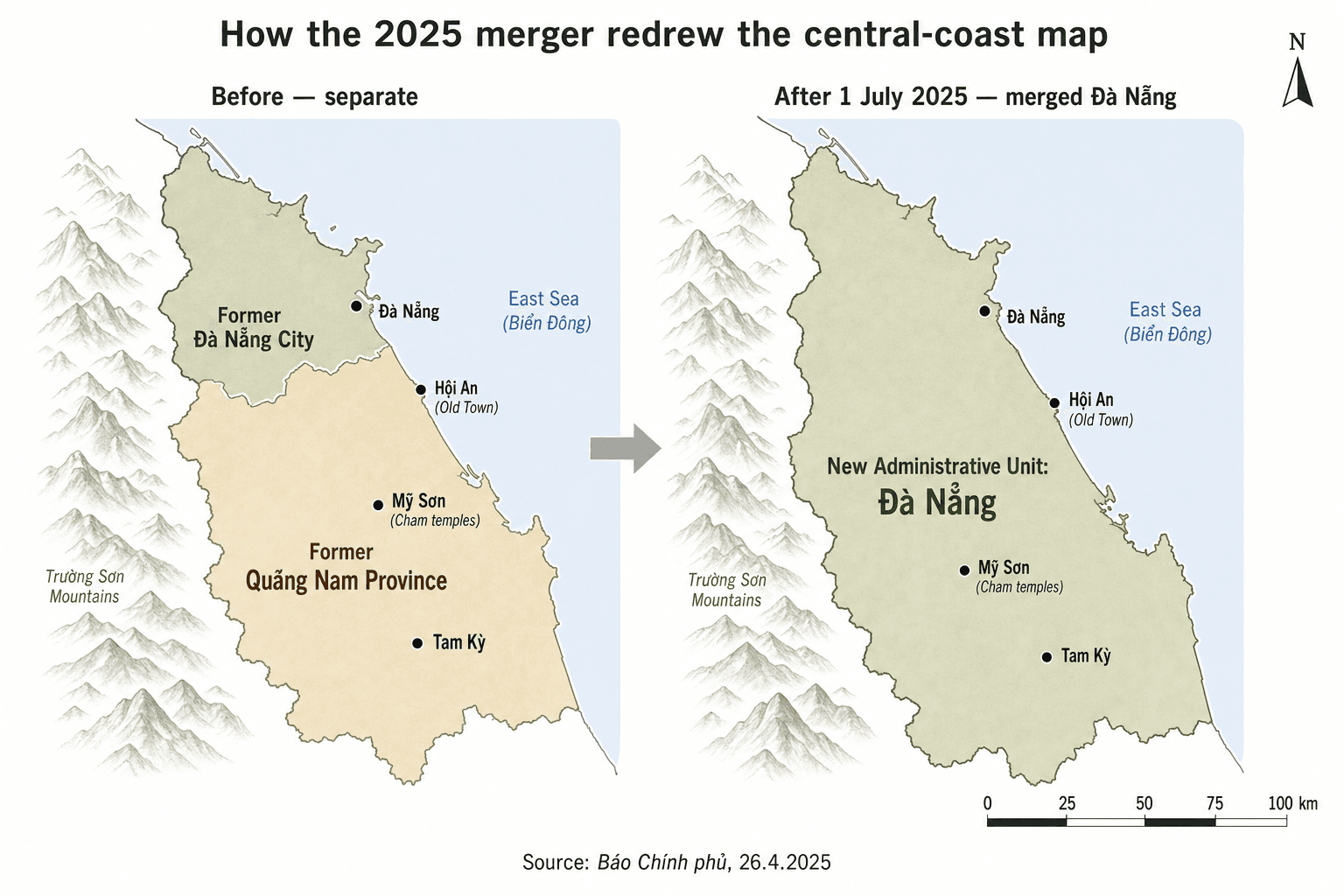
Map: Nghe Prana editorial, based on Báo Chính phủ, 26.4.2025
On 12 June 2025, the National Assembly passed Nghị quyết 202/2025/QH15. Effective 1 July 2025, the centrally-administered city of Đà Nẵng absorbed the entire province of Quảng Nam. The merged unit kept the name "Đà Nẵng" and became one of Vietnam's largest centrally-administered cities by area.
The numbers, from the government's policy portal xaydungchinhsach.chinhphu.vn (26 April 2025): 23 wards (phường), 70 communes (xã), and 1 special zone (đặc khu Hoàng Sa). Natural area 11,867.18 km². Population 3,065,628. Approval by referendum: Đà Nẵng 222,482 voters (99.77%), Quảng Nam 421,940 voters (98.52%).
This wasn't a quiet boundary tweak. It was the largest territorial reorganization in central Vietnam in a generation, and it was endorsed at the ballot box before it went to the Assembly.
Did Hội An stop being a city?
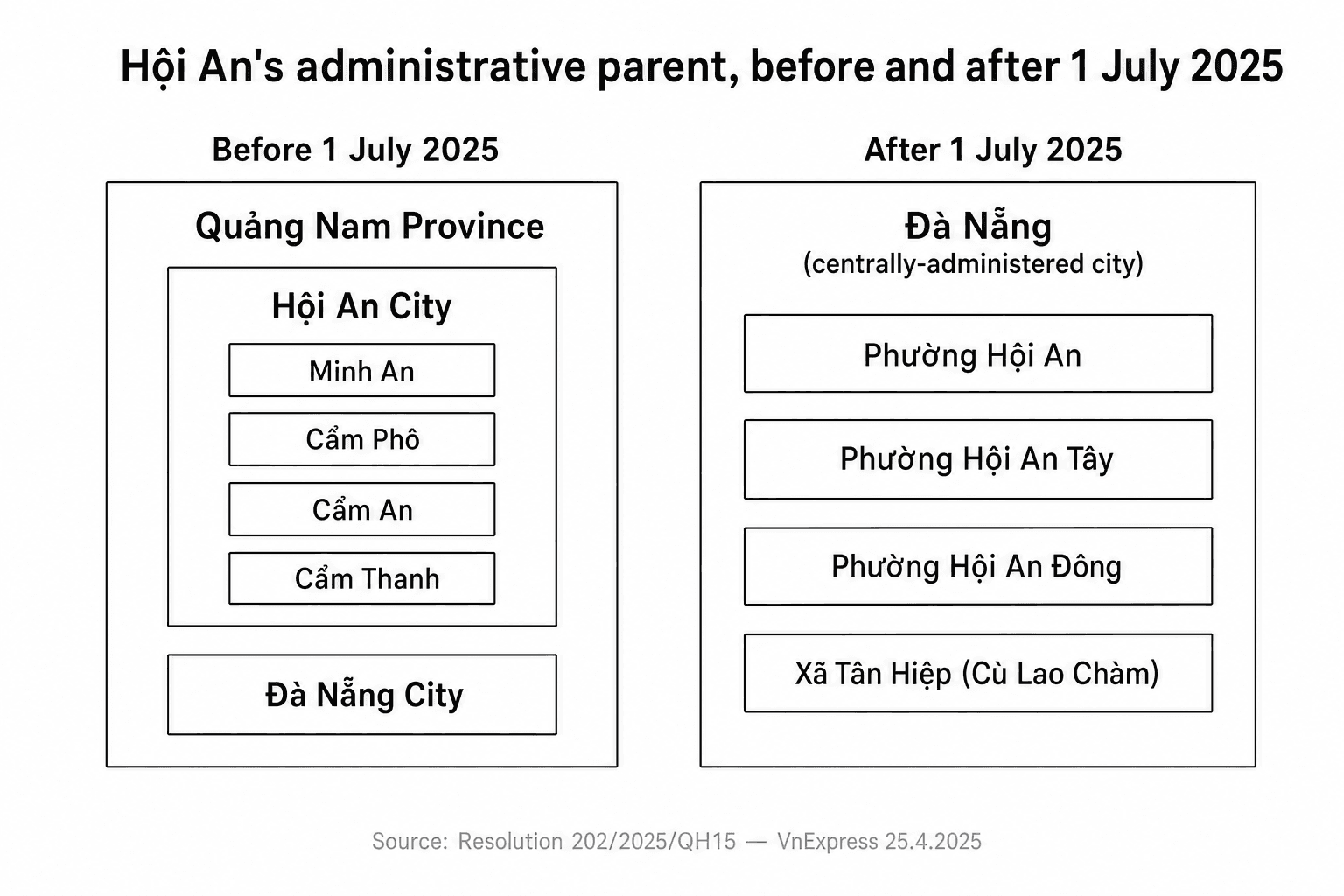
Diagram: Nghe Prana editorial, based on Resolution 202/2025/QH15 and VnExpress, 25.4.2025
Yes — administratively. As VnExpress reported on 25 April 2025, Hội An was dissolved as a "thành phố" (city) and reorganized into three wards plus one commune:
Phường Hội An — the central ward, merging the former Minh An, Cẩm Phô, Sơn Phong, Cẩm Nam, and Cẩm Kim wards. This is the Old Town and its immediate hinterland.
Phường Hội An Tây — merging Cẩm Hà, Thanh Hà, Tân An, and Cẩm An. The western and beach-side belt, where many hotels — including ours — now sit.
Phường Hội An Đông — merging Cẩm Châu, Cửa Đại, and Cẩm Thanh. The eastern wetlands, water-coconut palms, and beach.
Xã Tân Hiệp — Cù Lao Chàm island. The only locality that kept its old designation as a commune, and the only one whose name didn't change at all.
The Hội An researcher Phùng Tấn Đông, quoted by VnExpress, put the cultural cost plainly: "Khi có thay đổi về tên gọi, sự nhận diện thương hiệu chắc chắn ít nhiều bị ảnh hưởng." ("When the designation changes, brand recognition is inevitably affected to some degree.") Đà Nẵng's director Nguyễn Thanh Hồng framed it as "a major initiative creating breakthroughs in administration and development space." Both can be true. For the traveler in 2026, neither is the load-bearing fact. The load-bearing fact is the next section.
So who manages the Old Town now?
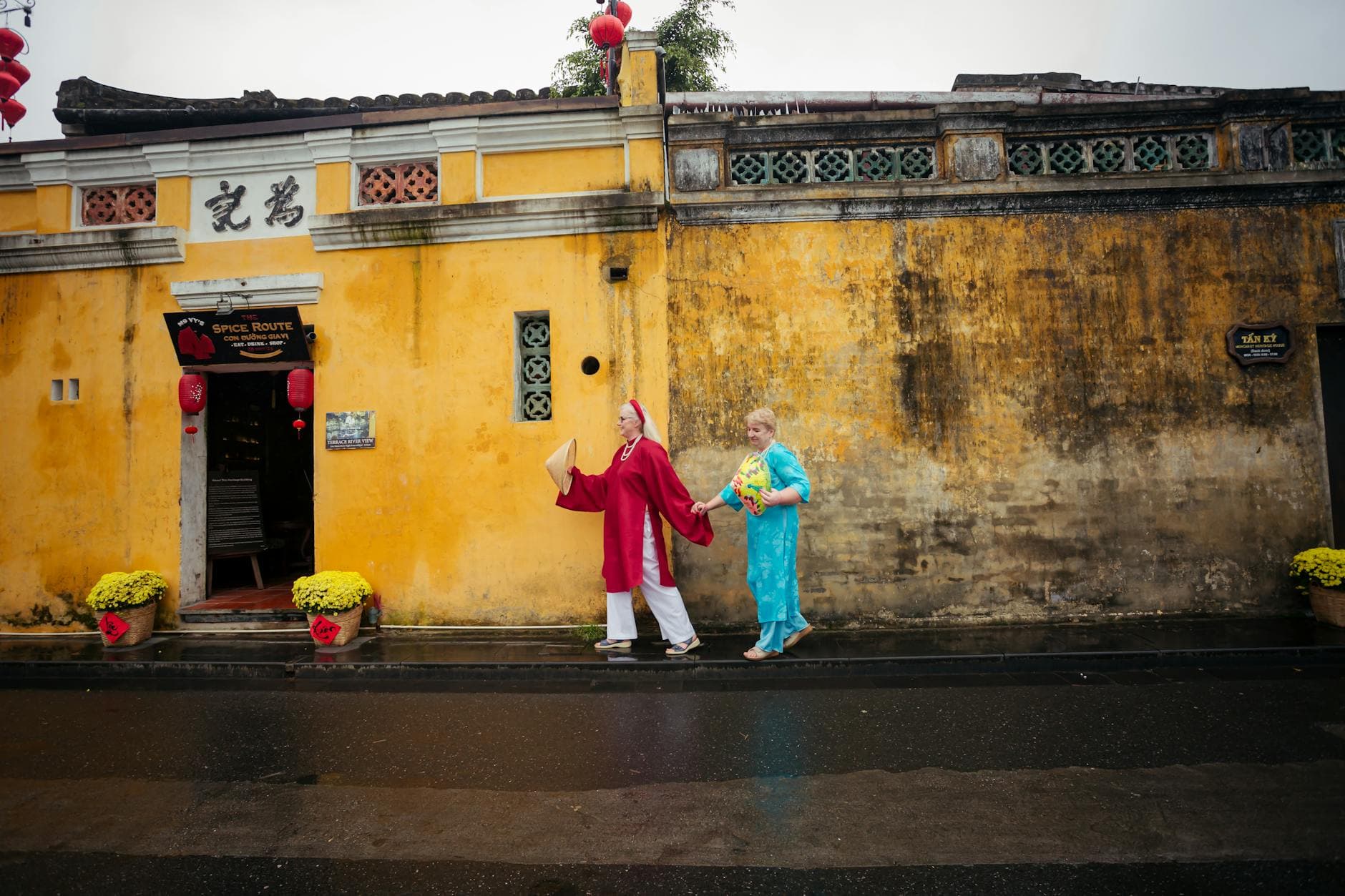
Photo: Võ Văn Tiến / Pexels
A new body, with a narrower mandate.
On 26 November 2025, Báo Đà Nẵng reported that the Đà Nẵng People's Committee had issued Quyết định 2641 (Decision 2641/QĐ-UBND), formally establishing the Trung tâm Bảo tồn Di sản Văn hóa Thế giới Hội An — the Hội An World Heritage Conservation Center. It is a public-sector unit under Đà Nẵng's Department of Culture, Sports and Tourism, and it answers up to the Ministry of Culture, Sports and Tourism and, through the Vietnamese UNESCO National Commission, to UNESCO itself.
This is the successor to the old Trung tâm Quản lý Bảo tồn Di sản Văn hóa Hội An, which had operated under Quảng Nam province since the Old Town was inscribed in 1999. The change is not just the parent. As Tuổi Trẻ reported on 10 July 2025, the new center's territorial remit is deliberately smaller:
"Thay vì quản lý toàn bộ các giá trị không gian di sản Hội An (gồm khoảng gần 50 di tích, đình chùa, làng nghề…) thì nay phạm vi được thu hẹp trong vùng 1, vùng 2 và vùng đệm khu phố cổ."
("Instead of managing the full Hội An heritage space — nearly 50 monuments, communal houses, pagodas, and craft villages — the scope is now narrowed to Zone 1, Zone 2, and the buffer zone of the ancient quarter.") A Tuổi Trẻ source inside the new Department of Culture explained the redistribution: "Từ nay các làng nghề, di tích, giá trị văn hóa ở các phường, xã ở Hội An (ngoài khu phố cổ) thuộc địa phương nào thì giao về đơn vị đó quản lý." ("From now on, the craft villages, monuments, and cultural assets in Hội An's wards and communes outside the Old Town are handed to the local administration that contains them.")
In plain English: the new center concentrates on the UNESCO-inscribed core. The pottery village at Thanh Hà, the carpentry village at Kim Bồng, the water-coconut wetlands at Cẩm Thanh, the basket boats — these are now the responsibility of the wards they sit inside.
Trương Thị Ngọc Cẩm, formerly director of Hội An's Center for Culture, Sports and Broadcasting, was appointed Deputy Director-in-Charge of the new World Heritage Center. At Mỹ Sơn, Nguyễn Công Khiết was appointed Deputy Director of the Mỹ Sơn heritage authority under the same Đà Nẵng department.
Does any of this change my visit?
We checked, on the ground, the week the new structure was published. The honest answer: not in any way you will notice as a traveler in 2026.
The Old Town entry ticket — still issued at the same kiosks, still 120,000 VND for foreign visitors, still admits you to five monuments of your choice. The masthead at the top of the receipt changed; the gate did not.
Road signs — every "Hội An" sign still points to Hội An. The name is now a ward designation rather than a city designation, but as a place name on the ground it is unchanged. Sat-nav apps that called the destination "Hội An, Quảng Nam" in 2024 now display "Hội An, Đà Nẵng," which is correct.
The Old Town blackout protocol — Đêm Rằm Phố Cổ continues on lunar 14, 20:00–22:00. The event is run by the same operational team, now reporting to Đà Nẵng's Department of Culture instead of Quảng Nam's.
Tour permits and operator paperwork — operator verification needed. Local guides we have spoken to report no friction during the transition, but we are tracking this through 2026 and will update.
Cù Lao Chàm — still Xã Tân Hiệp, still a marine protected area, still served by the same ferry from Cửa Đại. The only locality whose name on the ticket did not change.
Mỹ Sơn — the site continues to operate normally. Administrative parent is Đà Nẵng; operational management at the gate is the same Mỹ Sơn unit.
Postal addresses — many hotels, including ours, are technically now in Phường Hội An Tây. Most online booking platforms and Google Maps still display "Hội An" as the locality, which remains correct.
If you are a returning visitor: nothing you remember has moved. If you are coming for the first time: ignore the headlines and book the trip you would have booked in 2024.
Why does Vietnam keep merging provinces?
Planning a trip around this? See dates at our quiet riverside hotel on the Thu Bồn. Check availability →
Photo: Võ Văn Tiến / Pexels
Because the central government is consolidating sub-national administration as part of a multi-year effort to reduce overhead and align provincial economic regions with their natural metropolitan anchors. Đà Nẵng — international airport, deep-water port, hospital network, and university cluster — is the economic anchor for the central coast. Quảng Nam, which contained both UNESCO sites but had no airport and no port of its own, was the historical and cultural counterweight.
By merging the two, the central government is — in the framing of Báo Chính phủ — creating a single administrative unit large enough to plan infrastructure, tourism, and cultural management at the scale the region's economy actually operates at. Whether that produces better heritage outcomes is a question for 2030, not 2026.
What is unambiguous in 2026 is that UNESCO's two inscribed sites in central Vietnam now share a single provincial-level administrative parent for the first time. That is genuinely new, and it is the angle most English-language coverage has missed.
What should travelers actually do differently?
Three things.
Write the address as Đà Nẵng on customs forms. As of 1 July 2025, "Quảng Nam" no longer exists as a province. If a form asks for province, write "Đà Nẵng." If a form asks for city, write "Hội An" — the place name is still accepted everywhere and is, in fact, now a ward name.
Don't be confused by older guidebooks. Any English-language guide printed before mid-2025 will say Hội An is in Quảng Nam province. It isn't, anymore. The Old Town hasn't moved; the line on the map did.
If you care about the Cham heritage angle, plan Mỹ Sơn as part of the same trip. Both UNESCO sites are now under the same Department of Culture, and a combined visitor pass is under discussion (operator verification needed; we'll update when published). At minimum, the two sites are now coordinated at the policy level for the first time since Mỹ Sơn was inscribed in 1999.
What does this look like from the hotel side?
Photo: Tuan Vy / Pexels
Practical notes from Nghe Prana, the riverside hotel on the Thu Bồn where this post is written. Our 23-room property sits in what is now Phường Hội An Tây, the western ward formed from the merger of Cẩm Hà, Thanh Hà, Tân An, and Cẩm An. Our reservations team confirmed in May 2026 that no guest documentation, OTA listings, or transfer paperwork required revision because of the administrative change. Two notes for visitors:
If you receive a property invoice for visa or expense purposes and it shows the address as "Phường Hội An Tây, TP Đà Nẵng" rather than "Cẩm An, TP Hội An, Quảng Nam," that is the new correct form. Both refer to the same physical location.
The Thu Bồn itself — the river the property faces — also crossed administrative lines, since the upstream stretches were in Quảng Nam and the estuary was in Đà Nẵng. From 1 July 2025, the entire river system is under a single administrative parent. For boat tours that traverse from the Old Town to the estuary, this is a quiet operational simplification.
Sources
Đắc Thành, VnExpress, 25.4.2025 — "Hội An sẽ không còn là thành phố" — vnexpress.net
Tây Bình, Báo Chính phủ, 26.4.2025 — "Hợp nhất Quảng Nam, Đà Nẵng: thành phố mới có 23 phường, 70 xã và 1 đặc khu Hoàng Sa" — xaydungchinhsach.chinhphu.vn
Quốc hội nước CHXHCN Việt Nam — Nghị quyết 202/2025/QH15, ban hành 12.6.2025, hiệu lực 1.7.2025.
Thái Bá Dũng, Tuổi Trẻ, 10.7.2025 — "Di sản thế giới Hội An và Mỹ Sơn chính thức trực thuộc Đà Nẵng, công bố bộ máy mới" — tuoitre.vn
Tây Bình, Báo Đà Nẵng, 26.11.2025 — "Quy định chức năng, nhiệm vụ Trung tâm Bảo tồn Di sản Văn hóa Thế giới Hội An" — baodanang.vn
About this article
This piece synthesizes the five Vietnamese primary sources listed above with on-the-ground verification at the Hội An Old Town entry kiosks, our own property records under the new ward designation Phường Hội An Tây, and conversations with local guides through May 2026. Items flagged "operator verification needed" — combined Old Town / Mỹ Sơn visitor pass, tour-permit paperwork — will be updated when the relevant Decisions are published.
No. Quảng Nam province was dissolved on 1 July 2025 under National Assembly Resolution 202/2025/QH15 and merged into the centrally-administered city of Đà Nẵng. Hội An is now administered from Đà Nẵng.
Did Hội An become a ward in 2025?
Yes. The former city of Hội An was reorganized into three wards — Phường Hội An, Phường Hội An Tây, Phường Hội An Đông — plus the island commune Xã Tân Hiệp on Cù Lao Chàm.
Is the Hội An Old Town still a UNESCO World Heritage site?
Yes. UNESCO inscriptions attach to the site, not to the administrative parent. A new body, the Trung tâm Bảo tồn Di sản Văn hóa Thế giới Hội An, was established by Đà Nẵng's People's Committee on 26 November 2025 under Decision 2641 to manage the Old Town.
Did the Hội An Old Town entry ticket change in 2026?
No. The ticket is still issued at the same kiosks at 120,000 VND for foreign visitors and admits the holder to five monuments of their choice.
Is Mỹ Sơn Sanctuary also administered by Đà Nẵng now?
Yes. Mỹ Sơn Sanctuary, the other UNESCO World Heritage site in the region, moved with Hội An on 1 July 2025 and is now under Đà Nẵng's Department of Culture, Sports and Tourism.
What is the new address for hotels in the Cẩm An area of Hội An?
The former Cẩm An ward was merged into Phường Hội An Tây. The new correct address form is 'Phường Hội An Tây, Đà Nẵng,' though the place name Hội An remains valid on all online listings and mapping platforms.
Has the Hội An lantern festival night (Đêm Rằm Phố Cổ) changed?
No. The 20:00–22:00 vehicle and electric-light blackout on lunar 14 — Đêm Rằm Phố Cổ — continues as before, operationally unchanged under Đà Nẵng's Department of Culture.
Why did Vietnam merge Quảng Nam into Đà Nẵng?
The merger consolidates sub-national administration around natural economic regions. Đà Nẵng is the central coast's economic anchor with an international airport and a deep-water port. The proposal was approved by referendum in April 2025 with 99.77% support in Đà Nẵng and 98.52% in Quảng Nam, then passed by the National Assembly as Resolution 202/2025/QH15.
References & Sources
Đắc Thành (2025). Hội An sẽ không còn là thành phố. VnExpress. View source
Tây Bình (2025). Hợp nhất Quảng Nam, Đà Nẵng: thành phố mới có 23 phường, 70 xã và 1 đặc khu Hoàng Sa. Báo điện tử Chính phủ. View source
Quốc hội nước CHXHCN Việt Nam (2025). Nghị quyết 202/2025/QH15 về sắp xếp đơn vị hành chính cấp tỉnh năm 2025. Công báo Chính phủ.
Thái Bá Dũng (2025). Di sản thế giới Hội An và Mỹ Sơn chính thức trực thuộc Đà Nẵng, công bố bộ máy mới. Tuổi Trẻ. View source
Tây Bình (2025). Quy định chức năng, nhiệm vụ Trung tâm Bảo tồn Di sản Văn hóa Thế giới Hội An. Báo Đà Nẵng. View source
Cổng Thông tin điện tử thành phố Đà Nẵng (2025). Thành phố Đà Nẵng sau sắp xếp có 16 đơn vị hành chính cấp xã. danang.gov.vn. View source
Cổng Thông tin điện tử thành phố Đà Nẵng (2025). Phường Hội An — thông tin đơn vị hành chính. danang.gov.vn. View source
VnExpress (2025). Bộ máy lãnh đạo TP Đà Nẵng sau sáp nhập với Quảng Nam. VnExpress. View source
Every room at Nghê Prana is designed around the science of sleep. Blackout curtains, nightly aromatherapy turndown, and riverside quiet — experience what real rest feels like.
Riverside hotel rooms on the Thu Bồn, ten minutes by bicycle from the Ancient Town. Whether it's one night between Hue and Da Nang or a full week of doing nothing — we kept your room quiet.
Free cancellation · Direct from the family who built the hotel






 WhatsApp
 Zalo
Zalo