Hoi An for Light Sleepers — Five Things to Verify Before You Book
A quiet hotel in Hoi An is structural, not marketed. Five concrete things to verify — AC type, curtain depth, neighbourhood, fan age, corridor exposure.
If you sleep light, the variable that decides your trip is not the hotel's star rating but five small structural facts most listings do not publish: the air-conditioner type, the curtain depth, the neighbourhood's night soundscape, the age of the ceiling-fan motor, and how exposed the room is to the corridor. The World Health Organization's 2018 Environmental Noise Guidelines for the European Region recommend night-time outdoor noise stay below 40 dB(A) annual average to protect sleep, and indoor bedroom noise below 30 dB(A) for good-quality sleep (WHO Europe). Most Hội An rooms do not publish a number. So you ask.
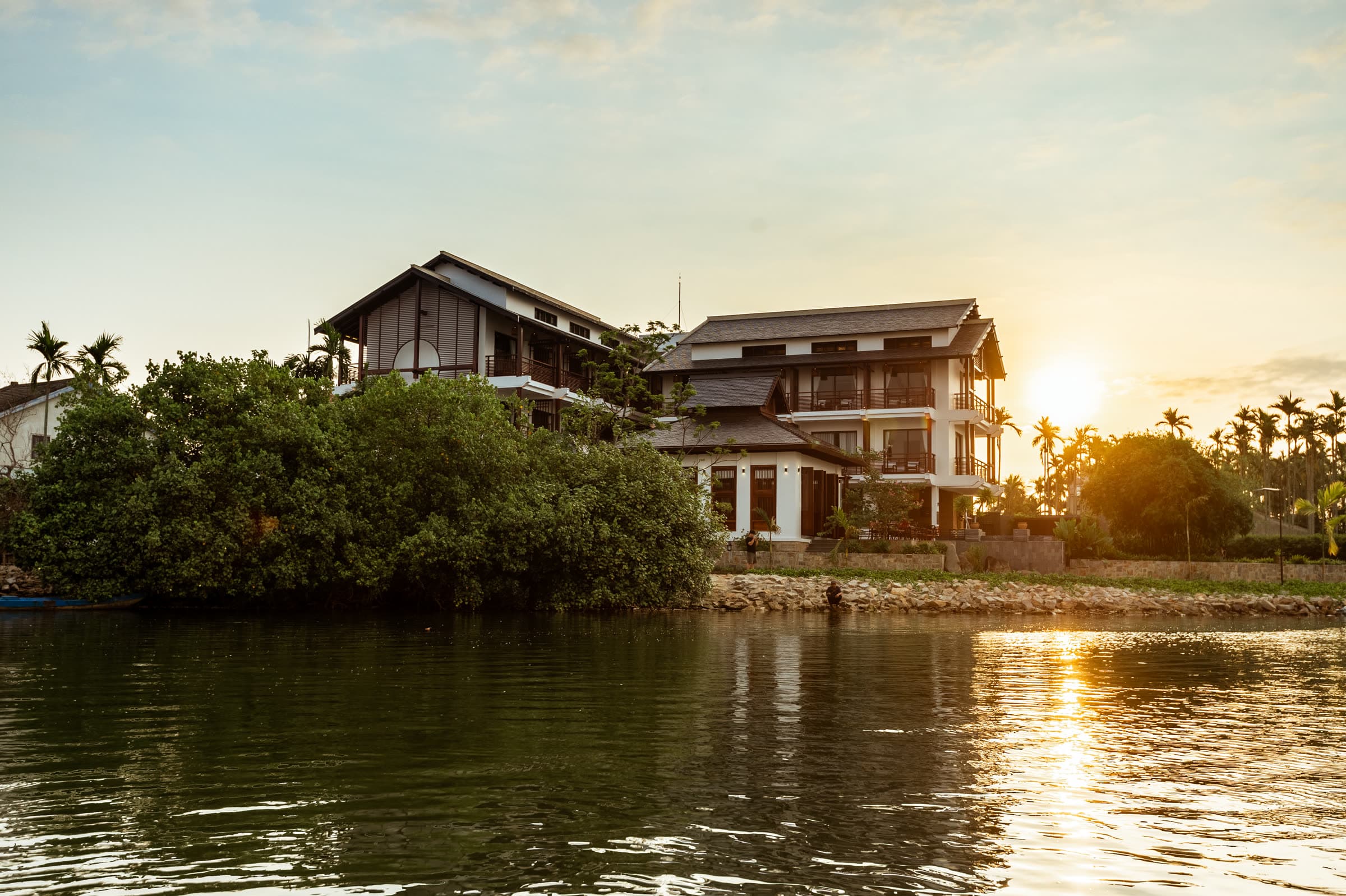
The five questions below are the ones we use to assess our own riverside rooms in Cẩm Nam — measured at 39 dB(A) on a quiet weeknight at 02:00 — and the ones to send by Zalo or WhatsApp to any property you are considering. None of these is about hotel quality. They are about price-tier reality, neighbourhood geography, and how the building was built.
1. Air-conditioner type — split or window?
A modern wall-split AC unit runs at roughly 25–35 dB(A) at the indoor head — quieter than a refrigerator. A window AC unit runs at 50–60 dB(A), which puts it well above the WHO night-time threshold for an indoor environment intended for sleep (general industry data; WHO recommends < 30 dB(A) indoors for good sleep). If you can sleep through a window-unit cycle, you can sleep anywhere. If you cannot, this is the single highest-leverage question to ask.
The polite version of the question: "Is the air conditioner a wall-mounted split system, and is the outdoor compressor on the room wall or on the roof?" A compressor mounted on the same wall as the bed transmits low-frequency hum into the headboard, even with a quiet split. A roof-mounted compressor is structurally quieter for the room.
Window AC is not a flaw. It is a price tier. A US$25-a-night room with a window unit is doing exactly what its price says. The question is whether you are the right guest for that room.
2. Curtain depth — three layers or two?
"Blackout curtain" is a term hotels use generously. A genuine blackout treatment has three components: a heavy outer panel, a blackout liner (a tightly-woven backing that blocks light transmission), and a sheer or voile inside the liner. Two-layer setups — heavy panel plus sheer — let dawn light through at the edges by 05:30 in summer Hội An, when the sun is up at 05:15 in June (Time and Date sunrise data, Đà Nẵng).
Ask: "Are the curtains true blackout with a separate blackout liner, or are they heavy decorative curtains?" If the listing photos show a single decorative panel, it is the second one. For a room facing east, this matters more. Eye masks are the cheap solution; the better solution is a room that faces a courtyard or has a third layer.
3. Neighbourhood — the Old Town soundscape vs. the south bank
Old Town Hội An is structurally noisy from 17:00 to 22:30. Lantern crowds, restaurant music, the night-market sound system on An Hội island, and tour-group call-and-response carry across small lanes. During those evening hours the heritage core is closed to scooters — the vehicle ban runs roughly 15:00 to 21:00, extended to about 21:30–22:00 in summer — so the noise is foot traffic and music, not engines. After about 22:30, once the crowds thin and the music winds down, the core is genuinely quiet, and it stays quiet until the bakery scooters at 05:00. If you sleep at 23:30 you have five quiet hours; if you sleep at 21:30 you have one noisy hour and the rest peaceful.
The south bank of the Thu Bồn — Cẩm Nam, the inland sections of Cẩm Châu, the rural pockets of Cẩm Hà — operates on a village rhythm. We measured 39 dB(A) on the riverside at 02:00 on a still weeknight in our Cẩm Nam location, comfortably under the WHO 40 dB(A) outdoor threshold. Frogs, the river, the occasional scooter at 04:30. For neighbourhood-by-neighbourhood detail see our Hội An hotel noise map.
An Bàng beach is in the middle: structural quietness because the lanes are short and traffic ends early, but beachside bars on the sand can carry music to nearby properties on a still night. Ask which side of An Bàng the property sits on.
4. Ceiling-fan motor age and quality
Planning a trip around this? See dates at our quiet riverside hotel on the Thu Bồn. Check availability →
An old or imbalanced ceiling-fan motor wobbles at 8–12 Hz and produces a low hum and an arrhythmic ticking that the brain registers as a problem even when you are asleep. A modern DC-motor ceiling fan is functionally silent. Many Hội An hotels run AC units in parallel with ceiling fans because the combination saves electricity at lower AC settings. If the fan is older than the renovation, you will hear it.
Two practical questions: "How old is the ceiling-fan motor?" and "Can the AC be set without the ceiling fan running?" A polite property will answer both honestly. If the fan is required to be on with the AC, you are stuck with the noise floor it sets.
5. Corridor exposure — door type and adjacency
The room next to a stairwell, an ice machine, an elevator, or the breakfast service path will hear those things between 06:30 and 09:30. Corridor noise also depends on door construction: a solid wood door with a foam gasket muffles voices well; a hollow-core door with a 5 mm gap at the threshold does not.
Ask: "Is the room near the elevator, stairs, or breakfast area? Is the door a solid hardwood door?" In Hội An, a lot of mid-range hotels are hand-built houses with thick masonry walls but inconsistent door specifications. The walls are usually fine. The door is the variable. A standalone bungalow with no shared corridor, like the format we use, removes this entire category.
What you cannot ask — and how to triangulate
Most Hội An hotels do not publish dB(A) measurements. The honest path is review-mining: filter Booking.com or Tripadvisor by the last 6 months, sort by lowest rating, and search reviews for the words "noise," "quiet," "AC," and "fan." Two negative reviews in 200 may be a one-off; a recurring pattern is the hotel telling you what its acoustic floor is. For the broader review-reading method see Day 7's review-filter post (forthcoming).
Most importantly: a quiet room is not a luxury. It is a match. A US$60 mid-range room in Cẩm Châu can sleep better than a US$300 heritage-core suite if the geography is on your side. The five questions above let you test the match before you pay.
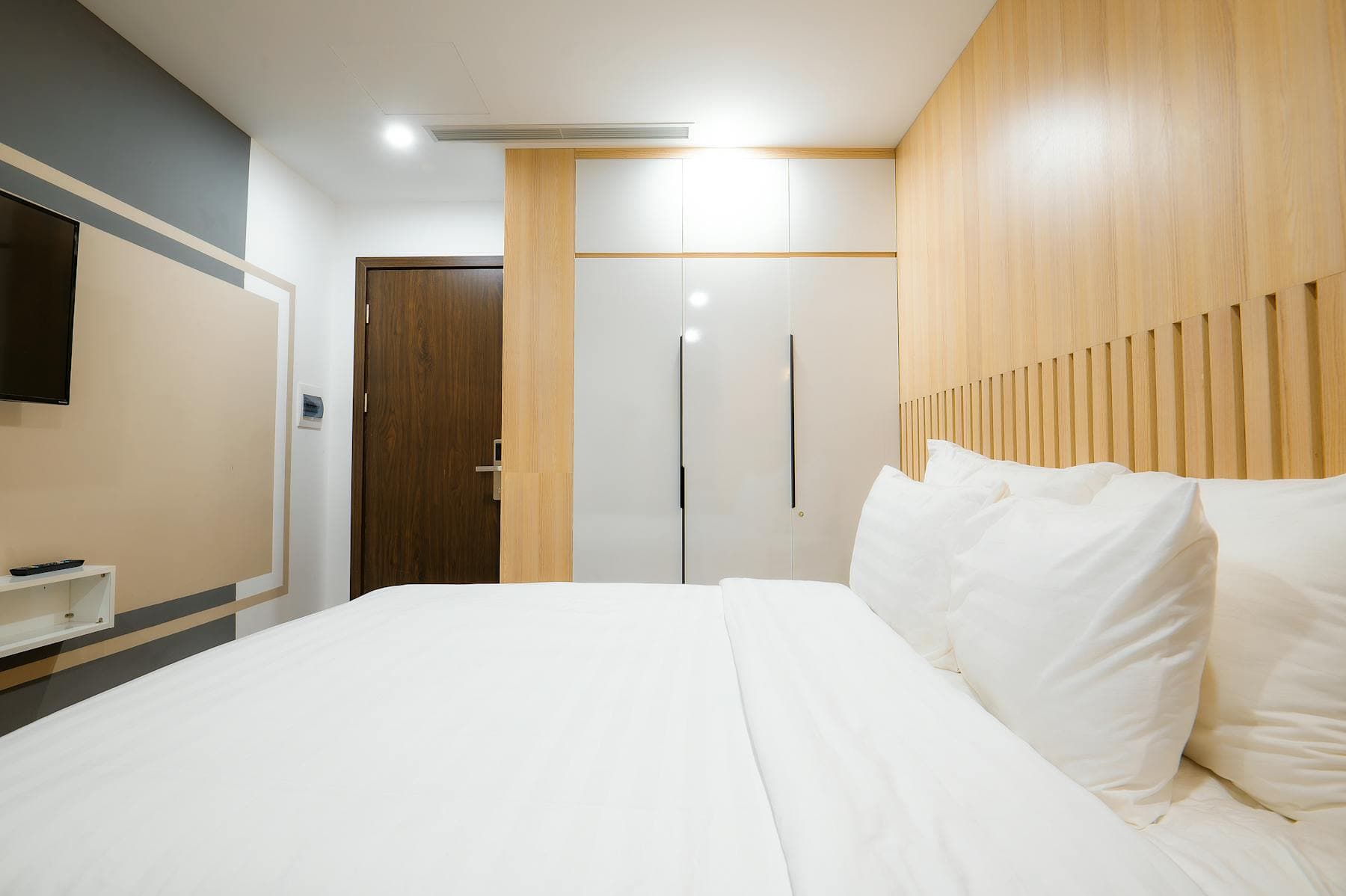
For the room category we offer, see our riverside rooms — built specifically around split-AC, three-layer curtains, DC fans, no shared corridors, and a south-bank position on the Thu Bồn. The rest of the riverside-hotel category is at Hội An riverside hotel.
Sleep is structural. Ask the structural questions.
Every room at Nghê Prana is designed around the science of sleep. Blackout curtains, nightly aromatherapy turndown, and riverside quiet — experience what real rest feels like.
Riverside hotel rooms on the Thu Bồn, ten minutes by bicycle from the Ancient Town. Whether it's one night between Hue and Da Nang or a full week of doing nothing — we kept your room quiet.
Free cancellation · Direct from the family who built the hotel

 WhatsApp
 Zalo
Zalo