Vietnam or Thailand for Two Weeks? The Honest Arithmetic
The comparison almost every trip plan makes once — and usually loses on the wrong criteria. Not beach against beach, but internal distances, opposite rainy seasons, the 45-day visa exemption, and how much of your fortnight you want to spend on a bus.
This decision is nearly always made on the wrong criteria. Both countries have beaches, good food and temples; comparing them on that gets you nowhere. The difference that actually matters over two weeks is a different one: how much of your time you spend in motion, and whether your travel dates meet the same rainy season in both countries. They do not.
TL;DR — Vietnam is a narrow band 1,650 kilometres long; Thailand is more compact and has the better domestic flight market. Anyone trying to see all of Vietnam in two weeks spends three to four days travelling. Anyone who limits themselves to one region gets more substance per kilometre in Vietnam. The decisive factor is the rainy season: Vietnam's central coast is wet from September to December, Thailand's Andaman coast from May to October — the countries hand each other the good months. Germans get 45 days visa-free in Vietnam, 60 in Thailand.
The mistake: all of Vietnam in two weeks
Vietnam looks manageable on a map and is not. Hanoi to Ho Chi Minh City is around 1,650 kilometres in a straight line — roughly Hamburg to Rome. The classic north–south route taking in Hanoi, Halong, Huế, Hội An and the Mekong Delta means three or four domestic flights or night trains in a fortnight.
It is doable and plenty of people do it. You should just know what it costs: of fourteen days, three to four go on transfers, check-ins and arriving, and the remaining ten spread across five places. You will have seen a great deal and been nowhere.
Thailand is kinder in this respect. Bangkok as a hub, short domestic hops to the islands, a denser network — the same kind of route costs less time there.
The rainy season is not a detail, it is the main criterion
The most important sentence in this comparison: the two countries do not share a rainy season, and in Vietnam the north does not even share one with the centre.
Period
Vietnam's central coast (Hội An)
Thailand's Andaman coast (Phuket, Krabi)
December – February
Dry, cool
Best time
March – May
Best time. Dry, mild to hot
Increasingly hot, then rain
June – August
Dry, very hot
Rainy season
September – December
Rainy season, floods in October
End of the rains, then good
In practice: if you travel at Easter or Whitsun, Vietnam is the better bet. If you travel in the autumn holidays, Thailand. For the summer holidays there is little in it — Vietnam's central coast is dry but hot; Thailand's west coast has its rainy season, the east coast (Koh Samui) does not.
Thailand's Andaman coast in November: high season starting. On Vietnam's central coast that is the rainy season. The two calendars run against each other.
Where Vietnam wins
Price. Vietnam is noticeably cheaper at comparable quality, particularly on accommodation and food. The gap has narrowed, but it is there.
Less tourist infrastructure — in the good sense. Vietnam has no equivalent to Thailand's thoroughly organised island chains. If that is what you want, Thailand is the better choice. If you want an old town where people still live, you are likelier to find it in Vietnam.
Food with regional identity. Thai food is better known abroad; Vietnamese food is more sharply separated by region. Phở in the north, bún bò in Huế, mì Quảng and cao lầu in Quảng Nam — you eat your way through the country rather than through a menu.
Coffee culture. Underrated, and a real difference. Vietnam is the world's second-largest coffee producer, and the phin filter culture is a world of its own.
Where Thailand wins
Beaches. Honestly: not comparable. Vietnam's coast is lovely, Thailand's Andaman coast is spectacular. If the beach is the main reason for the trip, fly to Thailand.
Domestic connections. More flights, more operators, shorter hops, a more robust network when something is cancelled.
Family-friendliness on the islands. The resort structure is built for families, with everything that implies — good and bad.
Visa-free period. 60 days against 45 in Vietnam. Irrelevant for a two-week trip, not irrelevant for long-stay travellers.
The suggestion almost nobody makes: not the whole country
Planning a trip around this? See dates at our quiet riverside hotel on the Thu Bồn. Check availability →
If you have two weeks and choose Vietnam, the most interesting version is not the north–south route but one region done properly. The central coast — Huế, Hội An, Đà Nẵng, plus the mountain roads and Cù Lao Chàm — carries two weeks comfortably and needs exactly one flight.
You trade the feeling of having "done" a country for the experience of having actually arrived somewhere. For many people that is the better holiday, and for families with younger children it almost always is.
The coast between Hội An and Huế. Two weeks in one region instead of five places in two weeks — the underrated version.
Entry, briefly
Vietnam: Germans have entered visa-free for up to 45 days since 15 March 2025, running to August 2028. Passport valid at least six months, two blank pages. Since 1 June 2026 a digital health declaration must be completed in advance.
Thailand: 60 days visa-free for German nationals. The same rule applies here: check the current position with your foreign ministry shortly before departure, not on an undated travel page.
If it is going to be Vietnam
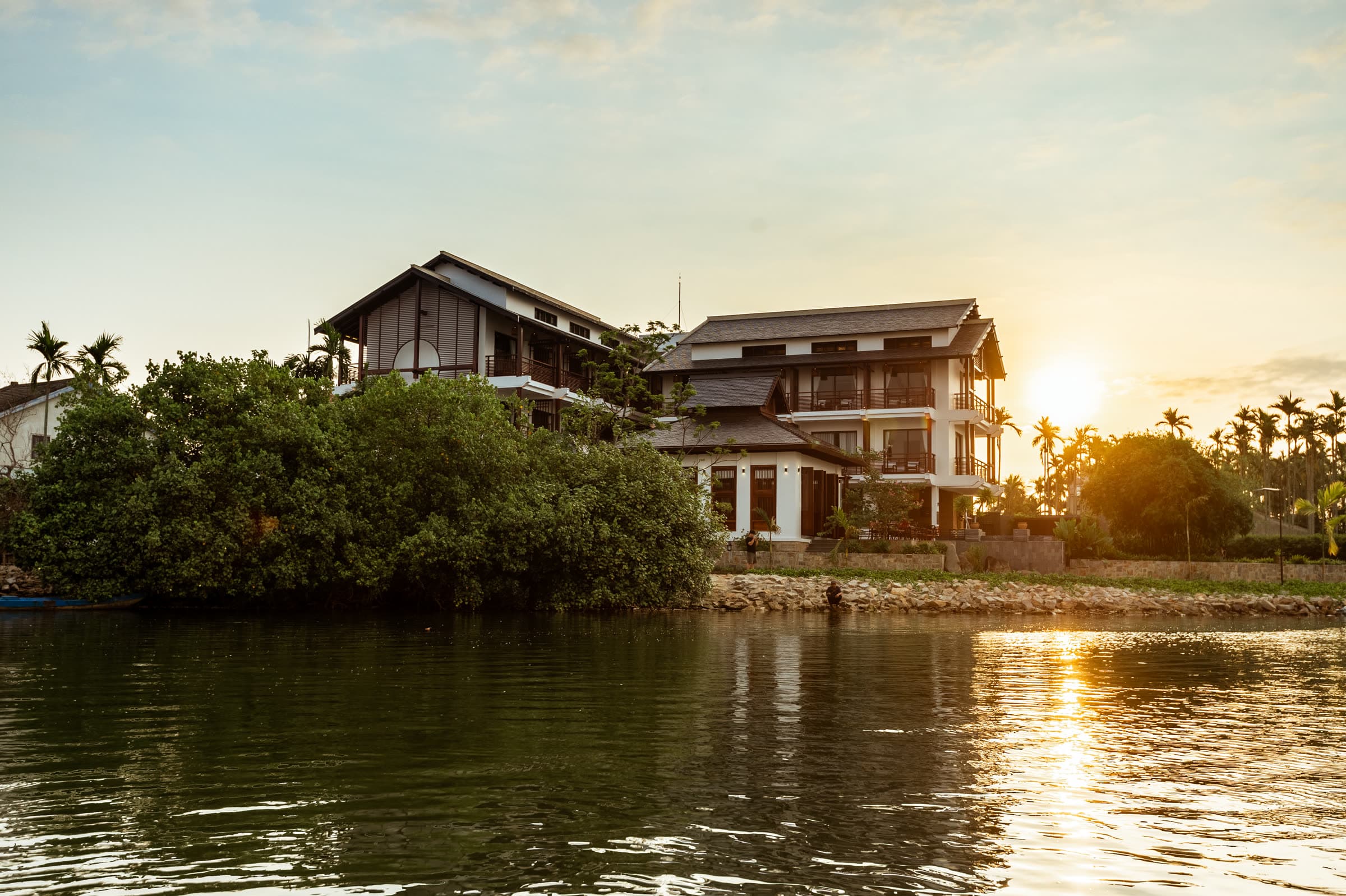
Our house sits on the south bank of the Thu Bồn in Cẩm Nam, opposite Hội An's Old Town. Every room faces the river or the garden, none faces a road. If your two weeks belong to the central coast, our month-by-month calendar for Hội An 2027 has the holidays and weather windows — and the 2027 school holiday dates explain why your federal state has a say in it.
Frequently Asked Questions
Vietnam or Thailand — which is better for two weeks?
Over two weeks the country matters less than the travel dates and the route planning. Travelling in spring (March to May), Vietnam is the better choice; in the autumn holidays Thailand, because Vietnam's central coast is then in flood season. Anyone wanting to see all of Vietnam loses three to four of the fourteen days to transfers.
When is the best time to travel to Vietnam?
For the central coast around Hội An: March to May — dry and mild to hot. June to August is dry but very hot. September to December is the rainy season with flooding in October and early November. The north and south follow different patterns.
Is Vietnam cheaper than Thailand?
Generally yes, particularly on accommodation and food, though by a smaller margin than it used to be. Domestic flights and organised tours are closer together.
How many places can you manage in two weeks in Vietnam?
Realistically three, if it is to stay relaxed — or one region properly. The central coast with Huế, Hội An and Đà Nẵng carries two weeks on a single domestic flight.
Do Germans need a visa for Vietnam or Thailand?
For neither: Vietnam grants 45 days visa-free (since 15 March 2025, running to August 2028), Thailand 60 days. For Vietnam a digital health declaration must also be completed in advance since 1 June 2026.
Position as of August 2026. Vietnam's entry rules — 45 days visa-free since 15 March 2025, running to August 2028, digital health declaration since 1 June 2026 — should be checked with your foreign ministry shortly before departure; the same applies to Thailand. Distances are straight-line. The climate figures for Vietnam's central coast come from our own analysis for Hội An; the Thai ones from the usual seasonal patterns of the Andaman and Gulf coasts. Field observations from Hội An, from the bank at Cẩm Nam.
Every room at Nghê Prana is designed around the science of sleep. Blackout curtains, nightly aromatherapy turndown, and riverside quiet — experience what real rest feels like.
Riverside hotel rooms on the Thu Bồn, ten minutes by bicycle from the Ancient Town. Whether it's one night between Hue and Da Nang or a full week of doing nothing — we kept your room quiet.
Free cancellation · Direct from the family who built the hotel


 WhatsApp
 Zalo
Zalo