Cạo Gió and Trúng Gió: What the Trials Found, What the Marks Are, and Why a Drooping Face Means Call 115
Cạo gió (coining, the Vietnamese cousin of gua sha) eased chronic neck and back pain in the short term in small trials with no sham treatment; we found no trial for colds, fever or trúng gió, and the marks are small bleeds that fade in days to two weeks. Skip it with blood thinners, bleeding disorders, possible dengue, pregnancy or broken skin, and keep camphor balms off small children. A drooping face, weak arm or slurred speech is a possible stroke, not wind: call 115, note the time, and do not scrape.
What are cạo gió and trúng gió, and does cạo gió work? Cạo gió ("scraping the wind"), also called đánh gió, is the Vietnamese home remedy in which the smooth edge of a coin or a spoon is scraped over skin rubbed with dầu gió (medicated oil) or balm, along the neck, back and chest, until red and purple streaks come up; doctors abroad call it coining, and it belongs to the same family as Chinese gua sha and Indonesian kerokan. Trúng gió ("struck by the wind") is the everyday name for feeling suddenly unwell after cold wind or a change in the weather, and Vietnamese medical pages use it for several different things: a cold, a chill with aches, or a faint. What the trials found: three small trials in Germany, with 40 to 50 people each and no sham treatment, found less neck or low back pain soon after one or two gua sha sessions (measured at one week in two of them) than in people on a waiting list or given a heat pad, and a 2021 review of 10 trials with 627 people concluded that scraping "may" help "some individuals" with chronic low back pain. We found no trial of cạo gió for colds, for fever or for trúng gió, which is what most people in Vietnam use it for. The streaks are small bleeds under the skin that fade within days to about two weeks, and doctors abroad have mistaken them for abuse. Vietnamese hospital pages and the Ministry of Health's newspaper say not to scrape young children, pregnant women, people who bleed easily (which includes dengue fever), people with heart disease or high blood pressure, or broken skin; US medical sources add anyone on blood thinners. The most important line on this page: a face that droops, an arm that goes weak, slurred speech, sudden confusion or loss of balance, even on a cold morning, may be a stroke, not trúng gió. Call 115, Vietnam's ambulance number, at once, note the time it started, do not scrape, and give nothing to eat or drink. A mouth that droops on one side, the "trúng gió méo miệng" of folk speech, is often Bell's palsy, but only a doctor can tell it from a stroke, so if it comes on suddenly, call 115 too. Said against our own interest: our spa does not offer cạo gió, gua sha, coining or cupping, and nothing on our menu treats trúng gió. Below are the trials, the marks, the harms, the stroke signs with Vietnamese hospital advice in our translation, and what our riverside hotel spa on the Thu Bồn in Hội An can and cannot offer a cold, achy visitor in a wet December.
Cạo gió and trúng gió: the short answer
Question
What the sources say
Verdict
Does cạo gió (gua sha) ease neck or low back pain?
Three German trials of 40 to 50 people, against a heat pad or a waiting list, found less pain soon after one or two sessions; a 2021 review of 10 trials (627 people) says scraping "may" help "some individuals" with chronic low back pain, and found that a single session did not beat the control
Possibly, in the short term; small trials, no sham
Does it cure a cold, a fever or trúng gió?
We found no trial. Vinmec says no scientific study has published an effect of cạo gió; DermNet says there is a lack of evidence "in any disease or condition"
Unproven
What are the marks?
Petechiae and bruises: blood leaking out of tiny vessels under the skin (Nielsen, 2023); they fade in 2 to 5 days in one trial's description, within 7 days for almost all users in a Hong Kong survey, and in one to two weeks after vigorous coining (Darsha, 2020)
Harmless in themselves; can be mistaken for abuse
Who should not be scraped?
Vietnamese hospital pages and the Ministry of Health's newspaper: young children, pregnant women, people with heart disease, high blood pressure, a bleeding tendency or dengue fever, broken or infected skin; US sources add blood thinners
Ask a doctor first if any of these apply
Can it burn?
The one burn case usually cited (2000) was, a 2023 commentary argues, fire cupping, not coining; camphor in some balms has poisoned young children
No flame belongs in coining; keep camphor balms off small children
Is a drooping face trúng gió?
NHS and Vietnamese hospitals: a drooping face, a weak arm or slurred speech may be a stroke; call the ambulance. Bell's palsy also droops one side of the face
A doctor's call, today; in Vietnam call 115
Does cold weather raise stroke risk?
A 2023 meta-analysis of 20 studies: extreme cold linked to a 33% higher risk of stroke; a Hà Nội hospital reports more stroke admissions in northern cold spells (a hospital statement, no stated method)
Yes, a real but relative rise
Does our spa offer cạo gió?
Not on our menu, and nothing on it treats trúng gió
No
What is cạo gió?
Cạo gió is scraping the skin with a smooth, rounded edge to bring up red streaks, done at home in Vietnam for colds, aches and "wind". The Ministry of Health's newspaper, Sức khỏe & Đời sống, defines it as "phương pháp sử dụng bờ của những vật có cạnh hình cung tròn và tương đối nhẵn nhụi như thìa nhôm" (a method using the edge of objects with a rounded, fairly smooth rim, such as an aluminium spoon), and lists coins, the rims of cups and bowls, porcelain dishes, combs, silver rings and buffalo horn; dầu gió is rubbed on first, and the scraping goes one way, from top to bottom and from the centre outwards, along both sides of the neck, the shoulders and both sides of the spine, until, in its words, "Thông thường, mỗi vùng cạo từ 3 đến 5 phút là da ửng đỏ" (usually each area turns red after 3 to 5 minutes of scraping) (Master of Medicine Hoàng Khánh Toàn, 31 July 2014, updated 8 June 2021). DermNet, the New Zealand dermatology site, says "It is called cao gio (scraping for wind) in Vietnam", that "a porcelain spoon, jade or buffalo horn can give the same result" as a coin, and that "The strokes generally form a 'pine tree' pattern on the body" (DermNet, June 2015). The same practice is gua sha in China, kerokan in Indonesia, kos kyal in Cambodia and khoud lam in Laos, according to a table of names in a 2020 case report (Darsha and Cohen, Cureus). It is common. In a survey of 3,209 adults in Hong Kong, "Gua sha was found to have a one-year prevalence of 22.7% and four-week prevalence of 6.6%", mostly with spoons on the back (Lam and colleagues, Complementary Therapies in Medicine, 2015). Among Vietnamese patients of a community health centre in Boston, "Among the 216 respondents, 68% reported using TVM" (traditional Vietnamese medicine), and of those using its home-grown forms, 62% used "wind scraping"; of the users who answered, 57% had not told their doctors (Nguyen and colleagues, Journal of Alternative and Complementary Medicine, 2016). The Ministry's newspaper calls it "rất hiệu quả, rẻ tiền, an toàn" (very effective, cheap and safe) for colds; what the trials actually tested is below.
Illustrative photo of a gua sha stone, not our spa. In Vietnam cạo gió is more often done at home with a coin or a spoon and dầu gió; our spa does not offer it.
What does trúng gió mean?
Trúng gió means "struck by the wind": the everyday Vietnamese name for falling ill suddenly after cold wind, rain or a change in the weather, and the sources do not agree on what illness it is. Vinmec's page says "Trúng gió là tên gọi của nhóm bệnh thời khí do sự thay đổi thời tiết trong Đông y. Còn trong Tây y, trúng gió được gọi là cảm mạo, thường gặp trong mùa lạnh" (in traditional medicine, trúng gió is the name for a group of seasonal illnesses caused by changes in the weather; in Western medicine it is called cảm mạo, a cold, common in the cold season) (Vinmec, 11 July 2024). A neurosurgeon at Bạch Mai Hospital describes it as a chill, "bị nhiễm lạnh biểu hiện như sốt, nhức đầu và đau nhức toàn thân, sổ mũi và ho" (catching cold, with fever, headache, aches all over, a runny nose and a cough) (Dr Nguyễn Quang Thành, in Nhân Dân, 12 December 2023). The Medlatec hospital group describes something else again: "Nguyên nhân gây trúng gió là do sự hoạt động quá mức của hệ thần kinh đối giao cảm khiến cho tim đập chậm lại còn mạch máu bị giãn nở ra và huyết áp tụt xuống" (trúng gió is caused by overactivity of the parasympathetic nervous system, which slows the heart, widens the blood vessels and drops the blood pressure), which is how doctors describe a common faint (Medlatec, 16 December 2022). So one name covers at least three things, a cold, a chill and a faint, and fear of it can bring on symptoms of its own: in a study of 100 Vietnamese refugee patients at two psychiatric clinics, half had panic disorder, and among those 50 the attacks were "wind-induced/temperature-shift-induced" in 24% (Hinton and colleagues, General Hospital Psychiatry, 2001). The trouble starts when the name is stretched further. Vinmec's page lists "Trúng gió méo miệng" (trúng gió with a twisted mouth) and says that in worse cases it brings "liệt nửa người gây nguy hiểm đến tính mạng" (paralysis of one side of the body, which is life-threatening); a twisted mouth or one-sided paralysis is what a stroke or Bell's palsy looks like, and the Bạch Mai doctor is plain that "trúng gió và đột quỵ là hai bệnh khác nhau về bản chất cũng như hướng điều trị" (trúng gió and stroke are two different illnesses, in their nature and in their treatment). Our reading: trúng gió is a real experience with a folk name, not a diagnosis, and the safest habit is to name the symptoms instead. A runny nose and aches after a cold, wet day is most likely a cold. A sudden drooping face, a weak arm, slurred speech or a collapse is an emergency (see the safety section).
Does cạo gió work? What the trials found
For chronic neck and low back pain, small trials found less pain soon after gua sha; for colds, fever and trúng gió, we found no trial at all. The three German trials share authors. In the first, run in Essen, 48 outpatients with chronic neck pain were randomised to one gua sha session or to a heat pad: "Gua sha patients were treated once with Gua sha, while control patients were treated with a local thermal heat pad." After one week, neck pain, rated on a visual analogue scale in millimetres, had fallen more in the gua sha group, by a "group difference -29.9 mm, 95% confidence interval: -43.3; -16.6 mm", but the trial was "an open randomized controlled clinical trial", meaning everyone knew which treatment they had, and the authors wrote that "The value of Gua sha in the long-term management of neck pain and related mechanisms remains to be clarified" (Braun and colleagues, Pain Medicine, 2011). In a pilot of 40 people with chronic neck or low back pain, one session was compared with a waiting list; 39 were analysed, 21 with neck pain and 18 with low back pain, gua sha patients in both the neck and the low back groups reported less pain than the waiting list seven days after the first assessment, and "No adverse events were reported" (Lauche and colleagues, American Journal of Chinese Medicine, 2012). In 50 people with chronic low back pain, two sessions beat a waiting list on pain and overall health, but "No further group differences were found" on function and the other measures (Saha and colleagues, Complementary Therapies in Clinical Practice, 2019). In Hong Kong, a crossover pilot in older people with chronic low back pain used a hot pack as the comparison, and "there was no significant difference observed between any outcome measures attained by the two interventions", although pain fell by 21–25% after gua sha against 16–18% after the hot pack over the one-week follow-up (Yuen and colleagues, Complementary Therapies in Medicine, 2017). Two reviews pool such trials, many of them Chinese. For chronic low back pain, a 2021 review of 10 trials with 627 people found less pain overall, rated "the quality of evidence was moderate owing to a lack of blinding and allocation concealment in some studies", found that a single session did not beat the control, and concluded only that "Scraping therapy may have a therapeutic effect for some individuals with chronic LBP" (Wang and colleagues, Journal of Manipulative and Physiological Therapeutics, 2021). For the symptoms of perimenopause, a 2018 review found that "A total of 6 RCTs met the inclusion criteria, and most were of low methodological quality", with its main analysis (5 of the 6 trials) comparing gua sha plus Western medicine with Western medicine alone, and called the evidence "Preliminary" (Ren and colleagues, Complementary Therapies in Clinical Practice, 2018). So where do the sources disagree? Vinmec writes that "tuy chưa có công trình nghiên cứu khoa học nào công bố tác dụng của phương pháp" (although no scientific study has yet published an effect of the method) cạo gió (Vinmec, updated 19 May 2026), DermNet that there is "lack of evidence for the efficacy of coining in any disease or condition", and the Ministry's newspaper that it is very effective. They are partly talking about different things. Vinmec is writing about colds and flu, for which we too found no trial; the trials measured chronic neck and back pain, and none of the German or Hong Kong trials had a sham treatment, so expectation can explain some of the difference. Our reading: a short-term easing of chronic neck or back pain is possible, the effect is not proven to last, and nothing has shown that scraping shortens a cold or a fever.
Study
Who
Compared with
When measured
What it found
Braun 2011, Germany
48 adults with chronic neck pain
A local heat pad
After 1 week
Less neck pain with gua sha (29.9 mm less on a visual analogue scale); open trial
Lauche 2012, Germany
40 adults with chronic neck or low back pain (39 analysed)
Waiting list
7 days after baseline
Less pain after one session; no adverse events reported
Saha 2019, Germany
50 adults with chronic low back pain
Waiting list
After two sessions
Less pain and better overall health; no other group differences
Yuen 2017, Hong Kong
Older adults with chronic low back pain (crossover pilot)
Hot pack
Over 1 week
No significant difference between the two
Wang 2021, review
10 trials, 627 people, chronic low back pain
Various controls
End of treatment; 3 trials to 1 and 3 months
"May" help "some individuals"; a single session did not beat control
Ren 2018, review
6 trials, perimenopausal symptoms
Western medicine alone
Varied
"Preliminary" evidence; most trials of low quality
Colds, fever or trúng gió
None found
None
None
We found no trial
What are the marks, and how long do they last?
The red and purple streaks are small bleeds under the skin, and they fade on their own within a few days to about two weeks. A 2023 commentary defines gua sha as press-stroking that creates "transitory therapeutic petechiae and ecchymosis, called 'sha', representing extravasation of blood in the subcutis", that is, pinpoint spots and bruises where blood has leaked out of tiny vessels (Nielsen and colleagues, Integrative Medicine Research, 2023). In the only study we found that measured what happens under them, laser Doppler scans of 11 healthy volunteers in Essen showed that "Gua Sha caused a fourfold increase in microcirculation PUs at the treated area for the first 7.5 minutes following treatment", with blood flow still raised 25 minutes later, and "There were no adverse reactions" (Nielsen and colleagues, Explore, 2007). How long they last depends on who is describing what. The Essen trial authors describe petechiae "that last 2-5 days"; the 2023 commentary says the sha "fades in 3–4 days without residue or side-effect"; in the Hong Kong survey almost all users said the marks "faded within 7 days"; and a case report of vigorous coining with a coin on a 45-year-old Vietnamese man says "Ecchymoses caused by coining usually resolve spontaneously within one to two weeks", and found them all gone at his visit one month later (Darsha and Cohen, Cureus, 2020). They are not in conflict: pinpoint spots from light scraping fade faster than raised bruises from hard scraping. The Vietnamese advice follows the marks, too: wait "4 - 7 ngày" (4 to 7 days) between sessions, until the marks from the last one have gone (Sức khỏe & Đời sống, 6 July 2019). Why it matters abroad: the marks look like injuries. A Stanford Medicine teaching page explains that "Since coining is causing a bruise (i.e. blood under the skin), the lesions should not be blanchable", that they come as lines with clear skin between them, and that "coining often brings concern for child or elder abuse in physicians not aware of this practice" (Stanford Medicine 25, 2016). A US nursing study of 19 Southeast Asian women notes that coining "is claimed to be a form of child abuse in some of the literature reviewed" (Davis, Journal of the American Academy of Nurse Practitioners, 2000), and the Cureus authors warn that clinicians "may contact child or adult protective services prior to establishing the correct etiology for the lesions". What to tell a doctor at home: that you, or your child, had cạo gió (coining, gua sha) in Vietnam, on which days, and with which oil or balm. One more reason to mention it: the same Stanford page reminds doctors that "In regions where dengue fever is endemic, consider this in your differential", because, as the Cureus authors note, dengue can leave bruises that look like coining.
Who should not have cạo gió, and what harms are documented?
People who bleed easily or take blood thinners. Vietnamese and US sources agree on this one. Sức khỏe & Đời sống: "Bệnh xuất huyết giảm tiểu cầu, hôn mê gan và các bệnh có khuynh hướng chảy máu: cấm cạo gió" (low-platelet bleeding disorders, liver coma and any tendency to bleed: no cạo gió) (6 July 2019). The Cureus case report: it "is contraindicated in certain patients including those with bleeding disorders, Von Willebrand disease, or those taking antiplatelet or anticoagulant medications". Stanford's page says the same of "antiplatelet/anticoagulant medications".
Anyone who might have dengue fever, and children. Vinmec: "Tuyệt đối không cạo gió cho trẻ em, người bị sốt xuất huyết vì nó có thể làm trầm trọng thêm tình trạng xuất huyết ở các đối tượng này" (never scrape children or people with dengue fever, because it can worsen the bleeding in them). Vietnamese Wikipedia adds that in children an early dengue fever can look like an ordinary fever, headache and tiredness. Sức khỏe & Đời sống also forbids scraping the heads of small children, whose skulls are not fully formed.
Pregnancy, heart disease and high blood pressure. "Cạo gió không được dùng cho những người bị mắc các bệnh tim mạch, tăng huyết áp, dễ xuất huyết, bị các bệnh da liễu ở những vị trí cần cạo gió, phụ nữ có thai và trẻ em tuổi còn quá nhỏ" (cạo gió must not be used for people with heart disease, high blood pressure or a tendency to bleed, skin disease where it would be scraped, pregnant women or very young children) (Sức khỏe & Đời sống, 31 July 2014). A 2024 Người Lao Động article adds people with varicose veins, heart or kidney failure, cirrhosis of the liver, recent fractures or surgery (Người Lao Động, 24 November 2024).
Broken, infected or thin skin. Vinmec says not to scrape "vùng da đang bị lở loét, trầy xước" (skin that is ulcerated or scratched), and warns that unclean tools can let bacteria in through scratches. Because scraping can draw blood to the surface, researchers who study gua sha propose applying hospital safety standards to the tools: blood "can sometimes be drawn through the surface of the skin leading to potential contamination of instruments and to risk of bloodborne pathogen exposure" (Nielsen and colleagues, Complementary Therapies in Medicine, 2012), so a tool should never be shared without disinfection.
A high fever, severe pain or signs of infection. A doctor's column in PLO: "Tuyệt đối không dùng cạo gió thay cho điều trị y tế nếu đang sốt cao, đau dữ dội, hoặc có dấu hiệu viêm" (never use cạo gió instead of medical treatment if you have a high fever, severe pain or signs of inflammation), and "Nếu mệt mỏi, sốt, đau mà cạo gió không giúp gì – đừng cố cạo tiếp, hãy đi khám" (if you are tired, feverish or in pain and cạo gió has not helped, do not keep scraping: see a doctor) (Dr Nguyễn Tiến Dũng, 18 November 2025). The symptoms behind a request for scraping can be serious: in an Indonesian case report, a 30-year-old woman who had had kerokan had been complaining of chest pain and upper-abdominal discomfort, and then "became markedly short of breath and died"; "Histology revealed that myocarditis was the cause of death", an inflamed heart, not the scraping (Samberkar and colleagues, Medicine, Science and the Law, 2020).
Camphor balms on small children. The danger here is the oil, not the coin. A 2002 report in JAMA is titled "Camphor intoxication after cao gío (coin rubbing)" (Rampini and colleagues; we could read only its title, and the 2023 commentary by Nielsen and colleagues, cited above, says the poisoning came from the product, not the scraping). In New York, three children aged 15 to 36 months had seizures from camphor, one of them "exposed through repetitive rubbing of camphor on her skin" (Khine and colleagues, Pediatrics, 2009), and the city's health department says "Do not use any camphor products on young children, especially if they are under 2 years of age." Vinmec says dầu gió "không thể dùng cho trẻ dưới 3 tháng tuổi" (cannot be used on babies under 3 months), and that "đã ghi nhận các ca trẻ sơ sinh được người lớn thoa dầu gió chứa tinh dầu bạc hà, long não khiến trẻ bị ngộ độc, co giật" (there have been cases of newborns rubbed by adults with dầu gió containing mint oil and camphor who were poisoned and had seizures) (Vinmec, 10 July 2024).
Burns: disputed. A much-cited 2000 report described a 45-year-old woman with "22% partial-thickness and full-thickness burns after she caught on fire during a coining treatment" (Amshel and Caruso, Journal of Burn Care & Rehabilitation). A 2023 commentary argues from the case's own photographs that round unburned patches on her back were left by cups, and that "Amshel and Caruso's is a case of negligent fire cupping, and not a complication of coining" (Nielsen and colleagues, 2023). Its authors research gua sha (the first author also led the 2007 and 2012 papers above), and two of them sit on the journal's editorial board, as they declare; DermNet still lists "one case report of oiled skin that caught on fire". Both agree on the practical point: there is no flame in cạo gió, and none should come near oiled skin.
Trúng gió or stroke? The signs that mean call 115, not scrape
A sudden drooping face, a weak arm or slurred speech is a stroke until a doctor says otherwise, cold weather or not: call 115 at once. The NHS lists the main signs: "face weakness – one side of your face may droop (fall) and it might be hard to smile", an arm you cannot lift and hold up, and "speech problems – you may slur your words or sound confused", and says "The easiest way to remember these symptoms is the word FAST. This stands for: face, arms, speech and time to call 999." In Vietnam the number is 115. Other stroke signs on the NHS page are weakness or numbness down one side, blurred vision or loss of sight, "confusion and memory loss", "feeling dizzy or falling over" and "feeling or being sick (nausea or vomiting)", which is exactly why a stroke can pass for trúng gió. And: "Symptoms of a stroke can sometimes stop after a short time, so you may think you're OK. Even if this happens, get medical help straight away" (NHS, last reviewed 12 September 2024). Vietnamese stroke doctors use the same letters, "Face - liệt mặt, méo miệng, Arm - yếu tay hoặc yếu nửa người, Speech - nói ngọng, nói khó, Time - thời điểm bị tai biến" (face: paralysis, a twisted mouth; arm: a weak arm or one weak side; speech: slurred or difficult; time: when it started) (VnExpress, 19 December 2022, in a report quoting the head of the stroke department at Military Hospital 103). What to do, from Vietnamese hospital doctors. Call the ambulance: "Tốt nhất nên gọi cấp cứu 115" (best to call 115) (Dr Nguyễn Đức Anh, Tâm Anh General Hospital in Hà Nội, in VnExpress, 13 September 2025). Do not scrape: the 2022 VnExpress report says "Tuyệt đối không cạo gió, chích máu đầu ngón tay" (never scrape the wind or prick the fingertips to bleed them), and a doctor at People's Hospital 115 in Hồ Chí Minh City says families still use "bôi dầu nóng, cạo gió, cắt lể" (rubbing on hot oil, scraping and cutting the skin to bleed it), "những phương pháp không có cơ sở khoa học và không mang lại hiệu quả trong điều trị đột quỵ" (methods with no scientific basis and no effect in treating stroke) (Dr Phạm Nguyên Bình, in Znews, 4 January 2025). A neurologist at Hữu Nghị Hospital explains why people reach for them: early stroke symptoms "dễ nhầm lẫn với triệu chứng bệnh cảm, tăng huyết áp" (are easily mistaken for a cold or high blood pressure), and "Đánh cảm, uống thuốc hạ huyết áp không đúng bệnh lý hoặc trích nặn máu, đều có tác hại tới cơ thể người đột quỵ" (scraping for a chill, taking blood-pressure pills for the wrong condition, or pricking to let blood, all harm a person having a stroke) (Dr Mai Đức Thảo, in VnExpress, 6 January 2021). Give nothing by mouth: "không cho ăn hay uống nước" (no food and no water) (VnExpress, 19 December 2022), and no pills, lemon juice or acupuncture on the way (Dr Nguyễn Đức Anh, 2025). Note the time: "Ghi nhớ giờ khởi phát triệu chứng đầu tiên giúp bác sĩ lựa chọn phương pháp điều trị" (remembering when the first symptom began helps the doctor choose the treatment) (VnExpress, 19 December 2022). Why minutes matter: clot-dissolving drugs and clot removal only help within a window, and the sources give different windows, "3- 4,5 giờ" extendable to "6-24 giờ tùy trường hợp và phương pháp can thiệp" (3 to 4.5 hours, extendable to 6 to 24 hours depending on the case and the method) at Tâm Anh in Hồ Chí Minh City (VnExpress, 6 August 2023), "trước 4 giờ, chậm nhất là 6 giờ" (within 4 hours, 6 at the latest) at Bạch Mai. They are describing different treatments and different patients, and they agree on the action. As the Bạch Mai doctor puts it, "người dân không nên mạo hiểm chờ xem những biểu hiện của mình là trúng gió hay đột quỵ vì có thể bỏ qua thời gian vàng điều trị" (people should not risk waiting to see whether their symptoms are trúng gió or a stroke, because they can miss the golden time for treatment).
Illustrative photo. For a drooping face, a weak arm or slurred speech, call 115 in Vietnam and note the time the first symptom began; do not scrape and give nothing to eat or drink.
Trúng gió méo miệng, the mouth that twists to one side after a cold night, is often Bell's palsy, but only a doctor can tell it from a stroke, so it is a doctor's matter the same day. The NHS describes Bell's palsy as "temporary weakness or lack of movement that usually affects 1 side of the face", with "a drooping eyelid or corner of your mouth", usually coming on "over a few days", and says it is "the most common cause of facial paralysis". It is treatable, and early: "treatment for Bell's palsy is more effective if started early (within 72 hours)", usually with steroid medicine, and the NHS expects most people to get better within 6 months. But the same NHS page opens with the warning to call the emergency number if "somebody's face droops on 1 side (the mouth or eye may have drooped)", if a person cannot lift both arms, or has slurred speech, because those "can be signs of a stroke" (NHS, last reviewed 4 July 2023). A Tâm Anh neurologist lists Bell's palsy, "liệt dây thần kinh số 7 ngoại biên" (peripheral facial nerve palsy), among the conditions easily mistaken for a stroke, with a drooping mouth, drooling and an eye that will not close (Dr Nguyễn Thị Minh Đức, in VnExpress, 6 August 2023). The rule for a traveller: a face that droops suddenly is a 115 call on its own, with or without a weak arm, slurred speech or confusion, because only a doctor can tell Bell's palsy from a stroke. Whatever the cause, a drooping face is a doctor's matter, never a scraper's.
Cold, wet weeks in Hội An: does the cold raise stroke risk?
Yes, on average, though the rise is relative, and we found no study from central Vietnam. A 2023 meta-analysis of 20 studies, which compared extreme cold with each place's own reference temperature, found that "the cold ambient temperature was significant associated with 33% (RR, 1.33; 95%CI: 1.17-1.51) and 18% (RR, 1.18; 95%CI: 1.06-1.31) increase in the risk of stroke morbidity and mortality, respectively" (Wen and colleagues, Brain and Behavior, 2023). An earlier review of 21 studies with 476,511 patients found a link between lower temperature and bleeding in the brain, "but not with IS and SAH" (the stroke caused by a blocked artery, which a Bạch Mai neurosurgeon says is behind more than 80% of strokes, and bleeding around the brain), and that "Older age appeared to increase vulnerability to low temperature for both IS and ICH" (Wang and colleagues, International Journal of Environmental Research and Public Health, 2016): no overall link with blocked-artery strokes, then, but a sign of one in older people. The two reviews measured different things: one compares extreme cold days with ordinary ones, the other the change per degree, so the second's narrower finding does not cancel the first. Vietnamese hospitals in the north report the same pattern in their winters: at Military Hospital 103, "khi thời tiết lạnh, số người đột quỵ chảy máu não tăng, chiếm khoảng 50% trong số ca đột quỵ" (in cold weather, strokes from bleeding in the brain increase to about 50% of stroke cases) (VnExpress, 19 December 2022), and Hữu Nghị Hospital in Hà Nội said that in cold spells at the turn of the year acute stroke admissions rose sharply, "thậm chí có thời điểm tăng 100% so với các thời điểm khác trong năm" (at times by 100% compared with other times of the year) (Nhân Dân, 13 January 2026). Those are hospital reports, not studies with a stated method, and both came in northern winters; the 2022 report was written as "miền Bắc rét đậm, rét hại" (the north was in a severe cold spell). What it means for a visitor: VnExpress's report says the cold is "đặc biệt đe dọa người cao tuổi và nhóm nguy cơ tai biến" (a particular threat to older people and those at risk of stroke), and the cold is one more reason to know the signs above, not a reason to fear a cool evening.
Why this page now: Hội An's December is cool and wet rather than cold, and this year the last week of November has brought cold air and heavy rain. Our guide to Hội An in December has the numbers: at Đà Nẵng airport, the nearest long-record station, "some rain on a median of 21.5 days out of 31 (about two days in three)" over the Decembers of 2014 to 2024, and, from model data for the hotel's own grid point, "highs of 24.5 °C and lows of 21.1 °C". That is mild, but after weeks of rain and wet clothes it can feel cold, and it is the season of colds, which Vinmec says come "nhiều vào mùa Đông - Xuân" (mostly in winter and spring), and so of the coin and the dầu gió. For the last week of November 2026 the national forecasters expected two spells of heavy rain, the first "triggered by a moderate to strong cold air mass" from 24 to 26 November, and the second from 27 to 30 November "when strengthening cold air combines with the intertropical convergence zone and easterly wind disturbances", with "200-300mm of rain, with localized totals exceeding 500mm" possible from Huế to eastern Đà Nẵng (VietnamNet, 24 November 2026). On the morning we wrote this, 26 November 2026, the National Center for Hydro-Meteorological Forecasting at nchmf.gov.vn carried a bulletin headed "TIN KHÔNG KHÍ LẠNH TĂNG CƯỜNG" (strengthening cold air). Official warnings come first: follow nchmf.gov.vn and the Đà Nẵng city authorities, stay out of floodwater, and see our rainy-season flood guide for how floods work in town. If the skin between your toes has suffered in the rain, our page on nước ăn chân covers it. On flood days we cannot promise here whether the spa is open, whether the pickup runs or whether the road to us is passable: message us on WhatsApp or Zalo before you set out, and never walk or ride through floodwater to reach us.
What our spa menu offers on a cold, wet day, and what it does not
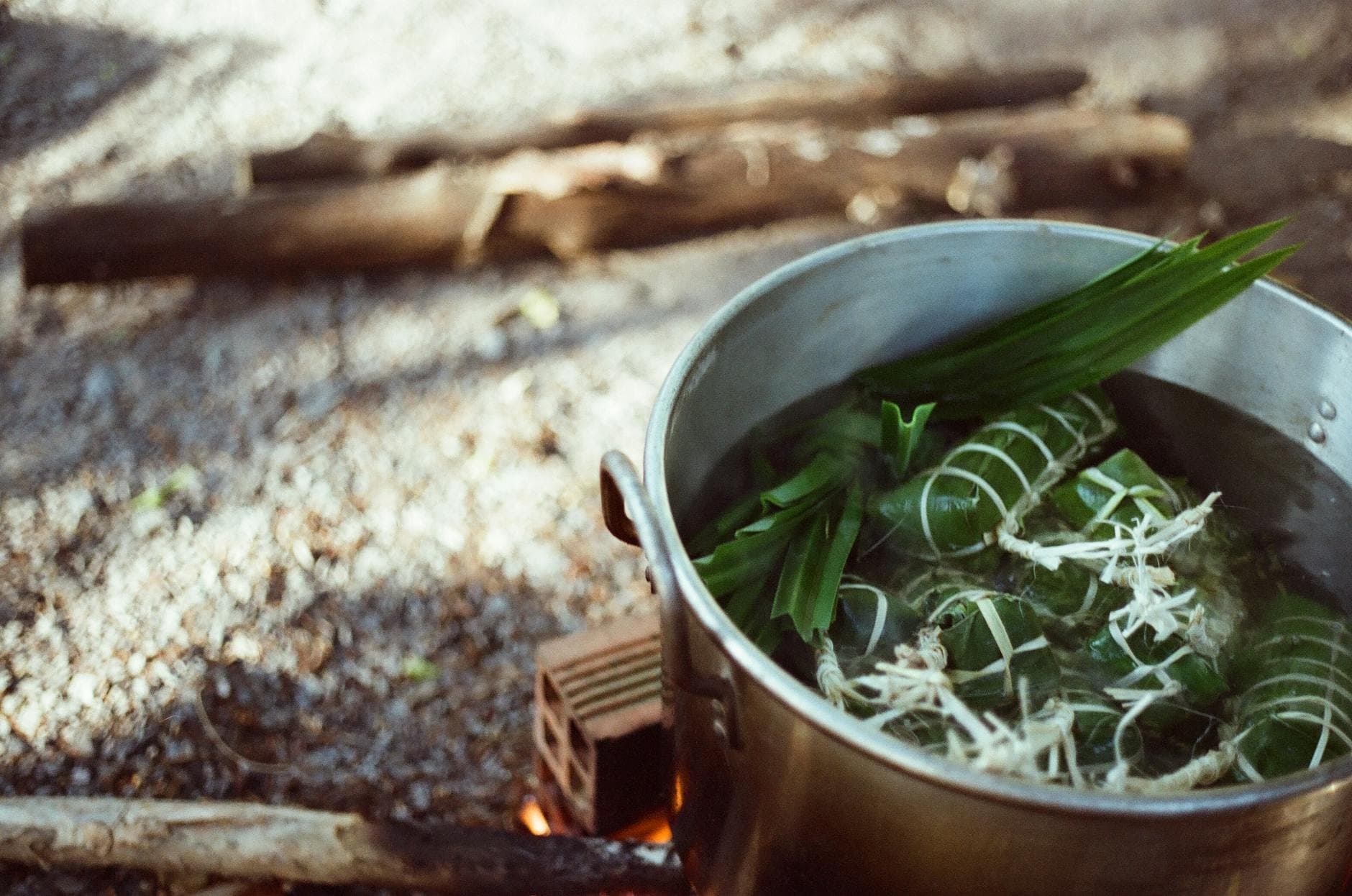
Illustrative photo, not our spa. Our Vietnamese herbal massage uses warm compresses of lemongrass, ginger and local herbs; it is warmth and massage, not cạo gió.
On our menu
Price
The menu's own words
For a cold, achy visitor
Cạo gió, gua sha, coining, cupping (giác hơi)
Not on our menu
None
We do not offer them
Vietnamese herbal full-body massage
520,000₫ (60 min); 700,000₫ (90 min)
"warm compresses of lemongrass, ginger and local herbs pressed into tired muscles"
Warmth and massage; no trial we found tests it for colds or trúng gió
Himalaya hot stone full-body massage
520,000₫ (60 min); 700,000₫ (90 min)
"Warm Himalayan stones glide over tight muscles"
Warmth and massage; tell us about blood thinners or numb skin
Herbal steam (xông hơi), private, listed as Sauna on our menu
300,000₫ (20 min); 350,000₫ (30 min), one person
"lemongrass and local herbs in hot steam"
Warmth; the menu's words, not a finding
Special treatment for back, neck & shoulder
490,000₫ (60 min); 660,000₫ (90 min)
"Focused work on the three places travel tension lives"
The same areas cạo gió works on, with hands instead of a coin
Luxury Gel polish
950,000₫
"Herbal foot soak 10 min, scrub 20 min, scraping massage 20 min + gel polish"
A foot item; the menu does not say what the "scraping massage" is, and it is not cạo gió as far as we know
Anything for stroke signs, a fever or dengue
Not on our menu
None
Call 115 or see a doctor
Prices are per person, VAT is included and there is no service charge; treatments starting from 19:00 carry a 20% evening surcharge, so a 520,000₫ hour becomes 624,000₫. At the 26,000₫ rate we use across the site, the herbal or hot stone hour is about US$20 and 90 minutes US$27, the private steam about US$12 for 20 minutes and US$13 for 30, and the back, neck and shoulder hour US$19. Prices are from our live spa menu, read on 26 November 2026, and the quoted words are the menu's descriptions, not findings. Said against our own interest: we do not offer cạo gió, gua sha, coining or cupping, and nothing on our menu treats trúng gió, a cold or a fever. The closest the trials come to our menu is that two of them used warmth as the comparison, a heat pad and a hot pack, and in the Hong Kong crossover trial pain also fell after the hot pack, with no significant difference between the two; we have measured nothing on our own guests. We are a hotel spa: there is no doctor on the premises, and nothing on the menu is a medical treatment. The menu does not say what is in the herbal compresses beyond lemongrass, ginger and local herbs, whether any oil or balm used contains camphor or menthol, whether a herbal or hot stone massage can stay light all the way through, or whether the therapist can keep off fresh cạo gió marks; ask when you book. On the consultation form, which the online booking leads straight to, you can tap an area twice on the body map to keep the massage off it ("Tap once to focus, twice to avoid"; Upper back, Shoulders and Head & neck are the zones where cạo gió marks usually are, and sometimes Lower back), choose Gentle pressure, and write in the "Anything else" box that you had cạo gió and when. The pressure you choose is where the therapist starts, not a contract: say less, more or not there at any point, and you can ask the therapist to skip an area, add covering or stop. If you have a fever, feel acutely unwell, or might have dengue, do not book a massage: our page on massage when you are sick explains why, and for the warmth itself our pages on the herbal steam and the hot stone massage say what each involves. Anyone with any of the stroke signs above needs 115, not a spa.
What we could not find
Planning a trip around this? See dates at our quiet riverside hotel on the Thu Bồn. Check availability →
A trial of cạo gió for colds, fever, flu or trúng gió. These are what it is mostly used for in Vietnam; the trials we found are on chronic neck and back pain and perimenopausal symptoms.
A trial with a sham treatment. The neck and back trials compared gua sha with a heat pad, a hot pack or a waiting list, so we cannot say how much of the effect is expectation.
Any effect measured beyond three months. The longest follow-ups we found, in three trials pooled by the 2021 review, were 1 and 3 months after treatment.
A study of cạo gió done in Vietnam. The trials we read are from Germany and Hong Kong, the reviews also searched Chinese databases, and the surveys of users are from Hong Kong and Boston.
How often cạo gió delays stroke care. Vietnamese doctors describe it from their wards; we found no count.
Whether the burn case of 2000 was coining or cupping, settled. We have the original abstract and a 2023 rebuttal by gua sha researchers; we could not see the original photographs.
Stroke and temperature in central Vietnam. The hospital reports we found are from the north, and the reviews pool studies from colder places.
Anything on our guests. We have measured nothing on the people we treat, so we claim nothing for them.
Questions people ask before booking
Can I get cạo gió at your spa?
No. Cạo gió, gua sha, coining and cupping (giác hơi) are not on our menu, and nothing on it treats trúng gió. The nearest things we offer are warm treatments: the Vietnamese herbal full-body massage with warm compresses of lemongrass, ginger and local herbs (520,000₫ for 60 minutes, 700,000₫ for 90), the Himalaya hot stone massage (the same prices) and the private herbal steam (300,000₫ for 20 minutes, 350,000₫ for 30). The "scraping massage 20 min" in our Luxury Gel polish is a foot item; the menu does not say what it is, so ask, and do not book it expecting cạo gió.
Is cạo gió safe?
For a healthy adult with intact skin, the sources treat it as low-risk: two of the three German trials reported no adverse events or no serious ones (the abstract of the third, Braun 2011, does not say), and a 2021 review found that "Only 1 study reported adverse effects, and none were serious". It is not safe for everyone. Vietnamese hospital pages and the Ministry of Health's newspaper rule out young children, pregnant women, people with heart disease, high blood pressure, a bleeding tendency or dengue fever, and broken or infected skin; US sources add anyone taking blood thinners. Camphor balms are a separate danger for small children. And it is never safe as a substitute for care: not for a high fever, severe pain, or any stroke sign.
How long do the marks last?
Usually a few days to two weeks. Trial authors describe pinpoint marks that last 2 to 5 days; in a Hong Kong survey of 3,209 adults almost all users said the marks faded within 7 days; after vigorous coining, a US case report says the bruises "usually resolve spontaneously within one to two weeks". Vietnamese advice is to wait 4 to 7 days, until the marks have gone, before scraping again. If you see a doctor abroad within that time, tell them about the cạo gió, so the marks are not mistaken for an injury or a bleeding disorder.
Is trúng gió real?
The feeling is real; the name is not a diagnosis. Vietnamese medical pages use trúng gió for a cold (Vinmec), a chill with fever and aches (a Bạch Mai neurosurgeon) and a faint caused by a slow heart and falling blood pressure (Medlatec). Each of those is real and has its own treatment. What trúng gió must never cover is a stroke, which the Bạch Mai doctor calls a different illness "về bản chất cũng như hướng điều trị" (in its nature and in its treatment), or Bell's palsy.
What should I do if someone collapses or their face droops?
Call 115 at once, in Vietnam, and note the time the first symptom began. Do not scrape, do not prick the fingertips, and give nothing to eat or drink, no pills and no lemon juice. While you wait, a Tâm Anh neurosurgeon advises laying the person in a clean, airy place, on their side with the head slightly raised, and loosening tight clothing; if they stop breathing, the same doctor says to start resuscitation. A Hữu Nghị Hospital neurologist adds that CPR is for someone "khi mạch không đập, người bệnh mất ý thức, không thở" (with no pulse, unconscious and not breathing), not for every stroke. Do this even if the symptoms pass: the NHS says stroke symptoms can stop after a short time, and you should still get help straight away. If it happens at our hotel, call 115 yourself, or ask whoever is nearest to call while you stay with the person.
Can I have a massage after cạo gió?
We found no study of massage over fresh cạo gió marks, so this is our reading of what the marks are. They are small bleeds under the skin, so we would leave the marked area alone until they fade, as the Vietnamese advice does for a second scraping (4 to 7 days apart, once the marks have gone), and have a massage elsewhere if you feel well. If you had cạo gió because you are feverish or unwell, wait until you are better; if you are on blood thinners and have marked bruising, ask your doctor. On the consultation form, tap Upper back, Shoulders, Head & neck or Lower back (wherever the marks are) twice to keep the massage off them, and write in the "Anything else" box when you had cạo gió. Whether the therapist can work around the marks, the menu does not say; ask when you book.
How to book
Nghê Prana Riverside Hotel & Spa, Hẻm 384 Nguyễn Tri Phương, Cẩm Nam, Hội An, on the Thu Bồn, 3.2 km from the Old Town. The spa is open from 9:00 to 21:00 every day and takes visitors as well as hotel guests. Book on the online form or by phone or WhatsApp on +84 896 687 961; an hour's notice is enough, and if you have had cạo gió in the last few days, or take blood thinners, say so when you book. Coming as two? The couple spa page shows the private room for two. Free pickup to the spa from anywhere within 5 km of us in a straight line, which takes in the Old Town, hotel guest or not: send your location to +84 896 687 961 on WhatsApp or Zalo and we reply within 15 minutes (9:00–21:00).
How we checked: on 26 November 2026 we read, in Vietnamese, two pages on cạo gió in Sức khỏe & Đời sống, the Ministry of Health's newspaper (31 July 2014, updated 8 June 2021; and 6 July 2019), Vinmec's pages on cạo gió (updated 19 May 2026), on trúng gió (11 July 2024) and on dầu gió for children (10 July 2024), Medlatec's page on trúng gió (16 December 2022), a doctor's column on who should not have cạo gió in PLO (18 November 2025), Người Lao Động's article on cạo gió mistakes (24 November 2024), Vietnamese Wikipedia's article on cạo gió (last edited 12 February 2025), Nhân Dân's interview with a Bạch Mai neurosurgeon on trúng gió and stroke (12 December 2023) and its report from Hữu Nghị Hospital (13 January 2026), VnExpress's stroke reports of 6 January 2021, 19 December 2022, 6 August 2023 and 13 September 2025, and Znews's report quoting People's Hospital 115 (4 January 2025); the NHS pages on stroke symptoms (last reviewed 12 September 2024) and Bell's palsy (last reviewed 4 July 2023); DermNet's page on coining (June 2015), Stanford Medicine 25's page on skin coining (2016) and New York City's health department page on camphor; the abstracts of Braun 2011 (Pain Medicine), Lauche 2012 (American Journal of Chinese Medicine), Saha 2019 and Ren 2018 (Complementary Therapies in Clinical Practice), Yuen 2017 and Lam 2015 (Complementary Therapies in Medicine), Wang 2021 (Journal of Manipulative and Physiological Therapeutics), Nielsen 2007 (Explore), Nielsen 2012 (Complementary Therapies in Medicine), Davis 2000 (Journal of the American Academy of Nurse Practitioners), Amshel and Caruso 2000 (Journal of Burn Care & Rehabilitation), Nguyen 2016 (Journal of Alternative and Complementary Medicine), Hinton 2001 (General Hospital Psychiatry), Samberkar 2020 (Medicine, Science and the Law), Khine 2009 (Pediatrics), Wen 2023 (Brain and Behavior) and Wang 2016 (International Journal of Environmental Research and Public Health); the full texts of Nielsen 2023 (Integrative Medicine Research) and Darsha and Cohen 2020; the title of Rampini 2002 (JAMA), which has no abstract; VietnamNet's forecast report (24 November 2026), the bulletins page of the National Center for Hydro-Meteorological Forecasting, and our own guide to Hội An in December. We also read our live spa menu. We are a hotel spa, not a clinic; nothing here is medical advice.
Braun M, Schwickert M, Nielsen A, et al. (2011). Effectiveness of traditional Chinese "gua sha" therapy in patients with chronic neck pain: a randomized controlled trial (abstract read 26 November 2026). Pain Medicine. View source
Lauche R, Wübbeling K, Lüdtke R, et al. (2012). Randomized controlled pilot study: pain intensity and pressure pain thresholds in patients with neck and low back pain before and after traditional East Asian "gua sha" therapy (abstract read 26 November 2026). The American Journal of Chinese Medicine. View source
Saha FJ, Brummer G, Lauche R, et al. (2019). Gua Sha therapy for chronic low back pain: a randomized controlled trial (abstract read 26 November 2026). Complementary Therapies in Clinical Practice. View source
Yuen JWM, Tsang WWN, Tse SHM, et al. (2017). The effects of Gua sha on symptoms and inflammatory biomarkers associated with chronic low back pain: a randomized active-controlled crossover pilot study in elderly (abstract read 26 November 2026). Complementary Therapies in Medicine. View source
Wang XQ, Duan PB, Zheng M, et al. (2021). Effect of scraping therapy on chronic low back pain: a systematic review and meta-analysis of randomized controlled trials (abstract read 26 November 2026). Journal of Manipulative and Physiological Therapeutics. View source
Ren Q, Yu X, Liao F, et al. (2018). Effects of Gua Sha therapy on perimenopausal syndrome: a systematic review and meta-analysis of randomized controlled trials (abstract read 26 November 2026). Complementary Therapies in Clinical Practice. View source
Nielsen A, Knoblauch NT, Dobos GJ, Michalsen A, Kaptchuk TJ (2007). The effect of Gua Sha treatment on the microcirculation of surface tissue: a pilot study in healthy subjects (abstract read 26 November 2026). Explore. View source
Nielsen A, Handel M, Stone JAM, Lee MS (2023). Misreport of burns as a result of 'coining', Gua sha; inherent harms from publication and ongoing citation of false facts (full text read 26 November 2026). Integrative Medicine Research. View source
Nielsen A, Kligler B, Koll BS (2012). Safety protocols for gua sha (press-stroking) and baguan (cupping) (abstract read 26 November 2026). Complementary Therapies in Medicine. View source
Darsha AK, Cohen PR (2020). New onset of linear purpura on the back: coining therapy-associated ecchymoses (full text read 26 November 2026). Cureus. View source
Davis RE (2000). Cultural health care or child abuse? The Southeast Asian practice of cao gio (abstract read 26 November 2026). Journal of the American Academy of Nurse Practitioners. View source
Amshel CE, Caruso DM (2000). Vietnamese "coining": a burn case report and literature review (abstract read 26 November 2026). Journal of Burn Care & Rehabilitation. View source
Rampini SK, Schneemann M, Rentsch K, Bächli EB (2002). Camphor intoxication after cao gío (coin rubbing) (title only; no abstract; read 26 November 2026). JAMA. View source
Lam CT, Tse SH, Chan ST, Tam JK, Yuen JW (2015). A survey on the prevalence and utilization characteristics of gua sha in the Hong Kong community (abstract read 26 November 2026). Complementary Therapies in Medicine. View source
Nguyen LT, Kaptchuk TJ, Davis RB, et al. (2016). The use of traditional Vietnamese medicine among Vietnamese immigrants attending an urban community health center in the United States (abstract read 26 November 2026). Journal of Alternative and Complementary Medicine. View source
Hinton D, Chau H, Nguyen L, et al. (2001). Panic disorder among Vietnamese refugees attending a psychiatric clinic: prevalence and subtypes (abstract read 26 November 2026). General Hospital Psychiatry. View source
Samberkar PN, Samberkar SP, Byard RW (2020). Potential forensic implications of kerokan therapy: a traditional Indonesian therapy associated with neck bruising (abstract read 26 November 2026). Medicine, Science and the Law. View source
Khine H, Weiss D, Graber N, et al. (2009). A cluster of children with seizures caused by camphor poisoning (abstract read 26 November 2026). Pediatrics. View source
Wen J, Zou L, Jiang Z, et al. (2023). Association between ambient temperature and risk of stroke morbidity and mortality: a systematic review and meta-analysis (abstract read 26 November 2026). Brain and Behavior. View source
Wang X, Cao Y, Hong D, et al. (2016). Ambient temperature and stroke occurrence: a systematic review and meta-analysis (abstract read 26 November 2026). International Journal of Environmental Research and Public Health. View source
Xie S; Oakley A (chief editor) (2015). Coining (June 2015; read 26 November 2026). DermNet. View source
Stanford Medicine 25 (2016). What is skin coining (Gua sha)? (2016; read 26 November 2026). Stanford Medicine. View source
NHS (2024). Symptoms of a stroke (last reviewed 12 September 2024; read 26 November 2026). nhs.uk. View source
NHS (2023). Bell's palsy (last reviewed 4 July 2023; read 26 November 2026). nhs.uk. View source
NYC Department of Health and Mental Hygiene (2026). Camphor (undated; read 26 November 2026). nyc.gov. View source
ThS. Hoàng Khánh Toàn (2014). Cạo gió thế nào cho đúng? (31 July 2014, updated 8 June 2021; read 26 November 2026). Sức khỏe & Đời sống (Ministry of Health). View source
Sức khỏe & Đời sống (2019). Cạo gió bài bản và khoa học (6 July 2019, updated 9 June 2021; read 26 November 2026). Sức khỏe & Đời sống (Ministry of Health). View source
Vinmec International Hospital (2026). Hướng dẫn cách cạo gió bằng dầu gió (11 July 2024, updated 19 May 2026; read 26 November 2026). Vinmec. View source
Vinmec International Hospital (2024). Các biểu hiện trúng gió bạn cần biết (11 July 2024; read 26 November 2026). Vinmec. View source
Vinmec International Hospital (2024). Đừng tùy tiện dùng dầu gió cho trẻ nhỏ (10 July 2024; read 26 November 2026). Vinmec. View source
Medlatec (2022). Biểu hiện trúng gió là gì? Cách xử lý như thế nào? (16 December 2022; read 26 November 2026). Medlatec. View source
BS Nguyễn Tiến Dũng (2025). Những người tuyệt đối không được cạo gió, rất nguy hiểm (18 November 2025; read 26 November 2026). Pháp Luật TP.HCM (PLO), at tuoitre.vn. View source
Người Lao Động (2024). Cạo gió và những sai lầm cần tránh (24 November 2024; read 26 November 2026). Người Lao Động, at tuoitre.vn. View source
Wikipedia tiếng Việt (2025). Cạo gió (last edited 12 February 2025; read 26 November 2026). vi.wikipedia.org. View source
Nhân Dân (interview with BSCKII Nguyễn Quang Thành, Bạch Mai Hospital) (2023). Trúng gió có phải là đột quỵ không? (12 December 2023; read 26 November 2026). Nhân Dân. View source
Nhân Dân (Hữu Nghị Hospital) (2026). Nhiều trường hợp đột quỵ não cấp trong những ngày chuyển mùa (13 January 2026; read 26 November 2026). Nhân Dân. View source
VnExpress (quoting Military Hospital 103) (2022). Trời lạnh dễ gây đột quỵ (19 December 2022; read 26 November 2026). VnExpress. View source
VnExpress (quoting Dr Mai Đức Thảo, Hữu Nghị Hospital) (2021). Hiểu nhầm trong sơ cứu đột quỵ (6 January 2021; read 26 November 2026). VnExpress. View source
VnExpress (quoting Dr Nguyễn Thị Minh Đức, Tâm Anh General Hospital) (2023). 6 bệnh dễ nhầm lẫn với đột quỵ (6 August 2023; read 26 November 2026). VnExpress. View source
VnExpress (quoting Dr Nguyễn Đức Anh, Tâm Anh General Hospital) (2025). Làm gì khi có người đột quỵ? (13 September 2025; read 26 November 2026). VnExpress. View source
Znews (quoting Dr Phạm Nguyên Bình, People's Hospital 115) (2025). Một sai lầm trong sơ cứu có thể khiến người đột quỵ biến chứng nặng (4 January 2025; read 26 November 2026). Znews. View source
VietnamNet (2026). Central Vietnam faces back-to-back heavy rains and worsening flood risks (24 November 2026; read 26 November 2026). VietnamNet. View source
Trung tâm Dự báo khí tượng thủy văn quốc gia (National Center for Hydro-Meteorological Forecasting) (2026). Bulletins page, including "Tin không khí lạnh tăng cường" of 26 November 2026 (read 26 November 2026). nchmf.gov.vn. View source
Every room at Nghê Prana is designed around the science of sleep. Blackout curtains, nightly aromatherapy turndown, and riverside quiet — experience what real rest feels like.
Riverside hotel rooms on the Thu Bồn, ten minutes by bicycle from the Ancient Town. Whether it's one night between Hue and Da Nang or a full week of doing nothing — we kept your room quiet.
Free cancellation · Direct from the family who built the hotel



 WhatsApp
 Zalo