Kim Bồng Village Festival 2027: Hội An's Woodworking Guild, Dates & How to Visit
The carpenters of Kim Bồng village, directly across the Thu Bồn from central Hội An, built the timber Old Town — and once a year they celebrate the craft. This guide separates the fixed ancestor-worship rite (giỗ Tổ nghề mộc, Thursday 11 February 2027) from the annually-set public festival program (2027 dates not yet published), tells the story of the carpentry guild that raised Faifo, and shows how to cross to the village by boat or bicycle from the quiet Cẩm Nam riverside.
Almost every timber house, carved column and swooping tiled roof in Hội An's Ancient Town was raised by the hands of one village: Kim Bồng, the carpentry village that sits directly across the Thu Bồn River, in the commune of Cẩm Kim. The woodworkers of the Kim Bồng guild (làng mộc Kim Bồng) built the merchant houses of old Faifo, carved the assembly halls, and — Vietnamese chronicles record — were summoned north to help build palaces for the Nguyễn court in Huế. Once a year the village holds a festival in their honour. English-language travel blogs cover a generic "Kim Bồng day trip" endlessly; the festival itself is almost unwritten about in English. This guide fixes that.
TL;DR — The Kim Bồng Traditional Woodworking Village Festival (Ngày hội Làng mộc Kim Bồng) honours the carpentry guild that built Hội An's Old Town. Its core is the ancestor-worship rite for the founders of the craft (giỗ Tổ nghề mộc), held on a fixed lunar date: the 6th day of the 1st lunar month — which in 2027 falls on Thursday 11 February 2027. Around that rite, Hội An Tourism runs an expanded public program of craft demonstrations, a rural market, folk games and performances; those program dates are set annually and the 2027 program dates are not yet published (the 2026 edition ran 27–28 February). The village is a short boat ride or bicycle hop across the river from central Hội An — and directly across the water from the quiet Cẩm Nam riverside.
What is the Kim Bồng village festival?
Kim Bồng (Kim Bồng) is a riverside village on the south-west bank of the Thu Bồn, in Cẩm Kim commune, part of Hội An. For roughly four centuries its woodworkers have been among the most respected in central Vietnam. The village gave its name to a distinct school of carpentry and woodcarving — nghề mộc Kim Bồng — spanning three branches: house-building and architectural carving, fine decorative woodcarving, and traditional wooden-boat building on the riverbank.
The festival — Ngày hội Làng mộc Kim Bồng, sometimes rendered as the Kim Bồng Carpentry Village Festival — is the village's annual celebration of that inheritance. At its heart is a solemn ancestor-worship ceremony, the giỗ Tổ nghề mộc, in which the carpenters pay respect to the founding masters of the craft and pray for a prosperous year. Wrapped around the rite is a public festival of live craft, market stalls, folk games, regional food and traditional performance. Hội An's heritage authorities count Kim Bồng among the town's living traditional-craft villages, alongside Thanh Hà pottery and Trà Quế herb-growing.
A woodcarver shaping a statue by hand — the carving-and-joinery craft the Kim Bồng guild built its name on. (Illustrative; not photographed at Kim Bồng.) · Thợ chạm khắc gỗ — nghề mộc làm nên tên tuổi làng Kim Bồng.
When is the Kim Bồng festival in 2027?
This is where precision matters, because the festival has two dates that behave differently — and most listings blur them together.
The ancestor-worship rite is fixed by the lunar calendar. The giỗ Tổ nghề mộc is traditionally held on the *6th day of the 1st lunar month (mùng 6 tháng Giêng*), in the days just after Tết. In 2027, Tết (lunar 1/1) falls on Saturday 6 February, so the 6th day of the first lunar month — and therefore the traditional Kim Bồng rite — falls on Thursday 11 February 2027**. This date is anchored to the lunar calendar every year, so it is knowable well in advance.
The expanded public program is set annually and varies. Separately from the fixed rite, Hội An / Quảng Nam tourism authorities organise a larger public festival — the version with the full craft demonstrations, market and stage program — and its dates move from year to year. The 2026 edition ran on 27–28 February 2026. As of this writing, the 2027 public-program dates have not been officially published. We are not going to invent them: expect a window in late February 2027, likely close to the 2026 pattern, but treat that as provisional until Hội An Tourism confirms. We will update this post the moment the official 2027 program is announced.
In short: if you want the traditional ancestor-worship rite, plan around Thursday 11 February 2027. If you want the big public craft festival with demonstrations and market, watch this space for the official late-February date and keep your plans flexible.
The carpentry guild that built Hội An
Kim Bồng's reputation is not a tourism invention — it is written into the fabric of the town across the river. From the 16th and 17th centuries, as the port of Faifo grew into one of Đàng Trong's great trading hubs, it was Kim Bồng carpenters who raised the timber merchant houses, the nhà rường frames, the carved beams and the tiled roofs that UNESCO would later inscribe as a World Heritage Site.
Vietnamese sources record that the guild's renown reached the imperial court: Kim Bồng artisans were among the craftsmen called to contribute to royal and religious construction under the Nguyễn dynasty, including work associated with the citadel and palaces at Huế. The village's third specialism — wooden-boat building — supplied the fishing and cargo craft that worked the Thu Bồn and the coast. To stand in Hội An's Ancient Town, in other words, is to stand inside a Kim Bồng workshop's finished catalogue.
Hội An's riverfront timber houses, reflected in the Thu Bồn — the heritage carpentry the Kim Bồng guild is famous for. · Nhà cổ ven sông Hội An soi bóng trên sông Thu Bồn — di sản nghề mộc Kim Bồng.
What happens at the festival?
The public festival turns the riverside village into an open-air workshop and fair. Expect roughly these elements, drawn from Hội An's heritage-centre accounts and coverage of recent editions:
Live craft demonstrations. Master carpenters and carvers work in the open — chiselling architectural details, shaping fine decorative pieces, and on the riverbank, building traditional wooden boats plank by plank. Visitors can watch joinery done without nails, the way Hội An's old houses were assembled.
A craftsman at work in a traditional workshop — the live carving demonstrations are the heart of the Kim Bồng festival. (Illustrative craft photo.) · Nghệ nhân chạm khắc trong xưởng truyền thống — phần trình diễn nghề là điểm nhấn của ngày hội.
A rural market and local food. A country-fair market (chợ quê) sells village produce, handicrafts and Quảng Nam specialities — the kind of regional cooking that rarely reaches the Old Town's tourist restaurants.
Folk games and performances. Traditional games, bài chòi folk singing, and music round out the day, giving the festival the feel of a village Tết rather than a staged show.
*The giỗ Tổ nghề mộc rite.* The ceremonial core is the ancestor-worship rite for the founding masters of the craft: incense, offerings, and prayers led by the village's senior carpenters at the communal house, asking the ancestors for a good year for the guild.
Planning a trip around this? See dates at our quiet riverside hotel on the Thu Bồn. Check availability →
How do you get to Kim Bồng from Hội An?
Kim Bồng is genuinely close — it only feels remote because it sits on the far bank of the Thu Bồn. There are two classic ways across.
By boat. Small wooden ferries and tour boats cross the river to Cẩm Kim from the Hội An riverfront — most easily from the Bạch Đằng quay and the An Hội area beside the Old Town. The crossing takes only a few minutes and drops you at the village landing, which is the most atmospheric way to arrive.
By bicycle. Since the Cẩm Kim bridge opened, you can also cycle straight over to the village — a flat, quiet ride through rice paddies that makes Kim Bồng an easy half-day loop from central Hội An. From the Cẩm Nam riverside, the village is directly across the water: a short pedal or paddle, not an expedition.
Where to stay: the quiet bank across the water
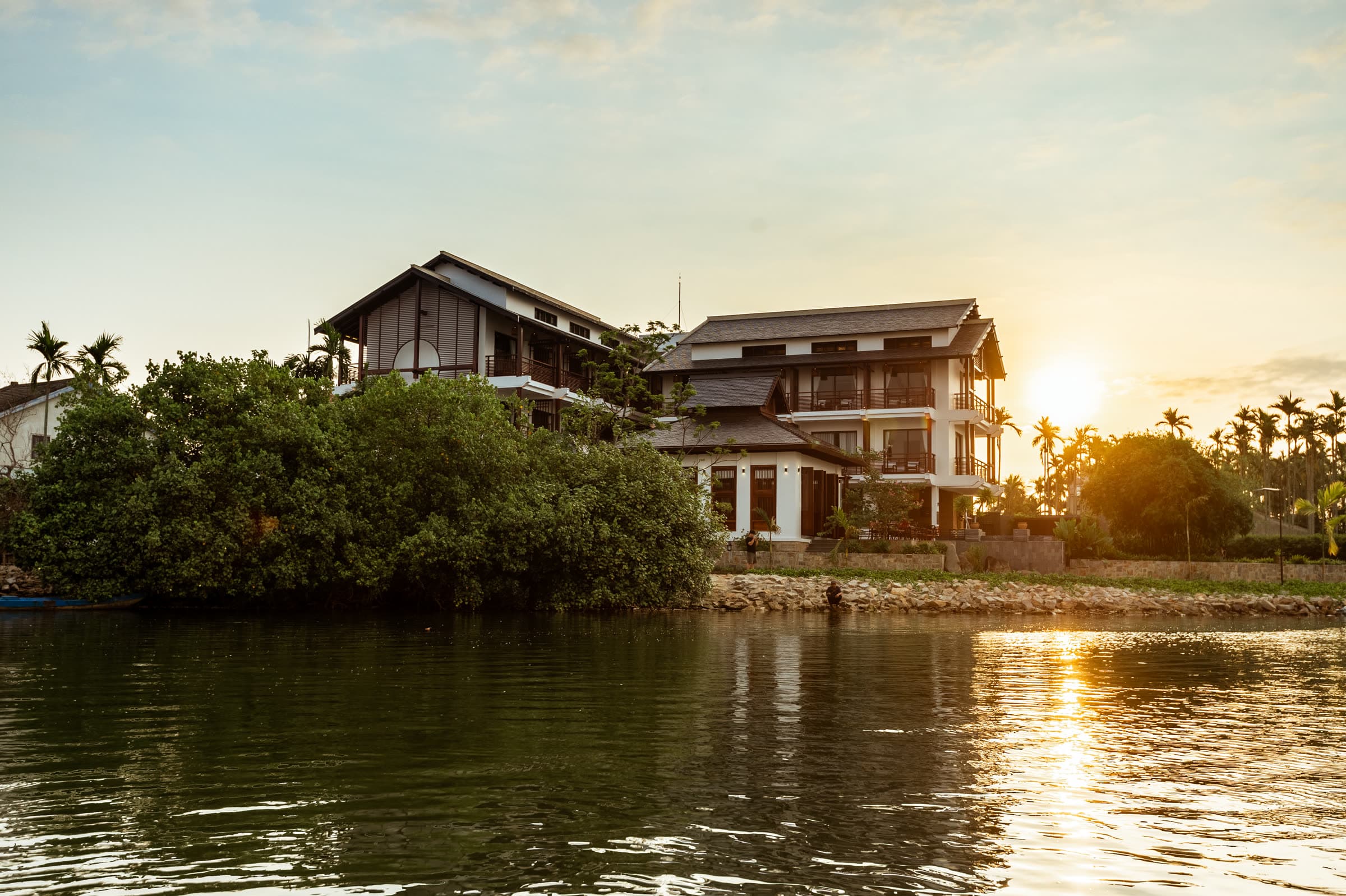
Here is the honest geography. Kim Bồng sits on one bank of the Thu Bồn; the Cẩm Nam riverside sits on the other, looking straight across at it. Nghê Prana is a riverside hotel on that Cẩm Nam side of the Thu Bồn — which means the woodworking village is, quite literally, the view across our river. You wake on the calm south-bank side of Hội An, cross for the festival by boat or bicycle in the morning, and come back to quiet water in the afternoon, rather than to a room deep inside the pedestrian Old Town. See our rooms for the riverside layout.
Frequently Asked Questions
When is the Kim Bồng village festival in 2027?
The traditional ancestor-worship rite (giỗ Tổ nghề mộc) is fixed to the 6th day of the 1st lunar month, which in 2027 is Thursday 11 February 2027. The larger public craft-festival program is set annually by Hội An Tourism and the 2027 dates are not yet published; expect a provisional window in late February 2027 (the 2026 edition ran 27–28 February). We will update this post when the official 2027 program is confirmed.
Where is Kim Bồng village?
Kim Bồng is a riverside carpentry village in Cẩm Kim commune, Hội An, on the south-west bank of the Thu Bồn River — directly across the water from central Hội An and the Cẩm Nam riverside.
Why is Kim Bồng village famous?
For its carpentry and woodcarving guild (nghề mộc Kim Bồng), whose craftsmen built the timber merchant houses of Hội An's Ancient Town, carved its assembly halls, built traditional wooden boats, and — Vietnamese records say — contributed to Nguyễn-dynasty construction in Huế.
What happens at the Kim Bồng festival?
Live carpentry, woodcarving and boat-building demonstrations; a rural market and local food; folk games and traditional performances; and the ceremonial ancestor-worship rite (giỗ Tổ nghề mộc) for the founders of the craft.
How do you get to Kim Bồng from Hội An?
By a short boat crossing from the Bạch Đằng / An Hội riverfront, or by bicycle over the Cẩm Kim bridge — a flat, quiet ride through the paddies. From the Cẩm Nam riverside it is directly across the river.
Is the Kim Bồng festival worth visiting?
If you care about how Hội An was actually built, yes — it is the one day a year the town's carpentry heritage is celebrated at its source, with live craft rather than souvenir stalls. Come for the rite on 11 February 2027, or for the fuller public program on the late-February dates once they are confirmed.
This article synthesises Vietnamese-language coverage of the Ngày hội Làng mộc Kim Bồng from Báo Quảng Nam, the Hội An heritage-conservation centre (hoianheritage.net / hoianworldheritage.org.vn), the Hội An city portal, vietnam.vn and Da Nang Fantasticity, cross-checked against the fixed lunar anchor for 2027 (Tết on 6 February, placing mùng 6 tháng Giêng on 11 February). The hotel-side contribution is the verified rite-date conversion and the honest fixed-rite-vs-provisional-program distinction, reported from the Cẩm Nam riverside directly across the Thu Bồn from the village.
The traditional ancestor-worship rite (giỗ Tổ nghề mộc) is fixed to the 6th day of the 1st lunar month, which in 2027 is Thursday 11 February 2027. The larger public craft-festival program is set annually by Hội An Tourism and the 2027 dates are not yet published; expect a provisional window in late February 2027 (the 2026 edition ran 27–28 February). We will update this post when the official 2027 program is confirmed.
Where is Kim Bồng village?
Kim Bồng is a riverside carpentry village in Cẩm Kim commune, Hội An, on the south-west bank of the Thu Bồn River — directly across the water from central Hội An and the Cẩm Nam riverside.
Why is Kim Bồng village famous?
For its carpentry and woodcarving guild (nghề mộc Kim Bồng), whose craftsmen built the timber merchant houses of Hội An's Ancient Town, carved its assembly halls, built traditional wooden boats, and — Vietnamese records say — contributed to Nguyễn-dynasty construction in Huế.
What happens at the Kim Bồng festival?
Live carpentry, woodcarving and boat-building demonstrations; a rural market and local food; folk games and traditional performances; and the ceremonial ancestor-worship rite (giỗ Tổ nghề mộc) for the founders of the craft.
How do you get to Kim Bồng from Hội An?
By a short boat crossing from the Bạch Đằng / An Hội riverfront, or by bicycle over the Cẩm Kim bridge — a flat, quiet ride through the paddies. From the Cẩm Nam riverside it is directly across the river.
Is the Kim Bồng festival worth visiting?
If you care about how Hội An was actually built, yes — it is the one day a year the town's carpentry heritage is celebrated at its source, with live craft rather than souvenir stalls. Come for the rite on 11 February 2027, or for the fuller public program on the late-February dates once they are confirmed.
References & Sources
Báo Quảng Nam (2025). Ngày hội làng nghề mộc Kim Bồng — nơi lưu giữ hồn gỗ Hội An. baoquangnam.vn. View source
Trung tâm Quản lý Bảo tồn Di sản Văn hóa Hội An (2023). Làng mộc Kim Bồng — làng nghề truyền thống Hội An. hoianheritage.net. View source
Trung tâm QLBT Di sản Văn hóa Hội An (2024). Các làng nghề truyền thống — Kim Bồng, Thanh Hà, Trà Quế. hoianworldheritage.org.vn. View source
Cổng thông tin điện tử thành phố Hội An (2026). Sự kiện văn hóa — Ngày hội làng nghề mộc Kim Bồng. hoian.gov.vn. View source
vietnam.vn (2026). Ngày hội làng nghề mộc Kim Bồng 2026 (27–28/2). vietnam.vn. View source
Da Nang Fantasticity (2026). Làng mộc Kim Bồng và lịch sự kiện lễ hội Hội An. danangfantasticity.com. View source
VnExpress Du lịch (2025). Làng mộc Kim Bồng — điểm đến Hội An. VnExpress. View source
Báo Đà Nẵng (2025). Cẩm Kim và nghề mộc Kim Bồng bên sông Thu Bồn. baodanang.vn. View source
Every room at Nghê Prana is designed around the science of sleep. Blackout curtains, nightly aromatherapy turndown, and riverside quiet — experience what real rest feels like.
Riverside hotel rooms on the Thu Bồn, ten minutes by bicycle from the Ancient Town. Whether it's one night between Hue and Da Nang or a full week of doing nothing — we kept your room quiet.
Free cancellation · Direct from the family who built the hotel


 WhatsApp
 Zalo
Zalo