Sa Huỳnh and Champa: What German Archaeologists Have Pieced Together About Hội An's 3,000-Year Pre-History
Twenty minutes by bicycle from the Old Town, a Vietnamese–German team excavated 108 pieces of 2,000-year-old gold jewelry at the Sa Huỳnh-culture cemetery of Lai Nghi. The Champa kingdom that followed, the rise of Faifo, and how the Thu Bồn river has been a trading spine for at least three millennia — synthesised from five Vietnamese sources and the German monograph that English-language guidebooks have missed.
Most English-language guidebooks open the Hội An story in the 16th century, with the Japanese merchants of Faifo. That start date is roughly 2,500 years too late. Twenty minutes by bicycle south of the Old Town, at a Sa Huỳnh-culture cemetery called Lai Nghi in Điện Bàn, a Vietnamese–German excavation team spent the years 2002 to 2004 lifting 108 intact pieces of gold jewelry, more than 8,600 glass beads, and two carnelian animal pendants — a waterfowl and a tiger — out of 63 burial urns spread across just 192 square metres of ground (Báo Đà Nẵng, 11 Jan 2025; Báo Văn hóa, 19 Oct 2024). The Vietnamese press has covered the find in granular detail; the English-language record has not. This post synthesises five Vietnamese sources, one ISBN-verifiable German monograph, and the published scholarship of Andreas Reinecke and Wibke Lobo to lay out what is now known.
Timeline: Nghe Prana editorial — sources cited in References below
Who were the Sa Huỳnh people?
The Sa Huỳnh (Văn hóa Sa Huỳnh) was the Iron Age culture that occupied the central Vietnamese coast from roughly 1000 BCE to the late 2nd century CE, named after a salt-flat village in Đức Phổ, Quảng Ngãi, where French customs officer M. Vinet first uncovered a field of burial jars in 1909 (VnExpress, 10 Jan 2025; vi.wikipedia.org — Văn hóa Sa Huỳnh). The term Sa Huỳnh culture was formally proposed in 1936 by the French archaeologist Madeleine Colani. Its diagnostic features are jar burials, three-pronged and double-headed animal ear-pendants, iron tools, and an early local glass-bead industry that produced lưu ly (artificial glass) in vast quantities.
These were not subsistence villagers. Báo Thanh Niên led its October 2024 dispatch with the headline "Cư dân cổ Sa Huỳnh từng rất giàu có" — "the ancient Sa Huỳnh residents were extraordinarily wealthy" — and quoted Professor Lâm Thị Mỹ Dung of Hanoi National University, who has worked the Lai Nghi trenches herself, describing them as "skilled traders, refined consumers, exceptionally wealthy within East–West maritime trade networks" (Báo Thanh Niên, 30 Oct 2024).
Did Germans really excavate in Hội An?
Yes — and the institutional partner is named explicitly in every major Vietnamese write-up of the Lai Nghi find. The German Archaeological Institute (Deutsches Archäologisches Institut, KAAK Bonn) was a formal collaborator alongside Quảng Nam Museum and the University of Social Sciences & Humanities at Hanoi National University on the 2002–2004 campaigns at Lai Nghi, and ran a separate joint research programme in Quảng Ngãi during 2004–2005 (Báo Văn hóa, 19 Oct 2024; vi.wikipedia.org — Văn hóa Sa Huỳnh).
The German archaeologist most often named in the Vietnamese coverage is Dr Andreas Reinecke. Báo Đà Nẵng records his observation that Lai Nghi contains "the most abundant quantity of gold beads discovered across all Sa Huỳnh sites in Vietnam to date" (Báo Đà Nẵng, 11 Jan 2025). The team's German-language synthesis, *Andreas Reinecke et al., Neue Entdeckungen zur Sa Huynh-Kultur (Lindensoft Verlag, 2002, ISBN 3-929290-27-8)*, remains one of the few book-length Western treatments of the culture — and it is barely cited in English-language travel writing.
A second figure worth knowing is Wibke Lobo, formerly of the Ethnologisches Museum Berlin, whose published work on Cham sculpture and the Đà Nẵng / Tourane museum collection remains a standard German-language reference for the period that followed Sa Huỳnh.
Map: Nghe Prana editorial — sources cited in References below
What did the Germans actually find at Lai Nghi?
The Lai Nghi cemetery sits in Điện Nam Đông ward, Điện Bàn town, Quảng Nam — a roughly five-kilometre cycle south from the Hội An Old Town along the south bank of the Thu Bồn (exact GPS of the public site marker needs operator verification). Three excavation phases between 2002 and 2004 opened 192 m² of ground and yielded (Báo Đà Nẵng, 11 Jan 2025; Báo Thanh Niên, 30 Oct 2024):
63 burial urns and traces of 4 earth burials
108 pieces of intact gold jewelry — 4 gold earrings with a distinctive twisted design and 104 bicone gold beads — dated 3rd century BCE to mid-1st century CE
2 carnelian animal pendants in agate: a waterfowl (1.5 × 0.75 × 1.1 cm, 1.13 g) and a tiger (1.4 × 0.7 × 1.1 cm, 1.13 g). These are the only carnelian animal beads ever recovered from a Sa Huỳnh context in Vietnam (VnExpress, 10 Jan 2025)
More than 8,600 glass beads (1–3 mm) and 1,500 semi-precious stone beads in agate, carnelian and nephrite
More than 300 ceramic objects, ~50 bronze artifacts (mirrors, tripods, vessels) and ~100 iron tools and weapons
C-14 dating places the cemetery at approximately 2,070 years old. The four gold ear-ornaments are the first such objects ever attributed to the Sa Huỳnh culture, a point made by Nguyễn Chiều of Hanoi National University, who joined all three excavation phases. The entire collection is now held at Quảng Nam Museum, and in October 2024 the province formally petitioned the Ministry of Culture, Sport and Tourism to designate the Lai Nghi gold assemblage as bảo vật quốc gia — national treasures (Báo Văn hóa, 19 Oct 2024).
Photo: Vitaly Gariev / Pexels
What came after Sa Huỳnh — and how did Champa rise?
The Sa Huỳnh culture wound down in the late 2nd century CE. Almost immediately afterwards, in 192 CE, the polity of Lâm Ấp was founded along the same coast — the seed of what would become the Champa kingdom. The continuity is not just chronological. Charles Higham, in Early Mainland Southeast Asia (River Books, 2014), and Hsiao-chun Hung and colleagues in their 2013 Journal of Island & Coastal Archaeology paper on coastal connectivity across the South China Sea, both argue that Sa Huỳnh's maritime trade networks — the same routes that brought carnelian from India and glass beadworking know-how from across the region — were the infrastructure on which Champa's Indianised statecraft was built.
Champa moved its political centre several times across roughly thirteen centuries. The earliest known capital, Simhapura, sits at modern Trà Kiệu about 18 km west of Hội An. The Buddhist capital Indrapura is at modern Đồng Dương. The Hindu sanctuary complex of Mỹ Sơn — UNESCO-inscribed in 1999, our nearest world-heritage neighbour together with the Old Town itself — was built between the 4th and 13th centuries. Champa as a sovereign kingdom ended in 1471, when Đại Việt forces under Lê Thánh Tông took the southern capital of Vijaya.
For the visitor coming through Hội An today, this is the throughline: the Thu Bồn delta has been a regional trading node not for four hundred years but for at least two thousand, and the Cham temples on the inland route to Mỹ Sơn are the visible upper layer of a much older sequence. (For the temple visit itself, see our standalone guide: My Son Sanctuary: A Day Trip from Hoi An.)
When did Faifo / Hội An become a port?
The town of Faifo — Hoài Phố in the older Vietnamese rendering, Hội An in the modern — emerged as a major international trading port from the 15th through 18th centuries, peaking in the early 1600s with the licensed Japanese shuinsen trade and a substantial Chinese merchant community. UNESCO inscribed the Hội An Ancient Town as a World Heritage site in 1999. In 2025, Vietnam's National Assembly Resolution 202/2025/QH15 merged Quảng Nam and Đà Nẵng administratively, so Hội An and Mỹ Sơn are now governed from Đà Nẵng (we covered this transition in detail in Hoi An vs Da Nang in 2026: What Changed When the Heritage Sites Merged).
Planning a trip around this? See dates at our quiet riverside hotel on the Thu Bồn. Check availability →
What's striking is that every layer in that sequence — Sa Huỳnh trade beads, Champa sandstone, Faifo ceramics, French colonial cadastres — sits within a one-day cycling radius of the Old Town, and most of it is accessible without a guide.
Why does this matter for visitors to Hội An?
Because the Hội An that the 1999 UNESCO citation describes — a 15th-to-19th-century South-East Asian trading port — is the youngest, most-photographed layer of a place that has been an international entrepôt since the late Bronze Age. The carnelian tiger pendant in Quảng Nam Museum was almost certainly carved by a craftsperson trained in workshops along the Indian Ocean rim and traded inland up the same Thu Bồn river that flows past our terrace. Knowing this changes how the Old Town reads.
Photo: Thái Trường Giang / Pexels
A practical itinerary that builds the layered story across a single day:
1. Morning — Quảng Nam Museum (in Tam Kỳ; needs operator verification of current opening hours and whether the Lai Nghi gold is on permanent display) to see the carnelian waterfowl and tiger pendants in person.
2. Midday — Trà Kiệu (Simhapura) for the Champa capital layer.
3. Afternoon — Mỹ Sơn for the Hindu sanctuary.
4. Evening — Hội An Old Town for the Faifo trading-port layer, ideally aligned with a Đêm Rằm Phố Cổ full-moon night.
How does Nghê Prana fit into the story?
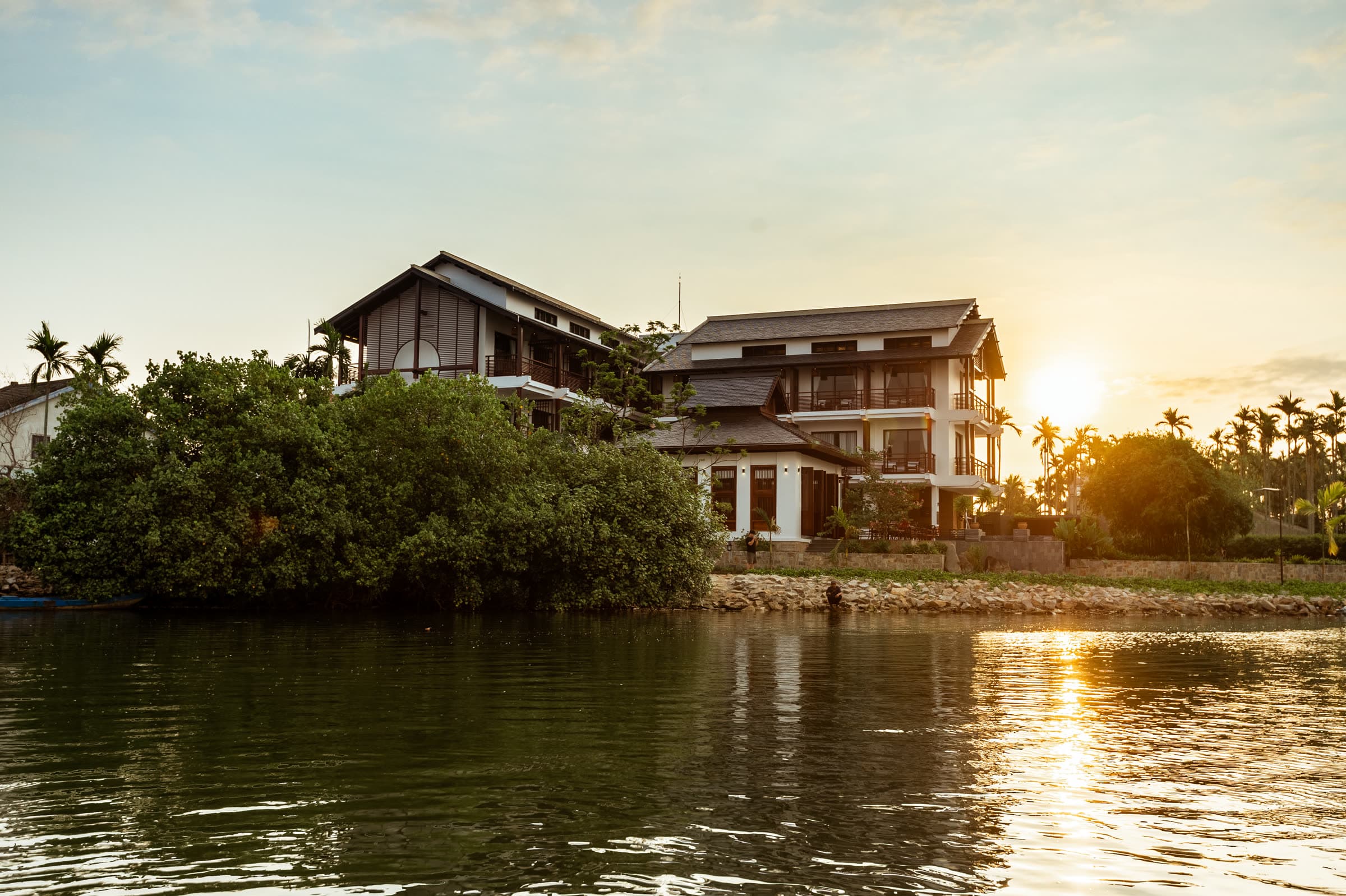
We sit on the south bank of the Thu Bồn between the Old Town and Điện Bàn — which means the Lai Nghi cemetery, the Sa Huỳnh site that yielded all those gold beads, is roughly 5 km from our front gate by bicycle along the river road (current condition of the dyke path and signage at the publicly accessible site marker needs operator verification before we publish a turn-by-turn). The same Thu Bồn that brought shuinsen into Faifo in 1604, and that brings cargo boats down to Cửa Đại today, was the conduit by which Sa Huỳnh traders moved carnelian and glass two millennia earlier. The river is the through-line.
We mention this not as marketing but as orientation: when guests ask what's worth doing beyond the Old Town and the beach, the archaeology answer is genuinely under-told, and it's twenty minutes by bicycle from where they're already standing.
What's still missing — and what comes next?
Two things. First, much of the German-language scholarship on Sa Huỳnh and early Champa — Reinecke's monograph, the KAAK Bonn working papers, and Wibke Lobo's catalogue contributions on Cham sculpture — has never been translated into English in any systematic way. Second, the on-site interpretation at Lai Nghi itself is minimal compared with Mỹ Sơn or Trà Kiệu. Both gaps are exactly the kind of thing we'd like to help close from the hotel side, with translated extracts and site visits in future posts.
About this article. This piece synthesises five Vietnamese primary sources (Báo Đà Nẵng, Báo Văn hóa, Báo Thanh Niên, VnExpress, vi.wikipedia.org) with the ISBN-verifiable German monograph by Andreas Reinecke (Neue Entdeckungen zur Sa Huynh-Kultur, Lindensoft Verlag 2002) and two English-language scholarly references (Higham 2014; Hung et al. 2013). The hotel-side contribution is the cycling-distance orientation and the layered single-day itinerary; the site-marker GPS, current museum-display status, and on-site signage will be verified locally and the post updated when confirmed.
The Sa Huỳnh (Văn hóa Sa Huỳnh) was the Iron Age culture of the central Vietnamese coast from roughly 1000 BCE to the late 2nd century CE. They practised jar burials, produced large quantities of artificial glass beads (lưu ly), and operated within East–West maritime trade networks that brought carnelian and other semi-precious stones from across the Indian Ocean.
What was found at Lai Nghi near Hội An?
Excavations from 2002 to 2004 opened 192 m² and uncovered 63 burial urns and 4 earth burials containing 108 intact pieces of gold jewelry, more than 8,600 glass beads, 1,500 semi-precious stone beads, and two unique carnelian animal pendants in the shapes of a waterfowl and a tiger — the only such objects ever found in a Sa Huỳnh context in Vietnam. The site has been C-14 dated to roughly 2,070 years old.
Did German archaeologists excavate near Hội An?
Yes. The Deutsches Archäologisches Institut (German Archaeological Institute, KAAK Bonn) was a formal partner alongside Quảng Nam Museum and Hanoi National University on the Lai Nghi excavations from 2002 to 2004, and ran further research in Quảng Ngãi in 2004–2005. The German archaeologist most often named in the Vietnamese coverage is Dr Andreas Reinecke.
What came before the Champa kingdom?
Sa Huỳnh. The Iron Age Sa Huỳnh culture occupied the central Vietnamese coast until the late 2nd century CE, immediately before the founding of Lâm Ấp in 192 CE, which evolved into the Champa kingdom. The maritime trade networks Sa Huỳnh established are widely seen as the infrastructure on which Champa's Indianised statecraft was built.
How old is Hội An?
Hội An rose as the international trading port of Faifo from the 15th through 18th centuries and was inscribed by UNESCO as a World Heritage site in 1999. But the Thu Bồn delta has been a regional trading node for at least 2,000 years — Sa Huỳnh-era cemeteries on the same river produced two-millennia-old gold jewelry and imported carnelian beadwork.
Where can I see the Lai Nghi gold jewelry today?
The Lai Nghi collection — 108 gold pieces, the carnelian waterfowl and tiger pendants, glass beads and bronze and iron artifacts — is held at Quảng Nam Museum. In October 2024 the provincial government petitioned the Ministry of Culture, Sport and Tourism to designate the assemblage as bảo vật quốc gia (national treasures).
When did Champa end?
As a sovereign kingdom Champa ended in 1471, when Đại Việt forces under Lê Thánh Tông captured the southern Champa capital of Vijaya. Cham communities and culture persisted, but the political map of central Vietnam reorganised under Đại Việt, eventually giving rise to the Faifo / Hội An trading port from the 15th century onwards.
How far is the Sa Huỳnh site at Lai Nghi from Hội An Old Town?
Lai Nghi is in Điện Nam Đông ward, Điện Bàn town, Quảng Nam — approximately five kilometres south of Hội An Old Town along the south bank of the Thu Bồn river, comfortably reachable by bicycle. Current road condition and on-site signage should be verified locally before planning a self-guided visit.
References & Sources
Andreas Reinecke et al. (2002). Neue Entdeckungen zur Sa Huynh-Kultur. Lindensoft Verlag (ISBN 3-929290-27-8).
An Trường (2025). Độc đáo bộ sưu tập đồ trang sức văn hóa Sa Huỳnh. Báo Đà Nẵng. View source
Thu Hoài (2024). Đề nghị công nhận bảo vật quốc gia: Hiện vật bộ trang sức văn hóa Sa Huỳnh. Báo Văn hóa. View source
Mạnh Cường (2024). Cư dân cổ Sa Huỳnh từng rất giàu có. Báo Thanh Niên. View source
Phương Linh (2025). Hạt chuỗi mã não hình thú — bảo vật thời cổ đại. VnExpress. View source
Bách khoa toàn thư mở Wikipedia (2024). Văn hóa Sa Huỳnh. vi.wikipedia.org. View source
Charles Higham (2014). Early Mainland Southeast Asia. River Books, Bangkok.
Hung, Hsiao-chun; Nguyen, Kim Dung; Bellwood, Peter; Carson, Mike T. (2013). Coastal Connectivity: Long-Term Trading Networks Across the South China Sea. Journal of Island & Coastal Archaeology, 8(3): 384–404.
Every room at Nghê Prana is designed around the science of sleep. Blackout curtains, nightly aromatherapy turndown, and riverside quiet — experience what real rest feels like.
Riverside hotel rooms on the Thu Bồn, ten minutes by bicycle from the Ancient Town. Whether it's one night between Hue and Da Nang or a full week of doing nothing — we kept your room quiet.
Free cancellation · Direct from the family who built the hotel


 WhatsApp
 Zalo
Zalo