Trà Quế Cầu Bông Festival 2027: Hội An's 500-Year Herb Village, Its Dates & How to Cycle There
Every spring after Tết, Hội An's ~500-year-old herb village of Trà Quế holds a flower-offering and harvest-blessing festival — Lễ hội Cầu Bông — almost unwritten-about in English. This guide separates the fixed lunar rite (mùng 7 tháng Giêng, Friday 12 February 2027) from the annually-set public program (2027 dates not yet published), states the recognitions correctly (National Intangible Cultural Heritage 2022; UN Tourism Best Tourism Village 2024 — not UNESCO), explains the river-algae fertiliser method, and shows how to cycle there from the quiet Cẩm Nam riverside.
Trà Quế is one of Hội An's oldest working villages: a grid of herb beds on a sandy spit between the Cổ Cò waterway and the Đế Võng river, about 3 km north-east of the Ancient Town, where families have grown aromatic herbs for roughly five centuries. Every spring, in the first days after Tết, the village throws a flower-offering and harvest-blessing festival — Lễ hội Cầu Bông — to thank the ancestors who cleared the beds and to pray for a good growing year. It is one of the most photographed village rites in central Vietnam and one of the least written-about in English. This guide fixes that, with the verified 2027 dates and the recognitions stated correctly.
TL;DR — The Trà Quế Cầu Bông Festival (Lễ hội Cầu Bông làng rau Trà Quế) is the herb village's annual flower-offering and harvest-blessing rite, held on a *fixed lunar date: the 7th day of the 1st lunar month (mùng 7 tháng Giêng*), with the ceremony running the 6th–7th. In 2027 that core rite falls on Friday 12 February 2027 (the eve rite on Thursday 11 February). Around it, Hội An organises an expanded public program of a herb-palanquin procession, folk games and farm-to-table cooking; those program dates are set yearly and the 2027 program dates are not yet published** — expect a provisional window in early-to-mid February 2027. Trà Quế is a flat bicycle ride from central Hội An, and we lend guests bikes from the quiet Cẩm Nam riverside.
What is the Trà Quế Cầu Bông festival?
Cầu Bông means, literally, to pray for blossom — for the flowering and fruiting of the crop. It is a folk agricultural rite of gratitude and petition: the villagers thank the tiền hiền, the founding ancestors who first cleared and settled the herb beds, and pray to Thần Nông, the deity of agriculture, for a year of mild weather and good harvests (mưa thuận gió hòa, mùa màng tươi tốt). Unlike the fishing wards' whale rites or the carpenters' guild ceremony, Cầu Bông is a farmers' festival — its offerings are seedlings, herbs and the first produce of the year.
The rite belongs to a wider agrarian calendar. Preparation begins before Tết with the raising of the ceremonial cây nêu pole on the 24th of the last lunar month; the deities are welcomed and the eve offering (cúng túc, or túc yết) is made on the 6th day of the first lunar month; and the main ceremony — the incense offering and the rite to Thần Nông — is held on the morning of the 7th. It is a small, working-village ceremony, not a staged spectacle, which is precisely why it is worth seeing.
When is the Trà Quế Cầu Bông festival in 2027?
As with Hội An's other village festivals, two dates behave differently — and most listings blur them together.
The rite itself is fixed by the lunar calendar. The Cầu Bông ceremony is always held on mùng 7 tháng Giêng — the 7th day of the 1st lunar month — with the eve rite the day before. In 2027, Tết (lunar 1/1) falls on Saturday 6 February, so the 7th day of the first lunar month lands on Friday 12 February 2027, with the eve offering on Thursday 11 February 2027. Because it is anchored to the lunar calendar, this date is knowable years ahead. For reference, the 2026 edition (Year of the Horse) peaked on the morning of 23 February 2026.
The expanded public program is set annually and varies. Separately from the fixed rite, Hội An and Quảng Nam tourism authorities build a larger public festival around it — the version with the full herb-palanquin procession, folk-game contests, cooking demonstrations and bài chòi singing — and those dates shift year to year. As of this writing, the 2027 public-program dates have not been officially published. We will not invent them: expect a window in early-to-mid February 2027, close to the fixed rite, but treat that as provisional until Hội An Tourism confirms. We will update this post the moment the official 2027 program is announced.
In short: for the traditional ceremony, plan around Friday 12 February 2027. For the fuller public program with the procession and games, watch this space for the official date and keep your plans flexible.
Trà Quế: the 500-year herb village
Trà Quế sits in the former Cẩm Hà commune, on the northern edge of Hội An, ringed by water. Vietnamese heritage records trace its settlement to around the 16th century, when migrants from the north of Đại Việt cleared the sandy ground to farm; the vegetable-growing craft here now counts more than 400 years, and the village likes to round it to five centuries. Today roughly two hundred households work about forty hectares of beds, growing the intensely aromatic herbs — húng, tía tô, rau răm, hành, ngò and dozens more — that season Hội An's kitchens.
The village's signature is its fertiliser. Instead of chemicals, Trà Quế growers rake up rong — the green algae and waterweed that grows in the neighbouring Đế Võng river and Cổ Cò waterway — and work it into the sandy beds. Vietnamese researchers credit this river-algae method, together with the particular sandy soil, for the concentrated aroma that makes Trà Quế herbs smaller, firmer and more fragrant than the same species grown elsewhere. The raking, drying and bedding of the rong is itself part of the heritage the village is recognised for.
Those recognitions are worth stating precisely, because they are often garbled in English. In April 2022 the vegetable-growing craft of Trà Quế (Nghề trồng rau Trà Quế) was inscribed on Vietnam's National Intangible Cultural Heritage list by the Ministry of Culture, Sports and Tourism (Bộ VHTTDL), under Decision 748/QĐ-BVHTTDL, in the category of folk knowledge and traditional craft — a national listing that expressly includes the customs, beliefs and festivals tied to the trade, Cầu Bông among them. In November 2024, Trà Quế was then named a UN Tourism (UNWTO) Best Tourism Village, one of 55 villages worldwide chosen that year, at a ceremony in Colombia. Both are real and significant — but neither is a UNESCO inscription. (Hội An's Ancient Town is a UNESCO World Heritage Site; Trà Quế's own honours are the national-heritage listing and the UN Tourism award, not a UNESCO one.)
Herb-and-vegetable beds in central Vietnam, worked much like Trà Quế's. (Illustrative; photographed in the Đà Nẵng area, not at Trà Quế itself.) · Luống rau ở miền Trung, canh tác tương tự làng rau Trà Quế.
What happens: procession, folk games and farm cooking
The public festival turns the herb beds into a stage. Drawing on Hội An's heritage-centre accounts and coverage of recent editions, expect roughly these elements.
The garden-blessing ceremony and herb procession. After the incense offering to Thần Nông, villagers carry a palanquin (kiệu) heaped with vegetables and herbs — a moving still-life of the year's first produce — in procession through the lanes, a public thanksgiving for the harvest to come.
Folk games drawn from farm work. The games are the fields turned into sport: contests for hoeing and raising the beds (cuốc đất, vun luống), best-grower competitions, tug-of-war (kéo co) and wrestling, alongside a contest for wrapping tôm hữu, the village's signature shrimp specialty. Visitors are handed hoes and seedlings and invited to plant a bed themselves — the festival is participatory by design.
Farm-to-table cooking and bài chòi. Cooks turn the just-picked herbs into Trà Quế classics — tôm hữu, bánh xèo and heaped plates of fresh herb salad — while bài chòi, the UNESCO-listed folk singing-game of central Vietnam, keeps the crowd. It is, in effect, a slow-food fair with five centuries of provenance.
Hand-tending the beds — the everyday labour the Cầu Bông festival gives thanks for. (Illustrative rural-Vietnam farm photo.) · Chăm sóc luống rau bằng tay — công việc nhà nông mà lễ Cầu Bông tri ân.
The herbs on your Hội An plate
Planning a trip around this? See dates at our quiet riverside hotel on the Thu Bồn. Check availability →
Trà Quế is not a museum village; it is a supplier. Its herbs travel the three kilometres into Hội An every morning and end up in the town's signature dishes — the fresh-herb tangle that finishes a bowl of cao lầu or mì Quảng, the rau sống beside grilled pork, the mint and coriander folded into bánh xèo. When Hội An cooking is described as tasting of its place, a good part of that place is Trà Quế. Our own kitchen leans on the same central-Vietnam herb tradition, which is why we point guests up the road to see where it grows.
The aromatic herbs central-Vietnam cooking is built on — Trà Quế's stock-in-trade. (Illustrative Vietnamese-herb photo.) · Rau thơm — thứ làm nên vị của ẩm thực miền Trung và là sản vật của Trà Quế.
How do you get to Trà Quế from Hội An?
Trà Quế sits about 3 km north-east of the Ancient Town, on the road toward Cửa Đại and An Bàng beach, and the nicest way to reach it is by bicycle. From central Hội An it is a flat 15-minute ride through paddies and vegetable land. From our side of the river at Cẩm Nam it is a little further — a flat, mostly lane-and-riverside pedal of roughly 20–30 minutes (about 4–5 km), crossing into town and out along the Đế Võng — but it is genuinely a ride, not a taxi trip. We lend guests bicycles, so you can leave after breakfast, watch the beds being worked, and be back by the river for lunch.
Where to stay: the quiet Cẩm Nam riverside
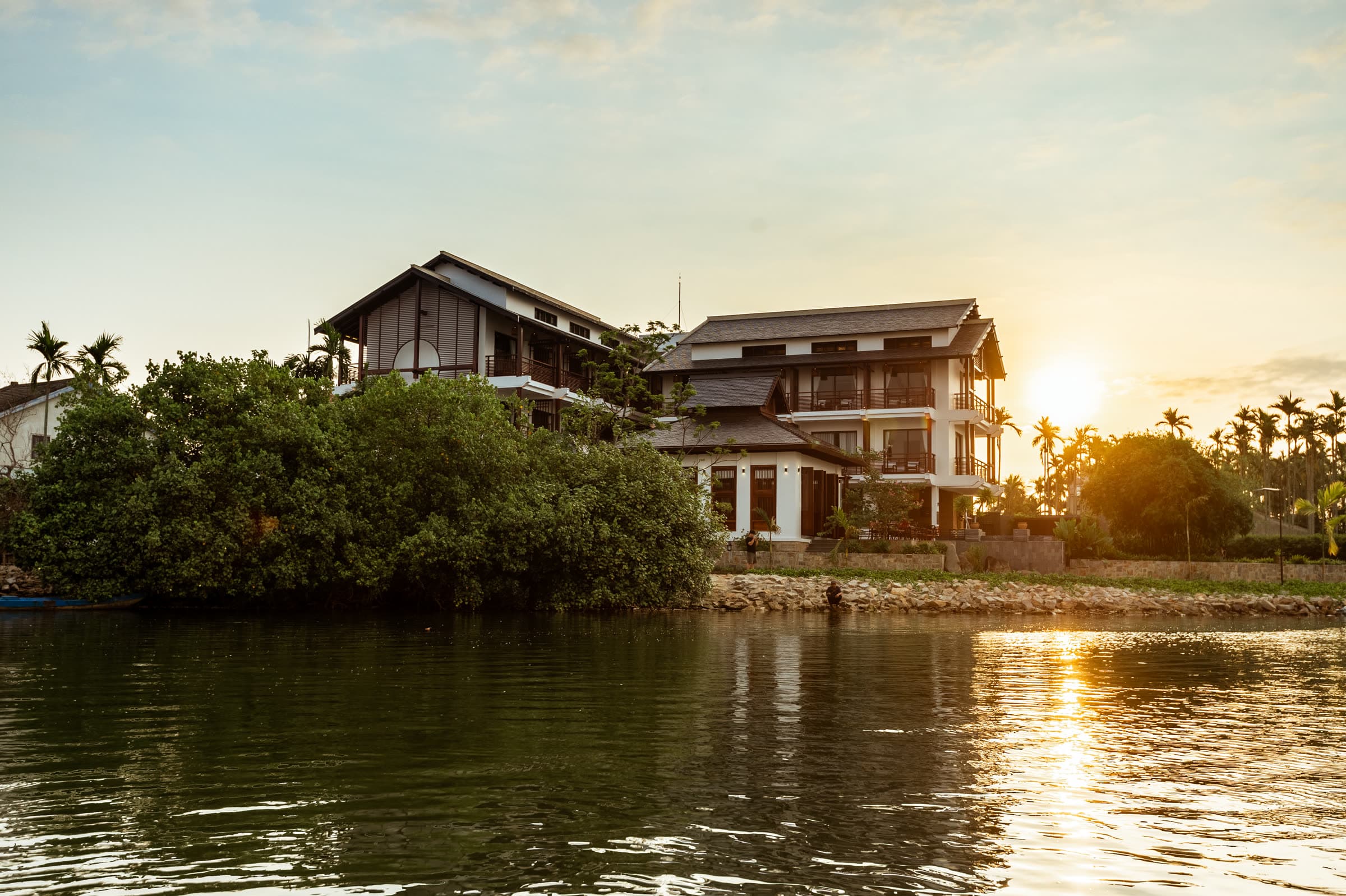
Nghê Prana is a riverside hotel on the Thu Bồn, on the calm Cẩm Nam side of Hội An — away from the crowds of the pedestrian Old Town but still within easy cycling distance of both the Ancient Town and the herb village. It makes Trà Quế an unhurried morning: coffee by the water, bikes over the bridge, the Cầu Bông beds in the cool of the day, and quiet river again by afternoon. See our rooms for the riverside layout.
Frequently Asked Questions
When is the Trà Quế Cầu Bông festival in 2027?
The core rite is fixed to the 7th day of the 1st lunar month (mùng 7 tháng Giêng), which in 2027 is Friday 12 February 2027, with the eve ceremony on Thursday 11 February. The larger public program is set annually by Hội An Tourism and the 2027 dates are not yet published; expect a provisional early-to-mid-February window. We will update this post when the official program is confirmed.
What is the Cầu Bông festival?
It is Trà Quế herb village's annual flower-offering and harvest-blessing rite, thanking the founding ancestors (tiền hiền) and praying to the agriculture deity Thần Nông for a good growing year. It combines a solemn ceremony with a herb-palanquin procession, farm-themed folk games and farm-to-table cooking.
Where is Trà Quế village?
Trà Quế is a herb-and-vegetable village in the former Cẩm Hà commune, about 3 km north-east of Hội An's Ancient Town, ringed by the Đế Võng river and Cổ Cò waterway in Quảng Nam, central Vietnam.
Is Trà Quế a UNESCO site?
No — and it is worth being precise. Trà Quế's vegetable-growing craft is a Vietnamese National Intangible Cultural Heritage (recognised by Bộ VHTTDL in 2022), and the village was named a UN Tourism (UNWTO) Best Tourism Village in 2024. Neither is a UNESCO listing. Hội An's nearby Ancient Town is the UNESCO World Heritage Site.
Why are Trà Quế herbs special?
The village fertilises its beds with rong, the river algae and waterweed raked from the neighbouring waterways, instead of chemicals. That traditional method, with the sandy soil, gives the herbs their concentrated aroma — and it is part of the heritage the village is recognised for.
How do I get to Trà Quế from Hội An?
By bicycle: about 3 km (a flat 15-minute ride) from the Ancient Town, or roughly 20–30 minutes from the Cẩm Nam riverside. It is an easy, flat pedal through farmland; we lend guests bikes.
Can visitors join in the festival?
Yes. Cầu Bông is participatory — visitors are invited to try hoeing and planting a bed, watch or join the folk games, and taste farm-to-table dishes like tôm hữu and bánh xèo made with just-picked herbs.
This article synthesises Vietnamese-language coverage of the Lễ hội Cầu Bông làng rau Trà Quế from the Đà Nẵng and Quảng Nam government portals, the Hội An heritage-conservation centre (hoianheritage.net / hoianworldheritage.org.vn), the Hội An city portal, VTV and VietnamPlus, cross-checked against the fixed lunar anchor for 2027 (Tết on 6 February, placing mùng 7 tháng Giêng on 12 February) and the recognition records (Decision 748/QĐ-BVHTTDL, 2022; UN Tourism Best Tourism Village, 2024). The hotel-side contribution is the verified rite-date conversion, the precise recognition wording, and the cycling route and bikes we provide from the Cẩm Nam riverside.
The core rite is fixed to the 7th day of the 1st lunar month (mùng 7 tháng Giêng), which in 2027 is Friday 12 February 2027, with the eve ceremony on Thursday 11 February. The larger public program is set annually by Hội An Tourism and the 2027 dates are not yet published; expect a provisional early-to-mid-February window. We will update this post when the official program is confirmed.
What is the Cầu Bông festival?
It is Trà Quế herb village's annual flower-offering and harvest-blessing rite, thanking the founding ancestors (tiền hiền) and praying to the agriculture deity Thần Nông for a good growing year. It combines a solemn ceremony with a herb-palanquin procession, farm-themed folk games and farm-to-table cooking.
Where is Trà Quế village?
Trà Quế is a herb-and-vegetable village in the former Cẩm Hà commune, about 3 km north-east of Hội An's Ancient Town, ringed by the Đế Võng river and Cổ Cò waterway in Quảng Nam, central Vietnam.
Is Trà Quế a UNESCO site?
No — and it is worth being precise. Trà Quế's vegetable-growing craft is a Vietnamese National Intangible Cultural Heritage (recognised by Bộ VHTTDL in 2022), and the village was named a UN Tourism (UNWTO) Best Tourism Village in 2024. Neither is a UNESCO listing. Hội An's nearby Ancient Town is the UNESCO World Heritage Site.
Why are Trà Quế herbs special?
The village fertilises its beds with rong, the river algae and waterweed raked from the neighbouring waterways, instead of chemicals. That traditional method, with the sandy soil, gives the herbs their concentrated aroma — and it is part of the heritage the village is recognised for.
How do I get to Trà Quế from Hội An?
By bicycle: about 3 km (a flat 15-minute ride) from the Ancient Town, or roughly 20–30 minutes from the Cẩm Nam riverside. It is an easy, flat pedal through farmland; we lend guests bikes.
Can visitors join in the Trà Quế festival?
Yes. Cầu Bông is participatory — visitors are invited to try hoeing and planting a bed, watch or join the folk games, and taste farm-to-table dishes like tôm hữu and bánh xèo made with just-picked herbs.
References & Sources
Cổng thông tin điện tử thành phố Đà Nẵng (2025). Lễ hội Cầu Bông Trà Quế. danang.gov.vn. View source
Trung tâm Quản lý Bảo tồn Di sản Văn hóa Hội An (2022). Nghề trồng rau Trà Quế — quá trình xây dựng hồ sơ công nhận Di sản văn hóa phi vật thể quốc gia. hoianheritage.net. View source
Trung tâm QLBT Di sản Văn hóa Hội An (2026). Đông đảo du khách tham gia lễ hội cầu bông Trà Quế. hoianworldheritage.org.vn. View source
Cổng thông tin điện tử tỉnh Quảng Nam (2024). Lễ hội Cầu Bông tại làng rau Trà Quế. quangnam.gov.vn. View source
Đài Truyền hình Việt Nam (VTV) (2026). Hội An: Rộn ràng Lễ hội Cầu Bông, đánh thức sức sống làng rau di sản Trà Quế. vtv.vn. View source
Báo Công an Nhân dân (2022). Nghề trồng rau Trà Quế được công nhận Di sản văn hóa phi vật thể Quốc gia. cand.com.vn. View source
VietnamPlus (TTXVN) (2024). Tra Que vegetable village in Hoi An named among best tourism villages 2024. vietnamplus.vn. View source
Cổng thông tin điện tử thành phố Hội An (2026). Sự kiện văn hóa — Lễ hội Cầu Bông làng rau Trà Quế. hoian.gov.vn. View source
Every room at Nghê Prana is designed around the science of sleep. Blackout curtains, nightly aromatherapy turndown, and riverside quiet — experience what real rest feels like.
Riverside hotel rooms on the Thu Bồn, ten minutes by bicycle from the Ancient Town. Whether it's one night between Hue and Da Nang or a full week of doing nothing — we kept your room quiet.
Free cancellation · Direct from the family who built the hotel


 WhatsApp
 Zalo
Zalo