The honest answer: most Hoi An hotels marketed as "5 minutes from the Old Town" are an 8-to-15 minute walk to the Japanese Covered Bridge (Chùa Cầu) at a normal pace, and 15-to-25 minutes in the June heat. A small number of properties are genuinely 200–400 metres from the bridge. The difference matters when your luggage is in one hand and the temperature is 33°C.
"Five minutes" on a Booking.com listing is a category convention, not a stopwatch reading. The same shorthand appears in hotel listings worldwide. It usually means "near enough that walking is plausible" rather than a measured time. This post is not a critique of the convention — it is a translator. If you know how to read it, you can match the right neighbourhood to your trip.
The reference point: where the Japanese Bridge actually sits
The Japanese Covered Bridge spans a small canal between Trần Phú Street and Nguyễn Thị Minh Khai Street in the centre of Hội An's Old Town. It is the emblem on Vietnam's 20,000 đồng note, an 18-metre footbridge with a small temple at its north end, and the geographic anchor every Hội An listing references. (Source: Wikipedia, "Japanese Bridge".)
Walking pace varies more than people expect. A relaxed cool-month pace in Hội An is roughly 4 km/h. In summer — when daytime temperatures regularly reach 33–37°C with humidity around 80–85% (Weather Atlas, Hội An climate) — a sustainable pace with a small bag is closer to 3 km/h, and most travellers stop in shade every 10 minutes. The same 1.0 km that reads as 15 minutes in March can feel like 22 minutes in late June.
Hotels in or on the edge of the Old Town pedestrian core
Vinh Hung Heritage Hotel sits at 143 Trần Phú Street, roughly 200 metres from the Japanese Bridge — about 3 minutes at any pace. The property is a two-storey heritage house entirely built from wood. (Booking.com, Tripadvisor listings.)
Vinh Hung Old Town Hotel is in the same family group, also inside the heritage core. Both properties are inside the pedestrian zone, which means cars cannot drop you at the door during Old Town vehicle-restriction hours.
Allegro Hoi An sits roughly 400 metres from the Japanese Bridge and 700 metres from the An Hội night market footbridge — a 5-to-7-minute walk, comfortable even in summer. (Hotel listing, official site.)
Properties inside the heritage core trade walking distance for two trade-offs: Old Town pedestrian-hour restrictions on vehicle access, and the soundscape of a tourist street that stays loud until 22:30. If you want zero-walk access to the bridge and you are travelling with a light bag, this is the right tier.
Hotels on the Old Town's south edge — Cẩm Nam side
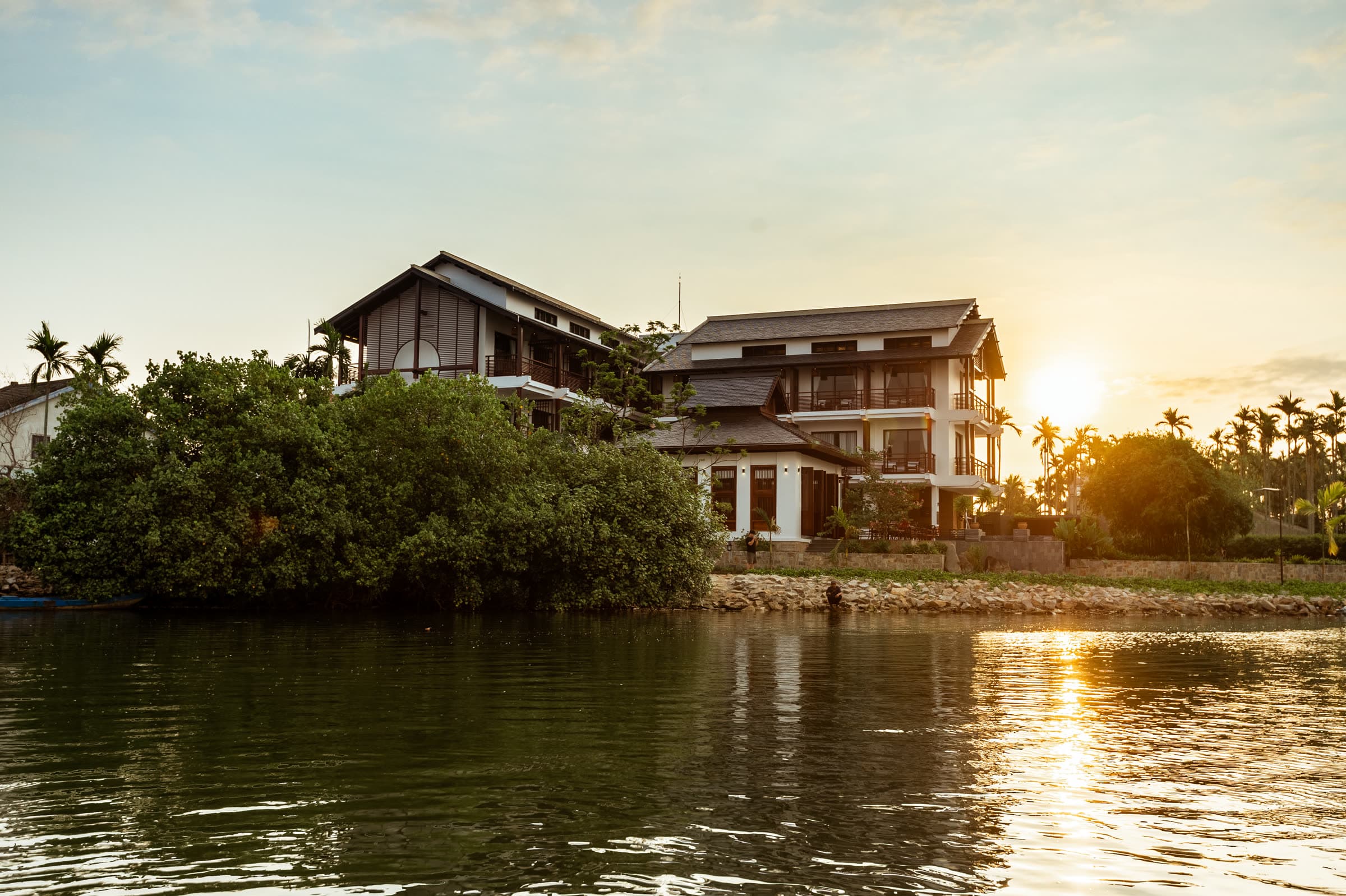
Cẩm Nam is the residential island directly south of the Old Town across the An Hội footbridge. From a typical Cẩm Nam riverside hotel like Nghê Prana on Hẻm 384 Nguyễn Tri Phương, the walk to the Japanese Bridge is roughly 1.0–1.2 km — about 12–15 minutes at a cool-pace 4 km/h, or 18–22 minutes in heat at 3 km/h. The route crosses the Cẩm Nam bridge or the An Hội footbridge into the pedestrian core.
The trade is structural: Cẩm Nam puts a river between you and the night-market noise without putting a taxi between you and dinner. We chose this side of the river specifically because the walk back at 22:00 is the quietest part of the day in Hội An — see our Cẩm Nam, Cẩm Kim, Cẩm Thanh quiet-islands guide for the geography in full.
Hotels in Cẩm Châu and along the Đỗ Đăng Tuyển corridor
Cẩm Châu is the ward immediately east of the Old Town. Properties along Đỗ Đăng Tuyển and the lanes off Lý Thường Kiệt are typically 1.2–1.8 km from the Japanese Bridge — 15-to-22 minutes at cool pace, 22-to-30 minutes in summer heat. Several mid-range hotels here describe themselves as "5–10 minutes" to Old Town, which is accurate by bicycle and optimistic on foot.
Planning a trip around this? See dates at our quiet riverside hotel on the Thu Bồn. Check availability →
Anantara Hoi An Resort sits on the Thu Bồn River less than a kilometre from the Old Town heritage core; the Tripadvisor consensus is a 10-to-15-minute walk along the riverside, which matches the GPS distance. (Anantara official site; Tripadvisor reviews.)
Hotels in Cẩm An and An Bàng — the beach side
An Bàng beach sits in Cẩm An ward, 4–5 km from the Japanese Bridge depending on the route, with most sources citing 4 km along Hai Bà Trưng Street. (BestPriceTravel, Vinpearl Hội An guides.) That is a 50-to-65-minute walk — meaning beach-side properties are functionally not walkable to Old Town. The standard transport is a 10-minute bicycle ride, a 12-minute scooter taxi, or a 15-minute Grab car.
Beach-side properties are the right choice if your trip's centre of gravity is the sand and you treat Old Town as one or two evenings. They are the wrong choice if Old Town is your daily anchor.
A reading guide for Booking.com listings
Three habits help. First: ignore the listing's stated walking time and look at the GPS pin relative to Trần Phú or Nguyễn Thái Học. Second: assume a 4 km/h pace in cool months and 3 km/h between May and August. Third: cross-reference with Google Maps walking directions, which use a 5 km/h baseline that runs slightly fast for Hội An's pedestrian streets and tropical air.
If you want to step out of the door into the lantern-lit lanes and you have one bag: Old Town heritage. If you want a quiet night and a 12-minute walk back from dinner: south bank — Cẩm Nam. If you want morning swims and accept that Old Town is a 12-minute scooter trip: An Bàng. None of these is wrong. They are different trips.
The "5 minutes" line on a listing is a marketing genre, like "cosy" or "stone's throw." Treat it the way you treat a recipe time: a starting point, not a stopwatch. The walk is part of how you meet the town.
Every room at Nghê Prana is designed around the science of sleep. Blackout curtains, nightly aromatherapy turndown, and riverside quiet — experience what real rest feels like.
Riverside hotel rooms on the Thu Bồn, ten minutes by bicycle from the Ancient Town. Whether it's one night between Hue and Da Nang or a full week of doing nothing — we kept your room quiet.
Free cancellation · Direct from the family who built the hotel


 WhatsApp
 Zalo
Zalo