Kerala is the home of Ayurveda — and we are not
Ayurveda is a south-Indian tradition with a five-thousand-year continuous lineage. Kerala specifically holds the state apparatus around it — the government-certified practitioner system, the classical Sanskrit texts in daily use, the gurukula training system, the karkidakam monsoon protocols. We want to be completely clear up front: Nghê Prana does not offer Ayurveda. We are not Kerala-trained, we do not perform Shirodhara, Abhyanga, Nasya, or panchakarma, and we make no claim to that lineage. What we offer is a different tradition — the Vietnamese herbal tradition, thuốc nam, on the Thu Bồn River. This page exists because travellers genuinely weigh the two, and the honest comparison helps you choose the right one.
Who Kerala is right for
Choose Kerala if you want authentic Ayurveda. There is no substitute, and we would never pretend to be one. Choose Kerala if you can give it twenty-one to thirty consecutive days — the traditional panchakarma, the seven-stage cleanse that classical Ayurveda was built around, requires that length and cannot be compressed. Choose Kerala if you specifically want karkidakam, the monsoon protocol that runs roughly June through August. Choose Kerala if Ayurveda is the entire purpose of the trip and you want the depth, the lineage, and the institutional structure that only the source can provide.
Who Hội An is right for
Choose Hội An if you want a quieter, lighter herbal reset rather than a clinical Ayurvedic programme — and if you are happy that it is a Vietnamese tradition, not an Indian one. Choose Hội An if the appeal is warm-compress and warm-oil massage, a Himalaya hot-stone treatment, and a Vietnamese herbal steam and bath, woven into days that also hold a walkable UNESCO town, a quiet riverside room, and a beach twenty-five minutes by bicycle. Choose Hội An if you are travelling from East Asia, Australia, or Western Europe and want airport-to-spa under an hour. The Vietnamese herbal tradition is its own deep, distinct lineage — it is not Ayurveda made smaller.
What the Vietnamese herbal tradition actually looks like in our spa
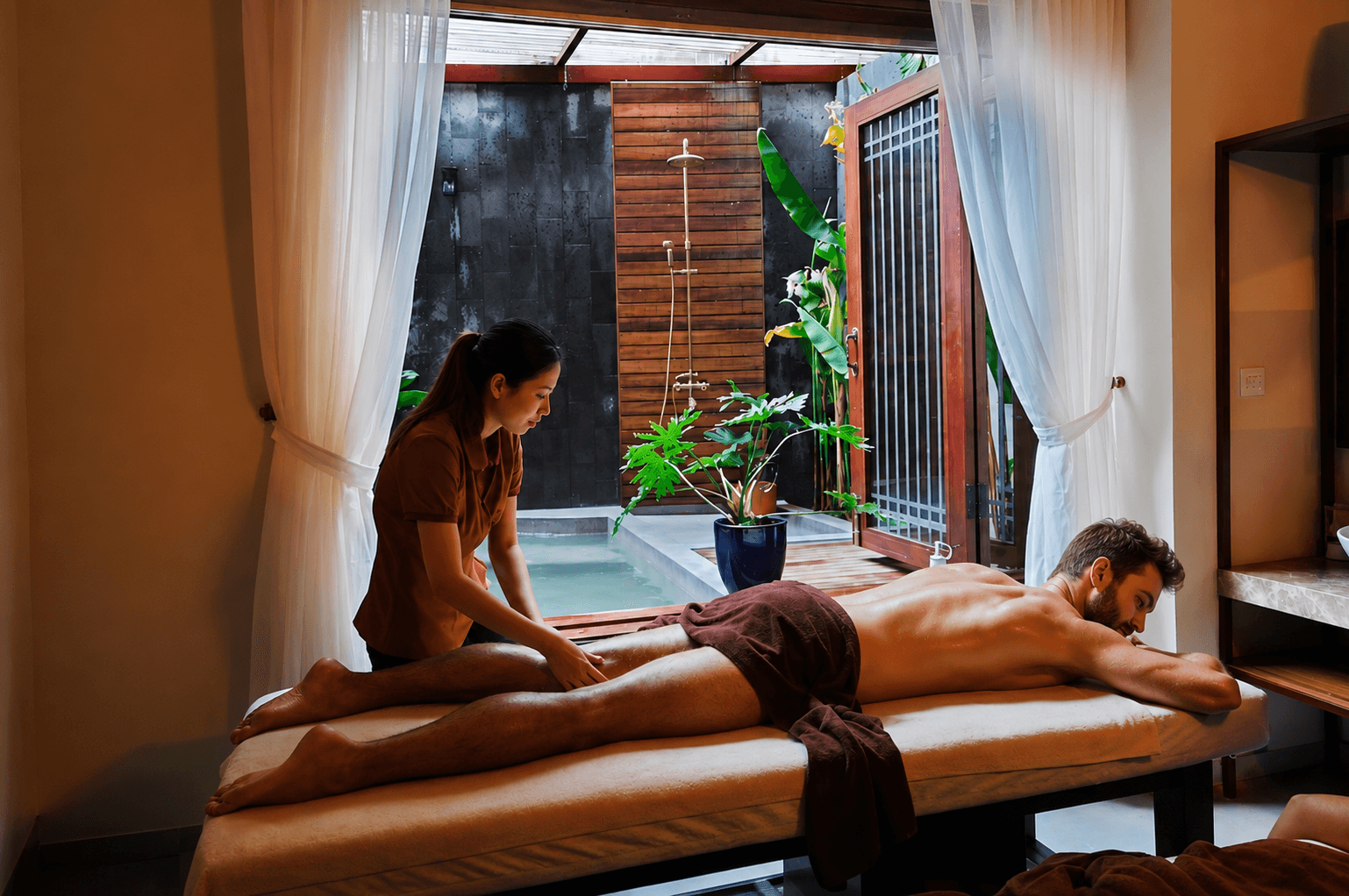
Our spa works in the Central Vietnamese herbal tradition (thuốc nam), not the Ayurvedic one. The signature is the warm túi chườm compress — lemongrass, ginger, turmeric, and pomelo leaf bundled into cloth, steamed, and pressed along the body — used on its own or layered into a warm-oil massage. Alongside it we offer Himalaya hot-stone work, a Vietnamese herbal steam (xông hơi) and herbal bath drawn from Trà Quế village herbs, reflexology, body scrubs, and facials. Treatments run roughly one to two hours and are booked by appointment rather than sequenced into a multi-week clinical arc — this is a riverside spa, not a panchakarma centre.
Two different lineages, not two versions of one
Thuốc nam is its own lineage, not a version of Ayurveda. Ayurveda has its dosha framework, its Sanskrit canon, its panchakarma sequencing; thuốc nam has its own materia medica, its warm-compress and herbal-steam methods, its roots in Vietnamese village medicine. Both are legitimately deep. They are simply different. So the takeaway is plain: for authentic Ayurveda, go to Kerala. For the Vietnamese herbal tradition on a quiet river — warm compresses, warm oil, hot stone, herbal steam — come to Hội An.