The honest summary, before the long version
Ubud and Hoi An are both legitimately good answers to the question "where in Southeast Asia should I go for a wellness reset?" The differences are real, but they are not ideological — they are practical. Ubud is the more famous brand and the easier first choice. Hoi An is quieter, more affordable, and structurally better suited to people who came to actually rest. Below is the honest version of how the two compare, written from a riverside hotel that watches both communities closely.
Wellness depth — and what each tradition actually offers
Ubud is built on a few overlapping wellness traditions: Balinese folk medicine (boreh, lulur, jamu), the international yoga circuit (Yoga Barn and similar), and a recent layer of breathwork, sound healing, and visiting Ayurvedic teachers. The yoga infrastructure is mature; the Ayurveda is largely imported.
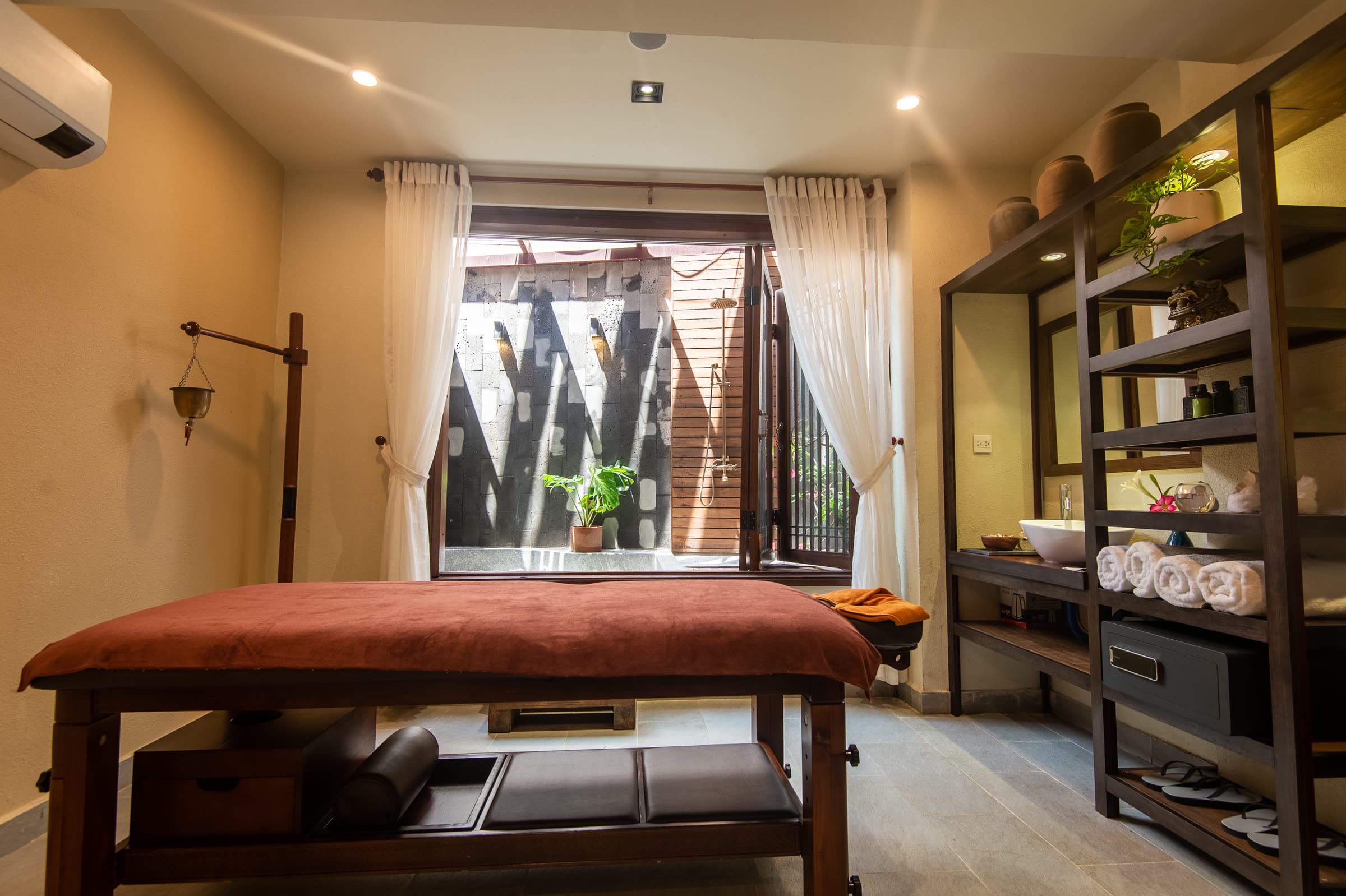
Hoi An's wellness layer is anchored in the Central Vietnamese herbal tradition (thuốc nam) — lemongrass, ginger, turmeric, and pomelo leaf bundled into warm túi chườm compresses, herbal baths drawn from Trà Quế garden herbs, warm-oil massage, and Himalaya hot-stone work. To be clear, we do not offer Ayurveda; for Ayurveda, Kerala (or Bali, with its imported teachers) is the place to go. That is the honest contrast: Ubud layers in imported Ayurveda on top of its Balinese roots, while Hội An offers a distinct, indigenous Vietnamese herbal lineage instead — a different tradition, not a version of the same one.
Crowds, scale, and what a "quiet morning" actually means
Ubud has had a tourism problem since the late 2010s. The central streets and the famous Tegalalang rice terraces carry constant scooter traffic and tour-bus density that do not relent during the day. Some retreats sit far enough outside the centre to absorb this, but the cost is access — you commute to your yoga class.
Hoi An's Ancient Town has its own density problem, concentrated between 14:00 and 22:00. The crucial difference is that staying on the south bank — at Cẩm Nam, on the Thu Bồn River — puts you in a residential ward with no through traffic, no bar zone, and no tour buses, ten minutes by bicycle from everything. The riverside morning in Hoi An is quieter than any morning in Ubud, full stop.
Cost, honestly
Ubud's pricing has compressed upward over the last five years. A reputable wellness retreat with daily yoga and five treatments now runs $1,800–$3,500 for a 7-night stay. Hoi An's equivalent runs $850–$1,400. The gap is not about quality — it is about land value, taxes, and international demand. Treatments at our spa start at 450,000 VND (about $18), VAT included. Our own riverside rooms start at $40/night.
Climate and the question of "best time to go"
Ubud is most reliable May to September. Hoi An's window is longer — March through August is dry, warm, and stable, with sea breezes in the afternoon. Both have wet seasons; Hoi An's includes a flood window in October and November during which the lower Old Town can briefly flood. The Cẩm Nam south bank is built above the flood line. For an unbroken wellness stay, March to August in Hoi An is the most reliable weather window in either destination.
How to choose
Choose Ubud if the wellness brand matters to you, if you specifically want the established yoga shala scene, if your wellness practice is the only thing on your trip, or if you have already been to Vietnam and want a different country.
Choose Hoi An if you want the same depth for less money, if you want a wellness reset plus a UNESCO town plus a beach in the same week, if you want a distinct Vietnamese herbal tradition (not Ayurveda) on a quiet river, if you came for sleep more than for performance, or if Bali feels overrun and you want to find what Ubud was in 2008.