Fête Cầu Ngư 2027 (fête maritime du culte de la baleine) : l'édition de Hội An, dates et comment y assister
La fête Cầu Ngư (culte de la baleine) est une fête maritime classée au patrimoine culturel immatériel national, tenue chaque printemps après le Tết le long de la côte de Đà Nẵng et de Quảng Nam — dont une édition à Hội An Đông, sur le rivage de Cửa Đại. Ce qu'elle est, la fenêtre honnête de 2027, la procession lễ nghinh Ông et comment y assister depuis Hội An.
Le long de la côte du Centre-Vietnam, dans les semaines qui suivent le Tết, les communautés de pêcheurs — de Hội An jusqu'aux quartiers de Đà Nẵng — célèbrent l'une des plus anciennes et des plus méconnues fêtes maritimes de la région : la fête Cầu Ngư (Lễ hội Cầu Ngư), la fête du culte de la baleine, ou « prière des pêcheurs ». Classée patrimoine culturel immatériel national, elle emplit des plages entières de processions, d'opéra populaire et de jeux de bateaux — et presque rien à son sujet, en particulier sur son édition de Hội An, n'existe en anglais.
Ce guide comble cette lacune. Il synthétise la couverture en vietnamien de la fête 2026 de Hội An Đông (Báo Văn hóa, vietnam.vn, le Centre du patrimoine mondial de Hội An) et les archives patrimoniales du portail de la ville de Đà Nẵng (danang.gov.vn) et de Danang Fantasticity, pour répondre aux questions que les pages anglaises passent sous silence : ce qu'est réellement la fête Cầu Ngư, quand elle devrait tomber en 2027, où elle se tient près de Hội An et comment vous pouvez y assister avec respect.
La flotte de pêche de Đà Nẵng — les équipages côtiers honorés par la fête Cầu Ngư. / Đội tàu cá Đà Nẵng — những ngư dân miền biển mà Lễ hội Cầu Ngư tôn vinh.
L'essentiel
Quoi : la fête Cầu Ngư (culte de la baleine / prière des pêcheurs), en l'honneur de Cá Ông — la baleine vénérée sous le nom d'Đức Ông Nam Hải, protecteur des pêcheurs.
Patrimoine : inscrite au patrimoine culturel immatériel national (l'édition de Đà Nẵng a été certifiée en 2016).
Quand en 2027 : pas encore publié. À prévoir fin mars – début avril 2027 (l'édition de Hội An tombe au deuxième mois lunaire après le Tết) ; dates officielles à confirmer par le tourisme de Quảng Nam / Đà Nẵng. Nous mettrons cette page à jour dès leur publication.
Où près de Hội An : phường Hội An Đông (l'ancien quartier de Cẩm An), sur la côte de Cửa Đại, près de la plage d'An Bàng.
Rite central :lễ nghinh Ông — une procession terrestre et maritime pour accueillir le dieu-baleine sur le rivage.
Qu'est-ce que la fête Cầu Ngư ?
Cầu Ngư signifie littéralement « prier pour le poisson ». En son cœur se trouve le culte de Cá Ông (« Seigneur Poisson ») — la baleine, vénérée sur toute la côte du Centre et du Sud du Vietnam sous le nom de Đức Ông Nam Hải, divinité de la mer du Sud qui abrite les pêcheurs dans la tempête et les guide jusqu'au port. Les villages de pêcheurs conservent les ossements des baleines échouées dans un sanctuaire (lăng Ông) et considèrent une baleine échouée comme une bénédiction, pleurée et inhumée avec tous les rites. La fête est l'acte annuel de gratitude de la communauté envers ce protecteur, et une prière collective pour ce que souhaite chaque famille de pêcheurs : trời yên biển lặng — un ciel clément, une mer étale, des bateaux en sécurité et des filets pleins.
La fête est bien plus que du folklore. En 2016, le ministère de la Culture, des Sports et du Tourisme a inscrit la fête Cầu Ngư de Đà Nẵng au patrimoine culturel immatériel national (Di sản văn hóa phi vật thể quốc gia), l'une des nombreuses traditions Cầu Ngư côtières — dont celle de Phú Yên — à obtenir ce statut national. C'est une observance religieuse vivante, portée par des communautés de pêcheurs en activité, et non un spectacle touristique mis en scène.
Quand a lieu la fête Cầu Ngư en 2027 ?
Soyons honnêtes : les dates de 2027 ne sont pas encore publiées, et nous ne les inventerons pas. La fête est calée sur le calendrier lunaire, et non sur une date grégorienne fixe, et les différents villages tiennent leurs éditions à des jours distincts au fil des semaines qui suivent le Tết. Ce que nous pouvons vous donner, c'est une fourchette fondée sur les faits. La fête de Hội An Đông s'est tenue en 2026 du 2 au 4 avril 2026, ce qui correspondait au 15e–17e jour du deuxième mois lunaire (année du Cheval). Comme le Tết 2027 tombe le 6 février 2027, le même calage au deuxième mois lunaire situerait l'édition 2027 de Hội An de fin mars à début avril 2027.
Édition
Date de référence
Calage lunaire
Statut 2027
Hội An Đông (Cửa Đại)
2–4 avril 2026
15e–17e, 2e mois lunaire
Estimation : fin mars – début avril 2027, à confirmer
Quartiers de Đà Nẵng (Thanh Khê, Mân Thái…)
févr.–mars 2025
1er–2e mois lunaire après le Tết
Estimation : févr.–mars 2027, selon le quartier
Considérez-la comme une fourchette de planification, non comme une garantie de réservation. Les sources vietnamiennes elles-mêmes divergent sur le point de savoir si l'édition de Hội An se situe au deuxième ou au troisième mois lunaire, ce qui explique précisément pourquoi une date 2027 « vérifiée » mais devinée serait pire qu'une fourchette honnête. Dès que le tourisme de Quảng Nam ou de Đà Nẵng publiera le calendrier officiel 2027, nous mettrons cette page à jour avec les jours confirmés.
Le déroulement : la procession lễ nghinh Ông
Le cœur cérémoniel est le lễ nghinh Ông — le rite d'accueil du dieu-baleine. Lors de la fête de Hội An Đông, il s'ouvre le premier après-midi au sanctuaire lăng Tiêu Diện, près de la plage de Cửa Đại : anciens, équipages de pêche et villageois se rassemblent, et l'accueil se déroule à la fois sur terre et en mer, une procession de bateaux décorés partant au large pour recevoir Đức Ông Nam Hải et inviter les esprits des ancêtres et les âmes perdues de la mer à regagner le sanctuaire pour partager les offrandes. Le culte principal (lễ chánh tế) suit le lendemain matin au sanctuaire Tụ Chánh Vạn, et un rite d'action de grâces (lễ tạ) clôt la fête le troisième jour.
Bateaux-paniers (thúng) dans les vagues à l'aube — l'embarcation des courses de ngoáy thúng de la fête. / Thúng chai trong sóng sớm — chiếc thúng dùng trong hội thi ngoáy thúng của lễ hội.
Autour des rites se déploie le hội — les réjouissances. Attendez-vous à du hát tuồng / hát bội (l'opéra classique du Centre-Vietnam) joué pour la divinité, et au hô hát bài chòi, le jeu populaire de chant et de cartes du Centre-Vietnam inscrit à l'UNESCO. Sur le sable se tiennent les jeux de mer qui transforment le travail quotidien d'un village de pêcheurs en sport : concours de đan lưới (tissage de filets) et de kéo lưới (halage de filets), ngoáy thúng ou lắc thúng (faire tournoyer et courir les bateaux-paniers ronds en bambou), tir à la corde et courses de relais avec des poissons. C'est à la fois dévotionnel et joyeux — le lễ et le hội entrelacés.
Où se tient-elle — Hội An Đông ou Đà Nẵng
Près de Hội An : l'édition locale appartient à phường Hội An Đông, le quartier côtier issu de l'ancien quartier de Cẩm An, sur le littoral de Cửa Đại, juste au sud de la plage d'An Bàng. La fête 2026 était centrée sur le lăng Tiêu Diện et le sanctuaire Tụ Chánh Vạn dans le secteur de Phước Hải, près de la plage de Cửa Đại — un quartier de pêche en activité, et non une zone touristique, ce qui explique en partie qu'elle reste si authentique.
À Đà Nẵng : des éditions plus grandes et mieux connues se déroulent dans les quartiers côtiers de la ville — Thanh Khê, Mân Thái, Nại Hiên Đông et d'autres — où les communautés de pêcheurs sont plus importantes. Ce sont les éditions le plus souvent relatées par la presse vietnamienne et celles qui portent la certification de patrimoine national. Si vos dates ne coïncident pas avec la fête de Hội An, une édition d'un quartier de Đà Nẵng est le recours, à environ 45 minutes plus haut sur la côte.
Vous organisez votre séjour ? Vérifiez les disponibilités de notre paisible hôtel au bord de la Thu Bồn. Voir les disponibilités →
La côte entre Hội An et Đà Nẵng, où la fête Cầu Ngư se déroule chaque printemps. / Dải bờ biển giữa Hội An và Đà Nẵng, nơi Lễ hội Cầu Ngư diễn ra mỗi độ xuân về.
Comment y assister depuis Hội An
La fête de Hội An Đông se déroule sur la côte de Cửa Đại / Cẩm An, à environ 5–6 km — soit près de 15 minutes — de la Vieille Ville. Le plus simple est un court trajet en taxi ou Grab jusqu'à la plage de Cửa Đại ou d'An Bàng ; les conducteurs à l'aise peuvent prendre une moto ou même pédaler sur la route côtière plate par une matinée fraîche. Comme les rites clés ont lieu tôt — l'accueil le premier après-midi, le culte principal le lendemain matin — prévoyez d'arriver en avance et suivez le flot des familles de pêcheurs vers le sanctuaire. Une note de respect : c'est une fête religieuse vivante. Habillez-vous sobrement, tenez-vous en retrait pour laisser les anciens et les équipages mener la procession, demandez avant de photographier les rites de près, et laissez la cérémonie de la communauté passer avant vos photographies.
Où loger près de la fête Cầu Ngư
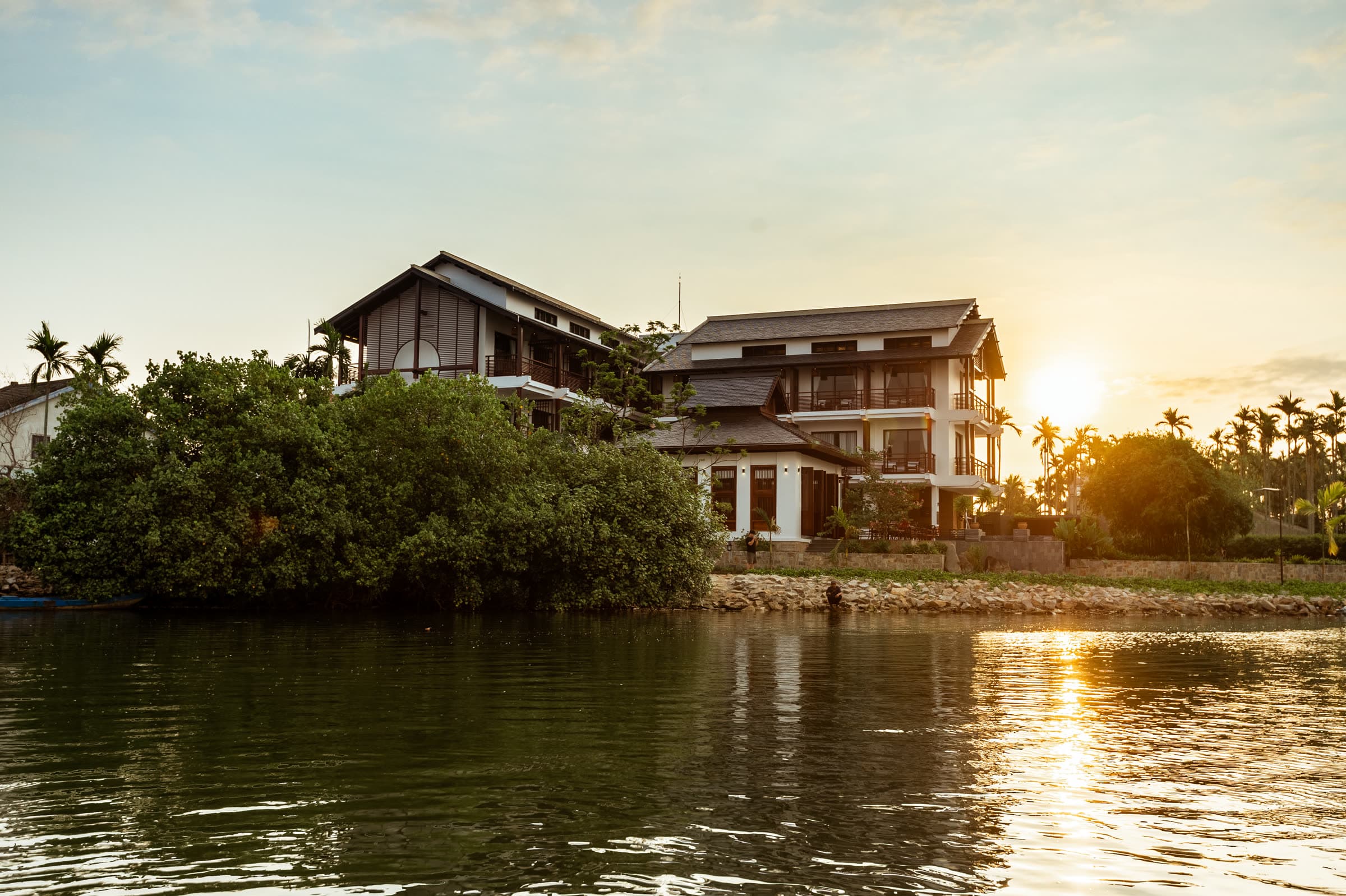
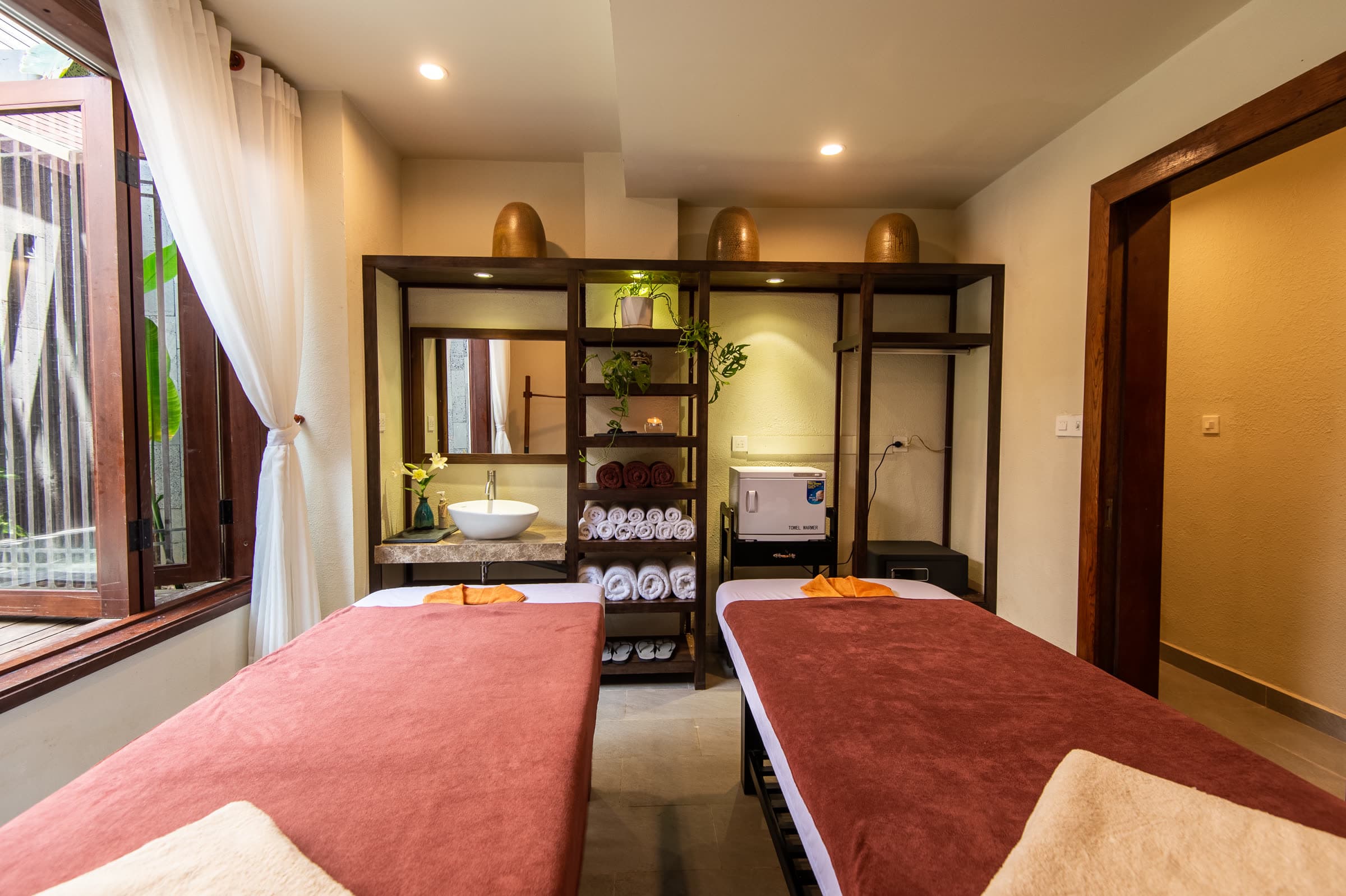
Nous sommes Nghê Prana, un hôtel-spa au bord de la rivière, sur la rive sud paisible du Thu Bồn à Cẩm Nam, Hội An — 23 chambres, une piscine, des vélos gratuits et un thé de bienvenue, à l'écart du vacarme nocturne pour que vous dormiez vraiment. La Vieille Ville est à environ 10 minutes à vélo, et la côte de Cẩm An / Cửa Đại où se tient la fête est à courte distance, ce qui fait de nous une base tranquille pour un petit matin de fête suivi d'un après-midi sans hâte au bord de la rivière. Vous pouvez voir nos chambres et nos tarifs sur la page des chambres. La fête maritime nourrit l'esprit ; le bord de la rivière est là où la journée se dépose.
Questions fréquentes
Qu'est-ce que la fête Cầu Ngư ? C'est la fête du culte de la baleine ou « prière des pêcheurs » (Lễ hội Cầu Ngư) de la côte du Centre et du Sud du Vietnam, en l'honneur de Cá Ông — la baleine vénérée sous le nom d'Đức Ông Nam Hải, protecteur des pêcheurs. Les communautés rendent grâce et prient pour une mer calme et une année en mer sûre et abondante. L'édition de Đà Nẵng est classée au patrimoine culturel immatériel national.
Quand a lieu la fête Cầu Ngư en 2027 ? Les dates officielles de 2027 n'ont pas été publiées. D'après le calendrier lunaire et la fête de Hội An Đông 2026 (2–4 avril 2026, les 15e–17e jours du deuxième mois lunaire), l'édition 2027 de Hội An est attendue de fin mars à début avril 2027. Considérez-la comme une estimation tant que le tourisme de Quảng Nam / Đà Nẵng ne l'a pas confirmée — nous mettrons cette page à jour dès qu'ils le feront.
Où se tient la fête Cầu Ngư près de Hội An ? Dans phường Hội An Đông (l'ancien quartier de Cẩm An), sur la côte de Cửa Đại, près de la plage d'An Bàng — les rites de 2026 étaient centrés sur le lăng Tiêu Diện et le sanctuaire Tụ Chánh Vạn. Des éditions plus grandes se tiennent aussi dans les quartiers côtiers de Đà Nẵng, comme Thanh Khê et Mân Thái.
Qu'est-ce que le lễ nghinh Ông ? Le lễ nghinh Ông est le rite central de la fête : la cérémonie d'accueil du dieu-baleine (Ông / Cá Ông) depuis la mer jusqu'au rivage. Une procession se déroule sur terre et en bateau pour recevoir Đức Ông Nam Hải et escorter la divinité — ainsi que les âmes honorées de la mer — jusqu'au sanctuaire du village.
Les touristes peuvent-ils assister à la fête Cầu Ngư ? Oui. C'est une fête communautaire publique, gratuite à regarder, et les visiteurs sont les bienvenus tant qu'ils font preuve de respect — s'habiller sobrement, rester silencieux pendant les rites, laisser aux familles de pêcheurs l'espace pour mener la procession, et demander avant toute photographie rapprochée. C'est une observance religieuse vivante, non un spectacle mis en scène.
Comment se rendre à la fête Cầu Ngư depuis Hội An ? La fête de Hội An Đông se trouve sur la côte de Cửa Đại / Cẩm An, à environ 5–6 km (15 minutes) de la Vieille Ville en taxi, Grab, moto ou vélo par la route côtière plate. Pour les éditions des quartiers de Đà Nẵng, comptez environ 45 minutes plus haut sur la côte, en voiture ou en Grab.
*Cet article synthétise la couverture en vietnamien et les archives du patrimoine national : Báo Văn hóa et vietnam.vn sur la fête 2026 de Hội An Đông, le Centre du patrimoine mondial de Hội An et hoianheritage.net sur les rites de Cửa Đại, ainsi que le portail de la ville de Đà Nẵng (danang.gov.vn), Danang Fantasticity et Tạp chí Đông Nam Á sur la fête plus large de Đà Nẵng et son statut de patrimoine national. Les dates 2027 indiquées ici sont une estimation tirée du calendrier lunaire, en attendant le calendrier officiel de Quảng Nam / Đà Nẵng, que nous publierons ici dès sa confirmation. Pour le calendrier des fêtes de la région, voir notre guide de la fête Quán Thế Âm 2027 et le calendrier 2027 de la fête des lanternes de Hội An.*
Đặng Ngọc Anh (2026). Rộn ràng khai hội cầu ngư Hội An Đông 2026. Báo Văn hóa (baovanhoa.vn). View source
Vietnam.vn (2026). Trải nghiệm văn hóa miền biển tại lễ Cầu ngư Hội An Đông. Vietnam.vn (Cổng thông tin đối ngoại). View source
Trung tâm Quản lý Bảo tồn Di sản Văn hóa Hội An (2020). Rộn ràng Lễ hội cầu ngư tại Cửa Đại. Hội An World Heritage (hoianworldheritage.org.vn). View source
Trung tâm Quản lý Bảo tồn Di sản Văn hóa Hội An (2019). Lễ cầu ngư ở Phước Trạch. hoianheritage.net. View source
Cổng thông tin thành phố Đà Nẵng (2016). Lễ hội cầu ngư Đà Nẵng được công nhận di sản văn hóa phi vật thể quốc gia. danang.gov.vn. View source
Danang Fantasticity (Cổng thông tin du lịch Đà Nẵng) (2025). Khai mạc Lễ hội Cầu ngư truyền thống quận Thanh Khê năm 2025. Danang Fantasticity. View source
Tạp chí Đông Nam Á (2025). Lễ hội cầu ngư quận Thanh Khê, Đà Nẵng 2025: Bảo tồn và phát huy giá trị văn hóa riêng có của ngư dân miền biển. Tạp chí Đông Nam Á (tapchidongnama.vn). View source
Bộ Văn hóa, Thể thao và Du lịch (2016). Danh mục Di sản văn hóa phi vật thể quốc gia — Lễ hội Cầu ngư. Cục Di sản Văn hóa (dsvh.gov.vn).
Every room at Nghê Prana is designed around the science of sleep. Blackout curtains, nightly aromatherapy turndown, and riverside quiet — experience what real rest feels like.
Chambres au bord du fleuve, à dix minutes à vélo de la vieille ville. Une nuit entre Hué et Da Nang ou une semaine sans emploi du temps — votre chambre restera silencieuse.
Annulation gratuite · Réservation directe auprès de la famille propriétaire


 WhatsApp
 Zalo
Zalo