Where Cẩm Nam sits in Hội An
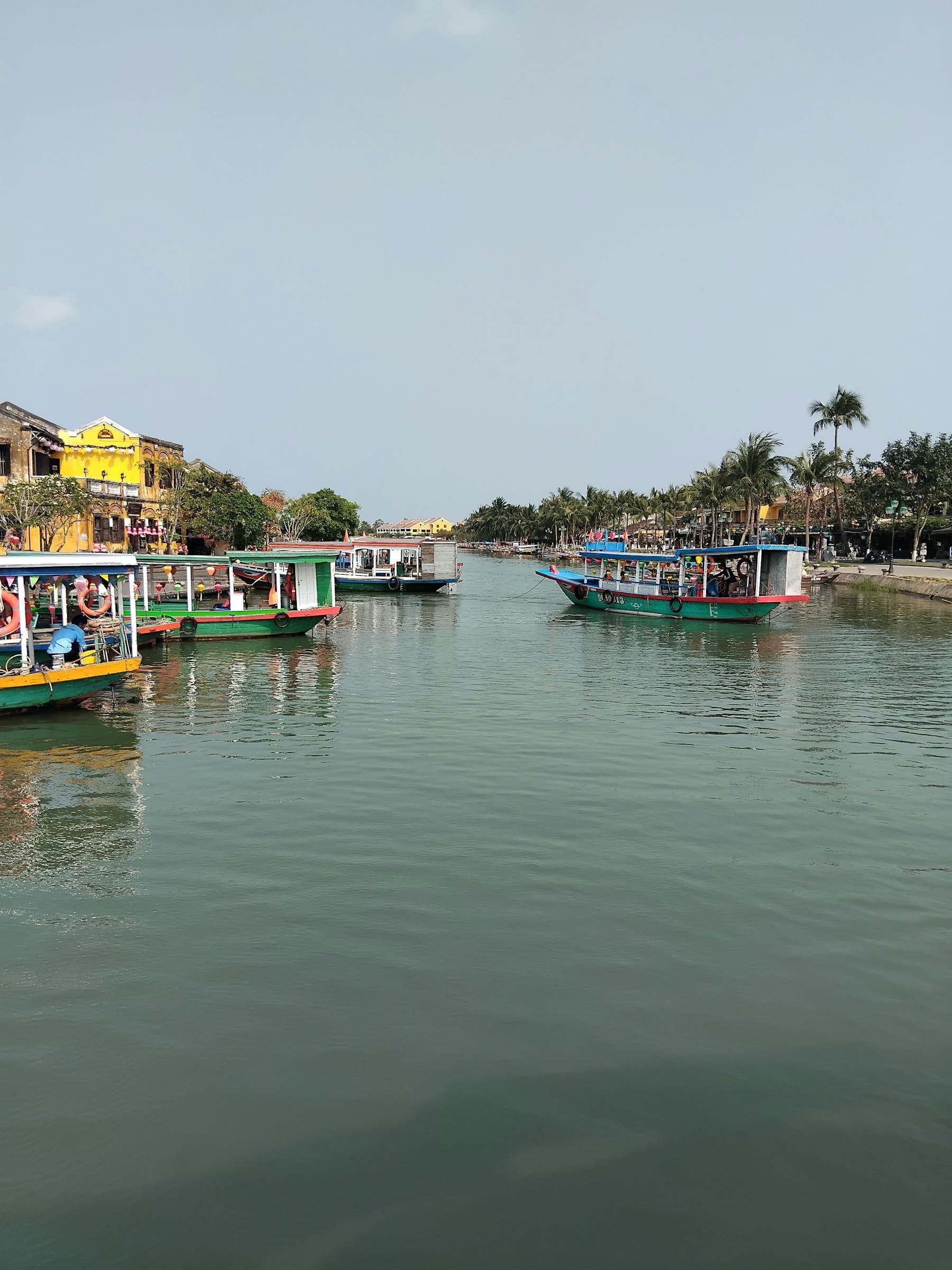
Stand on Bạch Đằng quay in the Ancient Town and look south across the river. The narrow strip of land in front of you, with rooftops just visible through the palms, is Cẩm Nam. The Thu Bồn bends here — slowing as it widens toward the estuary — and Cẩm Nam sits inside the bend. To its north, across the Hoài River (sông Hoài), where the lanterns are, is the Old Town. To its south runs the wide Thu Bồn River, with sandbanks and the far bank beyond. To its west, across another bend, is Cẩm Kim Island and beyond that the rice paddies of Quảng Nam. The island itself is small: roughly 2.5 square kilometres, home to about 5,500 people, reached from the Old Town by the Cẩm Nam bridge.
That bridge — the Cẩm Nam bridge — is the reason the neighbourhood works the way it does. It is short enough to walk in fifteen minutes and quick enough to cycle in five, and it is the main way onto the island. There are no tour buses on Cẩm Nam. There is no through traffic. Anyone who arrives has a reason to be there.
The character of the neighbourhood
Cẩm Nam is residential first and a destination second. The southern half of the island is single-family Vietnamese homes on small plots, with vegetable gardens, lemongrass hedges, and lemon trees in the courtyards. The northern half — the stretch nearest the bridge — has a small cluster of Vietnamese-style restaurants serving the dishes the neighbourhood is locally famous for: bánh đập (a cracker-and- rice-paper fold eaten with shrimp paste), hến trộn (baby clam salad), and grilled river-fish. Locals drive over the bridge to eat there on weekends; tourists discover it on cycling routes.
Along the eastern edge, where the island meets the wide main channel of the Thu Bồn, there is a thin ribbon of small riverside hotels, family-run homestays, and a handful of villas. Each has direct river frontage. The buildings are two or three storeys, set back from the water, separated by gardens. This is the riverside accommodation strip of Cẩm Nam, and it is one of the quietest places to sleep in Hội An.
History: from Cẩm Phố village to its own ward
Cẩm Nam was historically not a separate place. Before the twentieth century, the south bank of the Thu Bồn opposite Hội An's port was a single Vietnamese settlement known as Cẩm Phố village. The communal house of Cẩm Phố (đình Cẩm Phố) — the building that anchors any traditional Vietnamese village — was first built on Cẩm Nam Island. Repeated flooding of the island forced the villagers to relocate the communal house across the river, to its present location near the Japanese Covered Bridge. The original site on Cẩm Nam remained inhabited, but its civic centre had moved.
As the modern Vietnamese state reorganised Hội An into urban wards in the late twentieth century, the old Cẩm Phố village was broken into several phường: Cẩm Phố proper (on the north bank, including the Japanese Covered Bridge area), Cẩm Nam (the south-bank island), Cẩm Châu (the inland south-east neighbourhood), and Tân An. Cẩm Nam became its own ward — a small one by area, but with its own People's Committee, its own school, its own identity. The fact that it had once been the original site of the Cẩm Phố communal house is still mentioned by older residents.
What's there now
A short list of what you actually find on Cẩm Nam today:
- Homes. Most of the island is residential. Walking the inner lanes you pass family altars in open-front living rooms, drying fish on bamboo trays, children doing homework on tile floors.
- The bánh đập restaurant strip. Just south of the bridge, a row of family-run restaurants serves the Cẩm Nam specialties — bánh đập, hến xào, river fish grilled in banana leaf. Open lunch and dinner. Cash only. Excellent.
- Riverside hotels and homestays. A thin strip of small properties along the east-facing riverbank, each with river views. No chains. Family-run. Five to fifteen rooms per property is typical.
- A small market. Morning market near the school, mostly fresh fish, river herbs, and vegetables from the south-bank gardens.
- Cycling routes. The southern lanes of Cẩm Nam thread through rice paddies and connect via a small ferry to Cẩm Kim Island — a favourite half-day loop for visitors staying on the south bank.
Where to stay on Cẩm Nam
The accommodation on Cẩm Nam is, by character, small. The island's land area and its single-bridge access limit how large any property can grow, and the riverside strip is zoned for low-density use. What this means in practice is that every Cẩm Nam place to stay is somewhere between five and twenty-five rooms — boutique riverside hotels, family homestays, a few private villas. There is no resort on the island. There likely never will be.
Nghê Prana is on the east-facing stretch of Cẩm Nam at Hẻm 384 Nguyễn Tri Phương — the alley turns off the main road toward the river and ends at our gate. The property faces east onto a bend of the Thu Bồn where the current slows and the fishing boats moor at dusk. This is the Thu Bồn River, not the Hoài River where the lanterns are — the Hoài is on the other side of the island, 10 minutes away by bicycle, and cannot be seen from the hotel. 23 rooms, all river or garden facing. Two private villas (the Nghê Villa sister property) for groups up to eight. Family-run. The riverside hotel description is here.
How to get to and from the Ancient Town
- Bicycle: 5 minutes via the Cẩm Nam bridge. This is what most guests use. Bicycles are included with every Nghê Prana room.
- On foot: 15 minutes. The bridge has a pedestrian lane; the Old Town opens onto Bạch Đằng quay at the north end.
- Motorbike or scooter: 4 minutes. Parking is at any of the Ancient Town's perimeter lots — the Old Town's inner streets are pedestrian-only after 17:00.
- Taxi or Grab: 7 minutes, 30,000 đồng one way. Useful at the end of a long day.
- By river: Some Cẩm Nam riverside hotels arrange direct boat transfer across the Thu Bồn to the Ancient Town quay. 5 minutes by sampan, 150,000 đồng for a private crossing.
Who Cẩm Nam suits
- Light sleepers who want the Old Town within reach but cannot tolerate the Old Town's noise floor.
- Couples and honeymooners who want the lantern festival, the cooking class, the tailor — and a quiet, river-facing room to return to.
- Wellness and recovery travellers who came to Hội An specifically for sleep, spa, and structured rest rather than sightseeing.
- Cyclists who want to ride directly from the room into the rice paddies and the Cẩm Kim ferry without crossing traffic.
- Returning visitors who have stayed in the Old Town before and want a quieter side of Hội An.
Related reading
- Hoi An riverside hotel — what the phrase actually means
- The Thu Bồn River, Hội An — complete guide
- Cẩm Nam, Cẩm Kim, Cẩm Thanh — the three quiet islands of Hội An
- Hội An's five neighbourhoods — where to stay
- Old Town vs riverside — which sleeps better
- The quietest hotels in Hội An
- Hoi An vs Da Nang — where to stay
- Hoi An vs Ubud for wellness