You step off the jet bridge at Da Nang International Airport (DAD) and you are roughly 45 minutes from your hotel door in Hội An. This walkthrough takes you through the arrivals hall in the order you will actually walk it: immigration, baggage, SIM, ATM, ground transport. No backtracking, no surprises.
Da Nang is Vietnam's third-busiest airport. Most international visitors to Hội An land here rather than at Hanoi or Saigon, because it is the closest international gateway to the Old Town — about 30 km north. The terminal is modern, signage is bilingual Vietnamese/English, and the arrival sequence is genuinely simple once you know the order.
Terminal 2 — where international arrivals happen
DAD has two terminals. Terminal 2 (T2) is the international terminal — newer, 48,000 m², four floors. Terminal 1 (T1) handles domestic flights and connects via a short covered walkway. If you arrive on any flight from outside Vietnam — Singapore, Seoul, Bangkok, Kuala Lumpur, Doha, Taipei — you will land at T2.
Ground-floor T2 contains, in walking order from the jet bridge: arrival immigration, baggage claim, customs exit, then the public arrivals hall with SIM kiosks, ATMs, currency exchange, and tourist information.
Immigration — three lanes, one question
Vietnam's e-visa system is now the default for most travelers. The relevant 2026 rules:
90-day validity, single or multiple entry, available to citizens of all countries
US$25 single entry / US$50 multiple entry (official government fee)
3–5 business days processing — apply at evisa.gov.vn at least a week before flying
83 international gates accept e-visa holders, DAD included
At immigration you will see three lane categories. E-visa holders queue at the manual immigration counters (the automated gates are reserved for Vietnamese passport holders and some bilateral agreements). Visa-on-arrival travelers — a smaller and shrinking category — go to the dedicated VOA counter on the right of the immigration hall to pick up their stamp before joining the manual lane. Visa-exempt passport holders (UK, France, Germany, Italy, Spain, Japan, Korea, plus a few others on the unilateral exemption list) skip straight to the manual lane.
Have your passport, printed e-visa PDF, and a pen ready. The officer will ask one or two questions — "How long?", "Where are you staying?" — and stamp you in. Wait times are 10 to 30 minutes depending on which flights landed in your wave.
Baggage claim — belts 1 through 5
T2 has five baggage carousels. Your flight's belt number is displayed on monitors above the carousel area. Trolleys are free. If a bag is missing, the lost-baggage office is on the far left of the baggage hall, near the customs exit.
Customs is a green-lane walkthrough for almost everyone. Declare cash above US$5,000 equivalent, more than 1.5 L of spirits, or commercial quantities. Then you push through the sliding doors into the public arrivals hall.
SIM card — three carriers, one decision
The SIM kiosks sit immediately on your right after you exit customs. Vietnam has three major mobile carriers, and all three sell tourist SIM cards at DAD with English-speaking staff:
Viettel — the largest network, best rural and beach coverage. Default choice for travelers heading to An Bàng, Cù Lao Chàm, or Mỹ Sơn.
Vinaphone — strong urban coverage, slightly cheaper data bundles.
Mobifone — historically the foreigner-friendly carrier, decent coverage in central Vietnam.
Typical 2026 pricing: a 30-day unlimited-data tourist SIM costs around 200,000–300,000 VND (US$8–12). You hand over your passport for registration — Vietnamese law requires SIM cards be tied to an ID — and the staff inserts the SIM, activates it, and confirms data is working before you walk away. Get it done at the airport, not in town. Phone shops in Hội An sell the same SIMs at the same price, but the queue and language friction is higher.
ATM — pick your bank carefully
Foreign-card ATM fees in Vietnam are not regulated, and the spread between banks is wide. Approximate per-withdrawal fees at DAD in 2026:
VPBank — historically free for foreign cards (verify on the day; this is the foreigner-favorite)
Vietcombank — around 55,000 VND per withdrawal, max 3,000,000 VND per transaction
Sacombank — around 30,000–40,000 VND, similar limits
BIDV — charges a percentage (~3% of withdrawal), worst for large pulls
TPBank — added a foreign-card fee in 2025, no longer the free option it once was
On top of the local fee, your home bank may add a foreign-transaction surcharge. The math: one large withdrawal of 3,000,000 VND (about US$120) costs you 55,000 VND at Vietcombank but ~90,000 VND at BIDV. Pull large, pull once.
Always select "Decline conversion" if the ATM offers Dynamic Currency Conversion — taking the bank's exchange rate is almost always worse than your home card's network rate.
Currency exchange and what to spend cash on
There are currency-exchange counters in the arrivals hall — useful if you brought USD or EUR cash. Rates at the airport are about 1–2% worse than gold shops in Hội An, which doubles as the local money-changer network. For your first 24 hours, exchange a small amount (US$100–200) and rely on the ATM later.
What needs cash in Hội An: street food, market stalls, taxi tips, beach loungers, tailoring deposits, motorbike rentals. What takes card or QR: most restaurants over US$10/head, hotels, museums, tour bookings. Carry a mix.
The 30 km to Hội An — Grab, taxi, or private transfer
Planning a trip around this? See dates at our quiet riverside hotel on the Thu Bồn. Check availability →
Leaving arrivals, you turn left and head down the road toward the Grab pickup zone, which is "Lane 1" at the end of the road past the official taxi rank. The walk is about 3 minutes, signposted in English.
GrabCar — typically 320,000–420,000 VND for the 30 km / 45-minute ride to Hội An. The app shows the price upfront, and the driver cannot legally surprise you with extras. Best default for solo travelers and couples.
Mai Linh / Vinasun taxi — 380,000–500,000 VND on the meter. Reliable, but airport taxis sometimes argue the meter or refuse it. Get them to start the meter before you leave the curb.
Pre-booked private transfer — 450,000–700,000 VND, but the driver waits at arrivals with a sign, helps with bags, and speaks enough English to handle the route. If you booked through your hotel, this is included or pre-arranged. The premium pays for itself if you have small children, lots of luggage, or arrive after 11 pm.
The road runs south on the coastal highway, past My Khe Beach, the Marble Mountains, and into Hội An's northern districts. Traffic is usually light. Door-to-door — jet-bridge to hotel reception — count on 45 minutes in normal conditions, longer during evening rush.
What "arrival fatigue" actually feels like, and how to absorb it
Vietnam's arrival friction — paperwork, queue, language, the heat as you exit the terminal — is standard international-travel reality. It is not Vietnam being difficult; it is what landing in any country involves the first time. Tokyo's Narita, JFK, Heathrow, Charles de Gaulle all have their own version.
The thing that helps most: do not try to make a dinner reservation, a tour booking, or any complex decision in your first three hours on the ground. Get to your hotel. Drink water. Sit on a balcony. Walk slowly to one nearby place for noodles. The Old Town is not going anywhere; the river is still there in the morning.
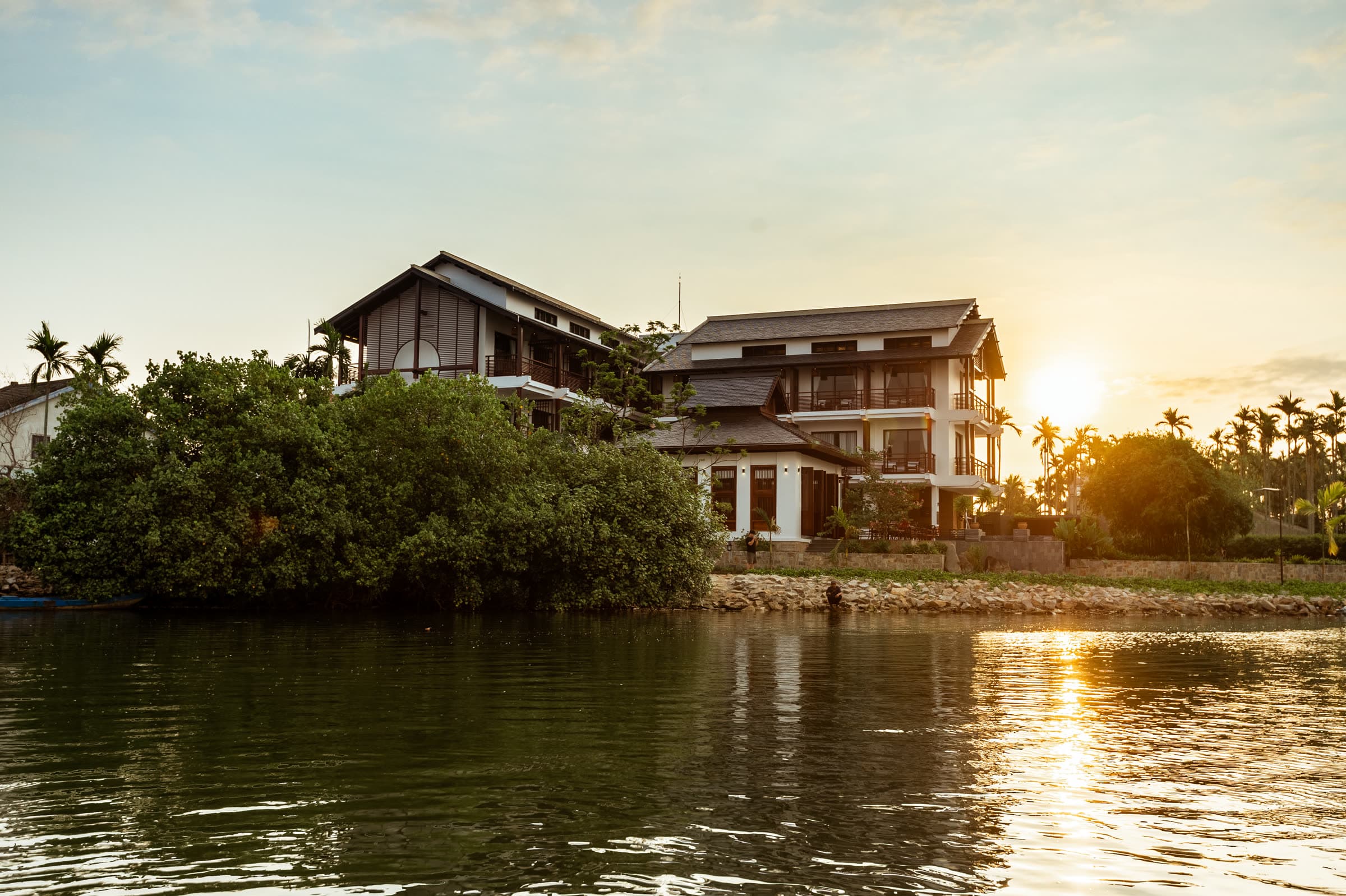
If you are staying riverside on the south bank — in Cẩm Nam, where the Thu Bồn river bends — your driver will take the bridge across at Cẩm Châu and drop you on the quiet side of town within 45 minutes of customs. The change from airport noise to river silence is the first thing first-timers tell us they noticed.
Practical reference
Airport code: DAD
Distance to Hội An: 30 km (45 min by car)
E-visa portal:evisa.gov.vn — official, US$25 single / US$50 multiple
Currency: Vietnamese đồng (VND); approximate rate 25,000 VND ≈ US$1
Plug type: A, C, F (most plugs accept US two-pin and EU two-pin)
FAQ — the questions first-timers ask before they arrive
Sources: Vietnam National Electronic Visa portal (evisa.gov.vn); Grab Vietnam airport-rides documentation; published 2026 carrier and bank fee schedules.
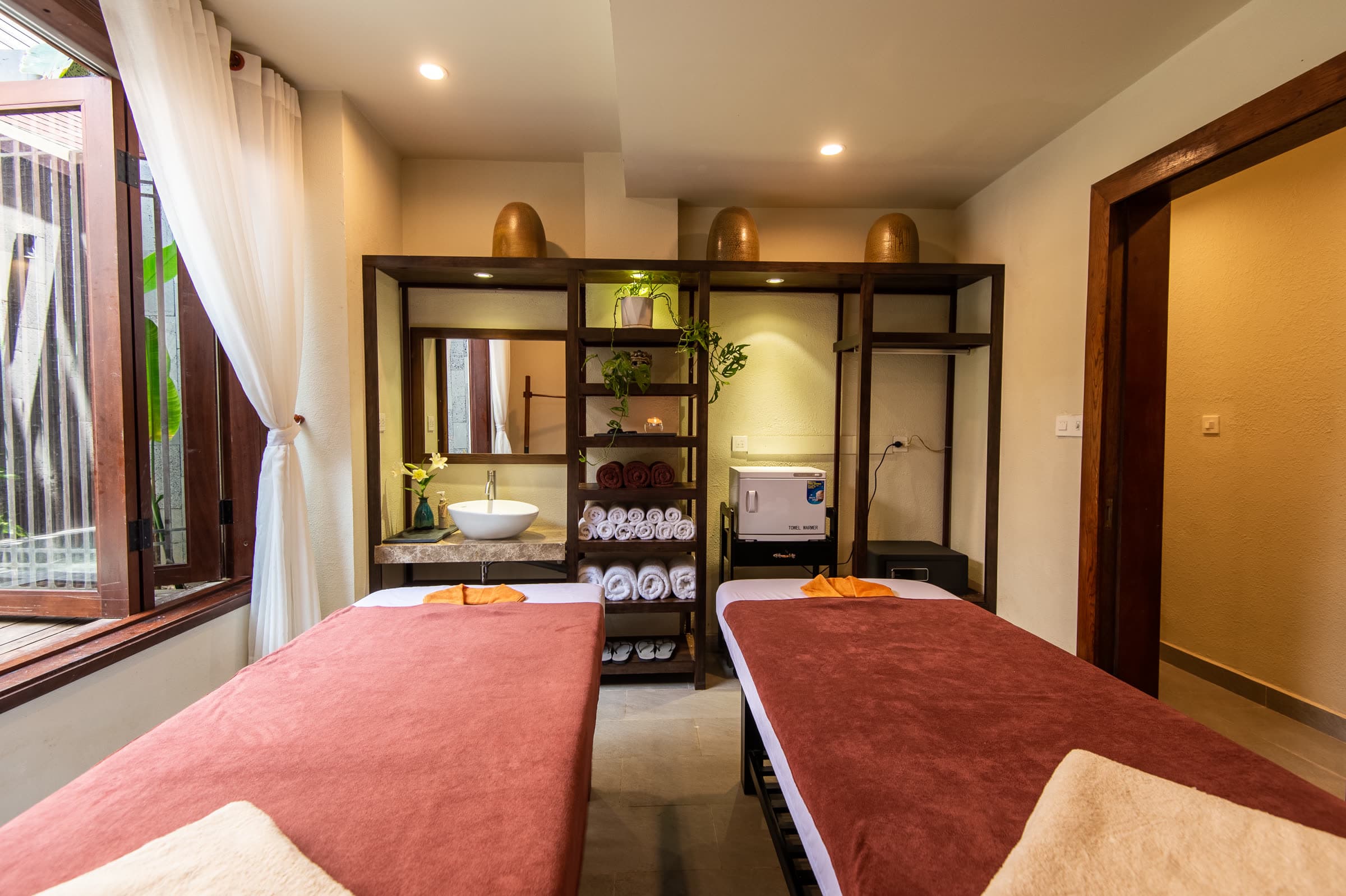
Every room at Nghê Prana is designed around the science of sleep. Blackout curtains, nightly aromatherapy turndown, and riverside quiet — experience what real rest feels like.
Riverside hotel rooms on the Thu Bồn, ten minutes by bicycle from the Ancient Town. Whether it's one night between Hue and Da Nang or a full week of doing nothing — we kept your room quiet.
Free cancellation · Direct from the family who built the hotel

 WhatsApp
 Zalo
Zalo