Hoi An Lantern Festival 2026: Every Date (Verified Full-Moon Calendar)
The Hoi An Lantern Festival happens on the 14th night of every lunar month — the evening before each full moon — which means thirteen specific dates fall inside the 2026 calendar year. On each one, the Old Town switches off its electric lights from roughly 6 to 10 pm, hangs silk lanterns as the only illumination, and fills the Thu Bồn with floating candle-floats. This is the corrected, verified 2026 calendar — exact Gregorian dates with the lunar conversions done for you — plus what actually happens, the lights-off window, and how to see it without fighting the crowd.
On thirteen evenings in 2026, the electric lights along Hội An's Old Town go dark on purpose and the streets revert to candle and moonlight. Silk lanterns become the only real light source, the Sông Hoài (the Hội An arm of the Thu Bồn) fills with thousands of floating candle-floats drifting downstream, and for about twenty minutes around dusk the town looks almost exactly as it did three centuries ago. Arrive on the wrong night and you get none of it — just a normal evening in a busy town. So the single most useful thing this guide gives you is the right dates.
The Hoi An Lantern Festival — Lễ hội đèn lồng, known locally as Đêm Rằm Phố Cổ ("Old Quarter Full-Moon Night") — falls on the 14th day of every lunar month, the evening before each full moon. This is the detail almost every English-language listing gets wrong: it is the 14th night, not the 15th, and not "sometime this month." Get the date right and everything else follows.
A note on accuracy: the dates below are computed from the lunar calendar and cross-checked against Vietnamese sources. Tết 2026 falls on Tuesday 17 February, and Rằm tháng Giêng — the first full moon of the lunar year — falls on Tuesday 3 March 2026 (per Đời sống & Pháp luật and Người Lao Động). That places the first festival night of the lunar year on Monday 2 March 2026. Every date in this guide is verified against those anchors.
The last four lantern nights of 2026
Four festival nights remain in the 2026 calendar: Thursday 24 September (14th of lunar month 8, the eve of Mid-Autumn and the most festive night of the year), Friday 23 October (14th of month 9), Sunday 22 November (14th of month 10) and Tuesday 22 December (14th of month 11). The series then continues with Thursday 21 January 2027 and Friday 19 February 2027 — the eve of Nguyên Tiêu, the first full moon of the Đinh Mùi year — and the full 2027 calendar is verified the same way. Re-checked on 21 September 2026 with two independent conversions: the Hồ Ngọc Đức lunar algorithm and the published Vietnamese perpetual calendar (lichngaytot.com gives 22 December 2026 as 14/11 Bính Ngọ).
When Is the Hoi An Lantern Festival in 2026?
The festival is held on the 14th night of each lunar month, year-round. Because the lunar and Gregorian calendars drift, the dates move every year. Here are all thirteen festival nights that fall within the 2026 calendar year, with the lunar-to-Gregorian conversion done for you.
#
Festival night (2026)
Lunar date
Notes
1
Fri 2 Jan 2026
14th of lunar month 11
Cool, dry; quiet first night of the year
2
Sun 1 Feb 2026
14th of lunar month 12
Pre-Tết; town busy with New Year preparation
3
Mon 2 Mar 2026
14th of lunar month 1 — Nguyên Tiêu
First full moon of the lunar year; the biggest, most atmospheric night
4
Wed 1 Apr 2026
14th of lunar month 2
Spring; comfortable, usually dry
5
Thu 30 Apr 2026
14th of lunar month 3
Falls in the 30 Apr–1 May holiday; expect domestic crowds
6
Sat 30 May 2026
14th of lunar month 4
Warm, dry; a Saturday, so busier
7
Sun 28 Jun 2026
14th of lunar month 5
Peak dry season; hot evenings (32 °C+)
8
Mon 27 Jul 2026
14th of lunar month 6
Domestic summer high season
9
Wed 26 Aug 2026
14th of lunar month 7
Around Lễ Vu Lan; locally significant
10
Thu 24 Sep 2026
14th of lunar month 8
The night before Mid-Autumn (Tết Trung Thu, full moon 25 Sep) — the most festive of the year
11
Fri 23 Oct 2026
14th of lunar month 9
Early wet season; check the flood forecast
12
Sun 22 Nov 2026
14th of lunar month 10
Cooler evenings, often the most photogenic light of the year
13
Tue 22 Dec 2026
14th of lunar month 11
Cool and dry; quiet, late-year night
The next festival night after the calendar above is Thursday 21 January 2027 (14th of lunar month 12). Tết 2027 falls on Saturday 6 February 2027.
If you only get one night, make it Monday 2 March 2026 (Nguyên Tiêu, the first full moon of the lunar year) or Thursday 24 September 2026 (the eve of Mid-Autumn). Those two carry the most ceremony. If you want the festival without the heaviest crowds, the lower-season nights — 2 January, 22 November, 22 December — give you the same lights-off Old Town with room to breathe.
Two different "Hoi An lantern festivals" in 2026 — which one do you mean?
Everything above is the monthly Đêm Rằm Phố Cổ — the 14th-night lights-off evening that has run since 1998 and needs no ticket. In 2026, for the first time, Hội An also has a separate, one-off event with a confusingly similar name: the Hội An International Lantern Festival 2026 (Lễ hội Đèn lồng Quốc tế Hội An 2026), themed "Hội An – Sắc màu di sản" ("Hội An – Colours of Heritage"), planned for Thursday 3 to Sunday 6 December 2026. The plan was issued by the Đà Nẵng City People's Committee and reported by Thanh Niên and Tuổi Trẻ on 31 July 2026.
What the plan describes: an opening ceremony with performances on the riverbank and on the water; about 15 large-scale lantern art installations at Sông Hoài square, the An Hội sculpture garden, along the river and through the Old Town streets; lantern-making workshops; an exhibition of lanterns and art made from recycled materials; a "Sắc màu di sản" arts programme; a night lantern walk (minh đăng dạ hành); talks on Hội An's craft trades; and photography and lantern-pattern design competitions. The installations are to stay up until Tết Nguyên Tiêu 2027 (Saturday 20 February 2027), so they will still be there for the 21 January and 19 February lantern nights.
Two things to know before you plan around it. First, 3–6 December are the 25th to 28th days of the tenth lunar month, not a full-moon night — the monthly lights-off evenings nearest to it are 22 November and 22 December. Second, the dates are the plan's, published as dự kiến (scheduled); if the programme changes we will correct this section. The plan as reported says nothing about ticketing, so we make no claim either way — we will add it when an official announcement does.
What Actually Happens on Festival Night?
From about 5:30 pm, motorbikes are blocked from the Ancient Town core. Then the town does the thing that makes this festival worth planning around: it switches off most electric lighting, and from roughly 6:00 pm to 10:00 pm the thousands of silk and paper lanterns strung across the streets become the only significant light source. This lights-off protocol is the heart of Đêm Rằm Phố Cổ — it is a local heritage policy, not a tourism gimmick.
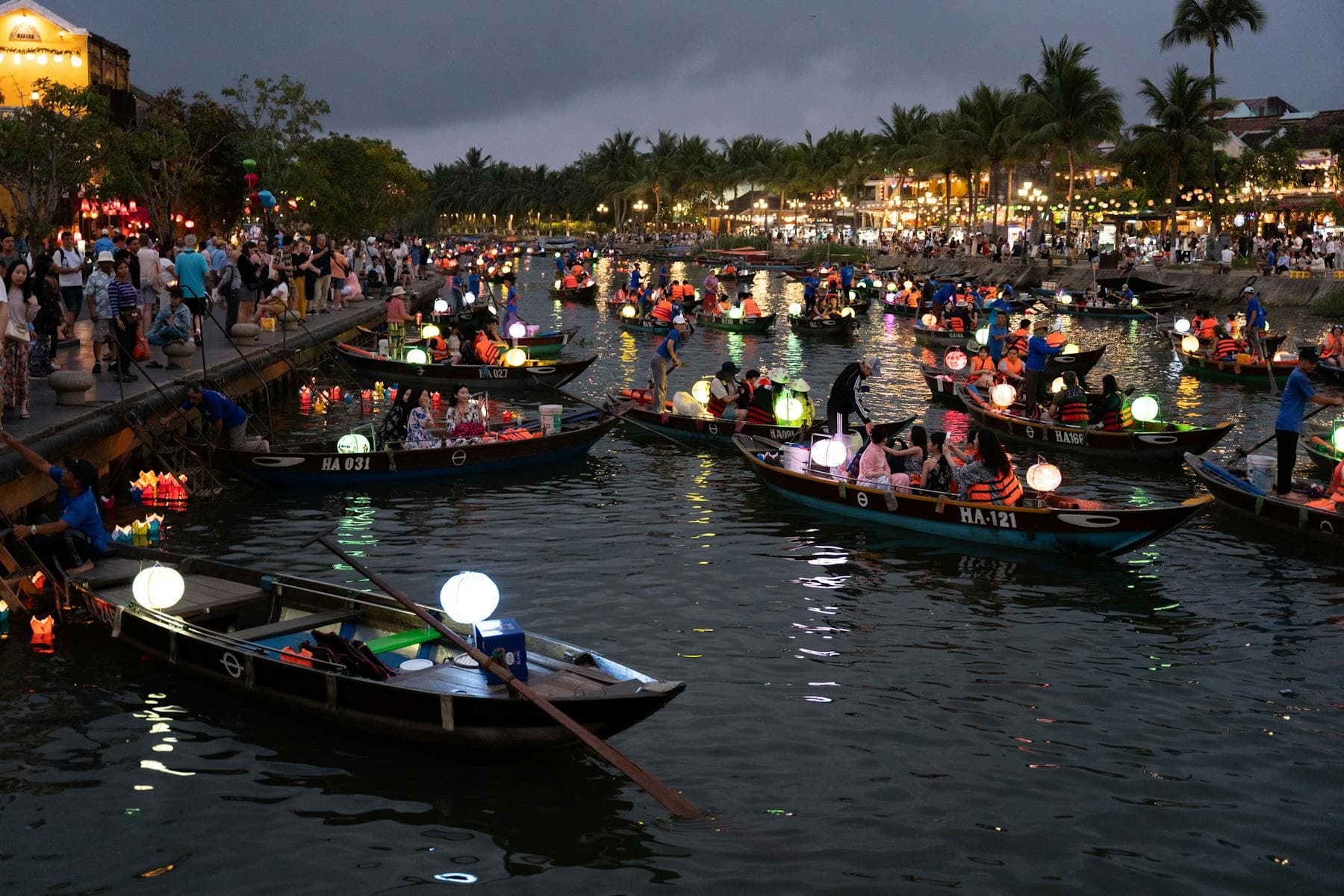
The river becomes a second source of light. Locals and visitors light small candle-floats — hoa đăng, paper lanterns with a candle inside — and release them onto the Sông Hoài from the An Hội footbridge and from small wooden boats launching off the Bạch Đằng quay. Each float carries a wish. Between roughly 7:00 and 9:00 pm the water fills with them, drifting downstream toward the Thu Bồn's main channel. Cultural performances run alongside: bài chòi folk singing at the An Hội square, traditional music on the Bạch Đằng stage, calligraphy at the assembly halls. By 10:00 pm normal lighting and traffic resume.
The lights-off idea has a documented origin. The Trung tâm Quản lý Bảo tồn Di sản Văn hóa Hội An (Hội An's heritage conservation centre) traces the monthly tắt đèn điện — "turn off the electric lights" — to a 1998 municipal decision, an idea associated with the Polish architect Kazimierz Kwiatkowski, who began documenting Hội An's vernacular architecture in 1982. Since mid-2025, following the administrative reorganisation that placed Hội An and Mỹ Sơn under Đà Nẵng, that same centre operates under Đà Nẵng's culture authority — so the 2026 festival is governed at the Đà Nẵng level for the first time.
Where Does It Happen, and How Do You See It from the Quiet Side?
The action concentrates on the Sông Hoài between the An Hội footbridge and the Cẩm Nam bridge, with the Bạch Đằng riverfront on the north (Old Town) bank as the densest spot. By about 7:15 pm on a peak night, the An Hội bridge and Bạch Đằng quay are shoulder to shoulder. You do not have to stand in that.
The water itself is the festival, which means the calmest seat is on it or across it. From what works for our own guests, who cycle in from the hotel ten minutes downstream (the release is not visible from the hotel itself), the pattern is simple: come early for the blue-hour window, or watch from the far bank of the Sông Hoài. Five approaches:
One — the blue-hour window. Reach the Bạch Đằng riverfront by 5:00 pm and take a spot on the steps facing the water. Lanterns come on against a cobalt twilight sky before the crowd builds. The best light is roughly 5:45 to 6:20 pm.
Two — from a boat. A small rowing boat (the Minh An boat guild's published rate is 150,000 VND per boat for 1–3 people and 200,000 VND for 4–5, for about 20 minutes) puts you mid-river among the floats. Book by 5 pm; availability is tight on festival nights.
Three — the south bank at Cẩm Nam. Walk five minutes past the An Hội night market to any riverside deck on Cẩm Nam and watch across toward the Old Town. The lantern reflections from this angle are often better than from the crowded north bank, and you will have a table.
Four — inside, not on the river. The Quan Công Temple courtyard and the Tấn Ký old-house interior fill with candlelight on festival nights and see a fraction of the crowd. Quiet, atmospheric, and a different kind of photograph.
Planning a trip around this? See dates at our quiet riverside hotel on the Thu Bồn. Check availability →
Five — Cẩm Kim island. A short ferry across the Thu Bồn reaches Cẩm Kim, where local families do their own smaller release with a fraction of the tourist density. Fewer lanterns on the water, more of the actual community.
A practical thread that ties it together: where you sleep decides how much of the evening you actually enjoy. Staying on the Thu Bồn rather than inside the pedestrian core means you can walk or take a short boat to the release, then retreat to quiet water when the crowd peaks — instead of fighting back through the night market to a hotel deep in the Old Town. (We are a riverside hotel on the Thu Bồn ourselves, which is exactly why we lay the evening out this way: the festival is a thing you visit, then come home from.)
What to Bring and How to Dress
The festival is participatory — everyone is welcome to light and release a hoa đăng. Floats are sold on Bạch Đằng and at the An Hội bridge for about 20,000–40,000 VND; bring small bills, as most vendors do not take cards on festival nights. Wear closed-toe, comfortable shoes — cobblestones plus candle wax make flip-flops a poor choice. From October onward, bring a light layer for the cooler evenings. Renting an áo dài (traditional dress) suits the night well; rental shops along Trần Phú keep extended hours on the 14th of the lunar month.
Frequently Asked Questions
When is the Hoi An Lantern Festival in 2026?
It is held on the 14th night of every lunar month. In 2026 that falls on: 2 Jan, 1 Feb, 2 Mar, 1 Apr, 30 Apr, 30 May, 28 Jun, 27 Jul, 26 Aug, 24 Sep, 23 Oct, 22 Nov, and 22 Dec. The most atmospheric are 2 March (first full moon of the lunar year) and 24 September (eve of Mid-Autumn).
What time does the Hoi An Lantern Festival start and end?
Motorbikes are cleared from the core around 5:30 pm, electric lights go off from roughly 6:00 to 10:00 pm, and the candle-float release on the river peaks between about 7:00 and 9:00 pm.
Is the lantern festival on every night in Hoi An?
No. Silk lanterns are lit in the Old Town most evenings year-round, but the full Đêm Rằm Phố Cổ — lights off, traffic closed, river-float release — happens only on the 14th night of each lunar month.
Do you have to pay to see the Hoi An Lantern Festival?
The festival itself is free to walk through; there is no separate lantern-festival ticket. The Ancient Town sightseeing ticket — 120,000 VND for international visitors and 80,000 VND for Vietnamese visitors (Quảng Nam Tourism price list, updated 20 January 2026) — covers entry to the heritage houses, assembly halls and museums. A candle-float (hoa đăng) costs roughly 5,000–40,000 VND depending on the seller if you want to release one, and a guild boat is 150,000–200,000 VND per boat for about 20 minutes.
When is the biggest lantern night in Hoi An in 2026?
The two largest are Monday 2 March 2026 (Nguyên Tiêu, the first full moon of the lunar year) and Thursday 24 September 2026 (the night before Mid-Autumn / Tết Trung Thu).
Can you release a lantern on the river yourself?
Yes. Buy a hoa đăng from a riverside vendor and release it from the An Hội bridge, the Bạch Đằng quay, or a small boat. Local custom is to make a wish as you set it on the water.
Is the lantern festival worth seeing during the rainy season (Oct–Nov)?
It can be, but watch the forecast. October and November are Hội An's wettest months and the Old Town can flood in bad years; the 23 October and 22 November nights are lovely in dry spells but may be cancelled or curtailed during high water.
Is the Hoi An International Lantern Festival 2026 the same event?
No. The monthly lantern festival (Đêm Rằm Phố Cổ) is the 14th-night lights-off evening listed in the calendar above and runs all year. The Hội An International Lantern Festival 2026 is a separate, first-time event planned for 3–6 December 2026 in the same Old Town spaces, with about 15 large lantern installations, workshops and performances; its dates are not full-moon nights. The nearest monthly lantern nights are 22 November and 22 December 2026.
Turn a lantern night into a getaway. A full-moon lantern evening is the natural centrepiece of a romantic trip to Hội An — couples often build an anniversary stay or a riverside couples massage and spa-for-two around one of these dates, and book a private couple's spa for the afternoon before. Planning further ahead? The 2027 lantern dates are verified too. We are on the quiet side of the Thu Bồn, 3.2 km downstream of the Old Town, where the lanterns are out of sight and the full moon rises over open water. Staying for a lantern night? Book a riverside room ten minutes by bicycle from the release.
Staying on a lantern night
The lantern release happens on the Sông Hoài, between the An Hội and Cẩm Nam bridges. We are a little downstream on the south bank — a 23-room riverside hotel ten minutes by bicycle from it. Guests walk in for the evening and cycle back to somewhere quiet. See the rooms.
This calendar synthesises the official record of the Trung tâm Quản lý Bảo tồn Di sản Văn hóa Hội An on the 14th-night Đêm Rằm Phố Cổ lights-off protocol, coverage of the 2025 move placing Hội An's heritage management under Đà Nẵng, and Vietnamese-press confirmation of the 2026 lunar anchors. The hotel-side contribution is the verified 2026 lunar-to-Gregorian date table and the viewing plan tuned to the Sông Hoài release window between the An Hội and Cẩm Nam bridges, observed first-hand from the Thu Bồn riverside.
The Hội An Lantern Festival (Đêm Rằm Phố Cổ) is held on the 14th day of every lunar month, the evening before each full moon. In 2026 the dates are 2 January, 1 February, 2 March, 1 April, 30 April, 30 May, 28 June, 27 July, 26 August, 24 September, 23 October, 22 November and 22 December 2026, then 21 January 2027. The biggest night is Nguyên Tiêu on 2 March 2026.
What time does the Hoi An Lantern Festival start?
Each festival evening runs from about 5:30 pm to 10:00 pm, with the peak lantern release between 7:00 and 9:00 pm. Electric street lighting in the Ancient Town is switched off from roughly 6:00 pm to 10:00 pm so the town is lit only by lanterns and moonlight.
How much does a lantern cost at the festival?
Paper and silk candle-lanterns to float on the river are sold at stalls on Bạch Đằng and the An Hội bridge for a few thousand to a few tens of thousands of đồng — published prices range from about 5,000 to 40,000 VND, so ask before you take one. Bring small bills, as most vendors do not accept cards on festival nights.
Is the Hoi An Lantern Festival free?
Yes — walking the Ancient Town during the festival is free, and there is no separate lantern-festival ticket. The Ancient Town sightseeing ticket (120,000 VND for international visitors, 80,000 VND for Vietnamese visitors, per the Quảng Nam Tourism price list updated 20 January 2026) covers entry to the heritage houses, assembly halls and museums. Floating a candle-lantern costs a few thousand to a few tens of thousands of đồng (published prices range from about 5,000 to 40,000 VND), and a 45-minute river boat for photography runs roughly 120,000–200,000 VND.
Is the Hoi An International Lantern Festival 2026 the same event?
No. The monthly lantern festival (Đêm Rằm Phố Cổ) is the 14th-night lights-off evening and runs all year. The Hội An International Lantern Festival 2026 is a separate, first-time event planned by the Đà Nẵng City People's Committee for 3–6 December 2026 in the same Old Town spaces — about 15 large lantern installations, workshops and performances, with the installations kept up until Tết Nguyên Tiêu 2027 (20 February 2027). Its dates are not full-moon nights; the nearest monthly lantern nights are 22 November and 22 December 2026. Reported by Thanh Niên and Tuổi Trẻ on 31 July 2026.
Where is the best place to watch the lantern release?
The Thu Bồn / Sông Hoài riverfront between the An Hội bridge and the Cẩm Nam bridge is the heart of the release. For fewer crowds in 2026, shoot from the Cẩm Nam south bank, take a small river boat to mid-river, or visit the quieter Cẩm Kim island release.
Can you see the Hoi An lantern festival from Nghê Prana?
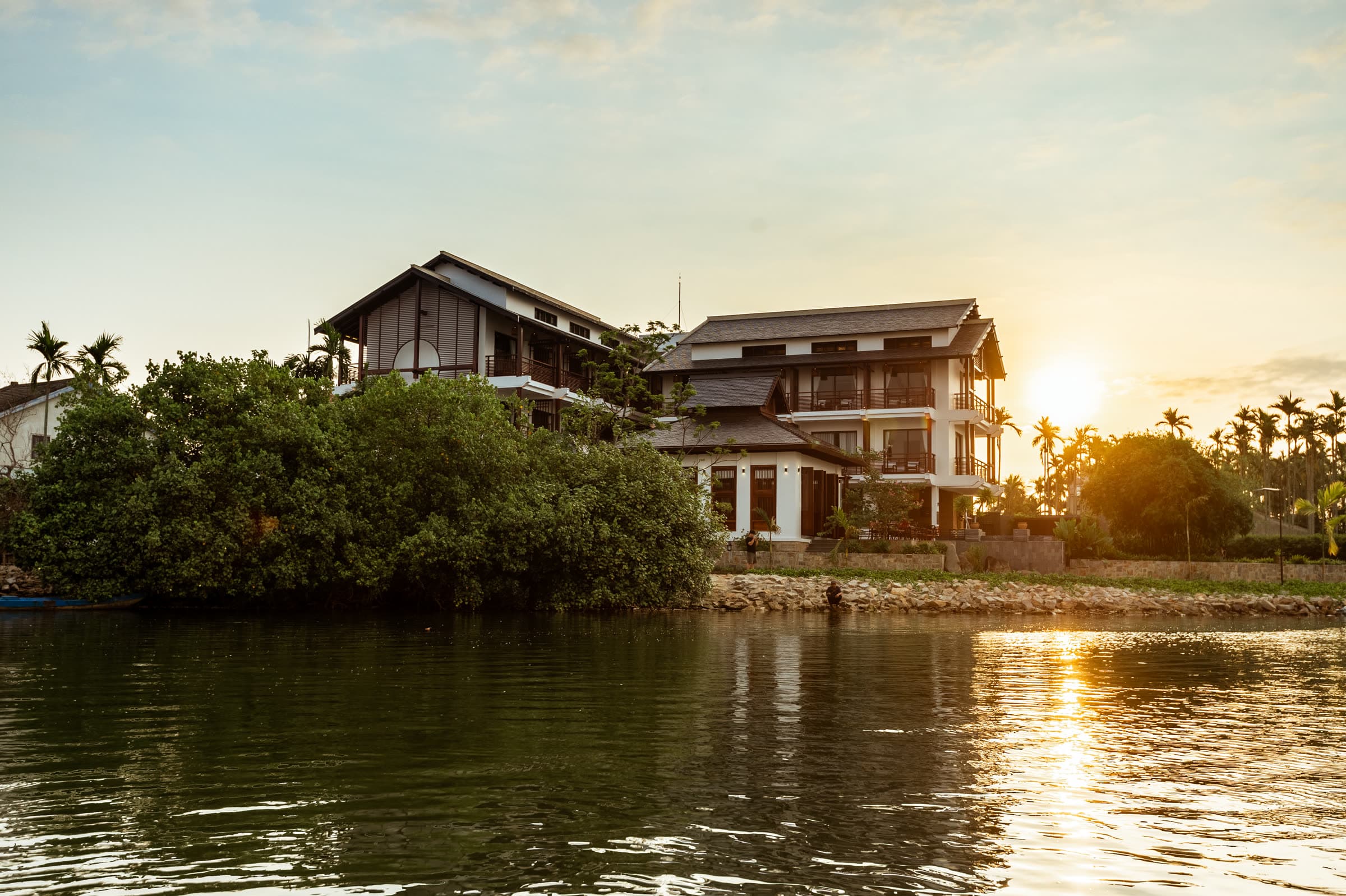
No. They are two different rivers. Nghê Prana is on the Thu Bồn River, on the south shore of Cẩm Nam island (15.8704° N, 108.3454° E). The lantern boats and the candle release are on the Hoài River (sông Hoài), which runs in front of the Old Town between the An Hội and Cẩm Nam bridges, on the other side of the island — about 2.2 km away in a straight line, and not visible from any of our rooms, balconies, the terrace or the pool. Guests go to the festival: 3.2 km, about 10 minutes on the bicycles included with every room, 40 minutes on foot, or a short taxi ride — then come back to a quiet room on a dark stretch of river.
What's the best place to stay for the Hoi An Lantern Festival?
Staying in the Old Town core puts you in the crowd; staying on the quiet side of the river keeps you close but calm. Be clear about one thing when you book anywhere: the candle-lanterns and lantern boats are only on the Hoài River (sông Hoài) in front of the Old Town, between the An Hội and Cẩm Nam bridges, so only rooms facing the Hoài can see them. Nghê Prana does not face it — we are on the Thu Bồn River, a different river, on the south shore of Cẩm Nam island, and you cannot see the lantern release from our rooms, balconies, terrace or pool. It is 3.2 km away: 10 minutes on the bicycles included with your room, or 40 minutes on foot. (Correction, 24 September 2026: an earlier version of this answer said you could watch from a Nghê Prana balcony. That was wrong.)
Do Hoi An hotels book up for the lantern festival?
Rooms that actually overlook the Hoài River (sông Hoài) — the Old Town's river, between the An Hội and Cẩm Nam bridges — fill first for the 14th-of-the-lunar-month dates, and the biggest night — Nguyên Tiêu on 2 March 2026 — is the earliest to sell out. "River view" alone is not enough: Hội An has two rivers. The lanterns are on the Hoài; most river-view rooms in Hội An, including ours, face the Thu Bồn, where no lanterns are released. If seeing the lanterns from your room matters, ask the hotel which river the room faces before you book.
References & Sources
Trung tâm QLBT Di sản Văn hóa Hội An (2020). Kiến trúc sư Ba Lan Kazimierz Kwiatkowski với Hội An. hoianheritage.net. View source
TTXVN / Tuổi Trẻ (2025). Di sản thế giới Hội An và Mỹ Sơn chính thức trực thuộc Đà Nẵng, công bố bộ máy mới. Tuổi Trẻ. View source
Đời sống & Pháp luật (2026). Rằm tháng Giêng 2026 là ngày nào Dương lịch?. doisongphapluat.com.vn. View source
Báo Người Lao Động (2026). Ngày đẹp, giờ lành cúng Rằm tháng Giêng 2026. Người Lao Động. View source
Trung tâm Quản lý Bảo tồn Di sản Văn hóa Hội An (2024). Đêm phố cổ Hội An (Đêm Rằm Phố Cổ). hoianworldheritage.org.vn. View source
Mạnh Cường (2026). Lần đầu Hội An tổ chức Lễ hội đèn lồng quốc tế (31 Jul 2026 09:48) — UBND TP Đà Nẵng plan: 3–6 Dec 2026, theme "Hội An – Sắc màu di sản". Báo Thanh Niên. View source
Lê Trung (2026). Hội An lần đầu tiên tổ chức Lễ hội đèn lồng quốc tế (31 Jul 2026 08:58) — installations kept until Tết Nguyên tiêu 2027. Tuổi Trẻ Online. View source
Quảng Nam Tourism (2026). Bảng giá vé Phố cổ Hội An 2026 — 120.000₫ khách quốc tế / 80.000₫ khách Việt Nam (updated 20 Jan 2026). quangnamtourism.com.vn. View source
Lịch Ngày Tốt (2026). Xem ngày tốt xấu ngày 22/12 — Lịch âm 14-11-2026 (Bính Ngọ); second conversion for the last 2026 lantern night. lichngaytot.com. View source
Every room at Nghê Prana is designed around the science of sleep. Blackout curtains, nightly aromatherapy turndown, and riverside quiet — experience what real rest feels like.
Riverside hotel rooms on the Thu Bồn, ten minutes by bicycle from the Ancient Town. Whether it's one night between Hue and Da Nang or a full week of doing nothing — we kept your room quiet.
Free cancellation · Direct from the family who built the hotel

 WhatsApp
 Zalo
Zalo