You do not need to speak Vietnamese to travel in Hội An — most people you will interact with speak some English — but learning 20 phrases changes the texture of every day. People smile, prices soften, and the language tells you things about Vietnamese culture that no guidebook does. Here are the twenty, in order of usefulness.
A note before we start. Vietnamese has six tones — ngang (flat), huyền (low falling), sắc (high rising), hỏi (dipping), ngã (broken-rising), nặng (heavy-low). The tone changes the meaning. Ma with flat tone means "ghost." With falling tone mà it means "but." With rising má it means "mother" or "cheek." It feels impossible at first. It becomes natural with practice — and in Hội An, you will hear the central Vietnamese accent, which is softer than the Hanoi standard you may have heard in apps.
The cultural rule: try, and try badly. Vietnamese people are genuinely warm with foreigners who attempt the language. A mispronounced xin chào is better than a confident hello. Even at 30% accuracy you are doing the social work of meeting people halfway.
The 20
1. Xin chào — Hello
Pronounced "sin chow" (the x is pronounced like English s; chào rhymes with "now"). The universal hello. Slightly formal — Vietnamese often shorten to just chào with the relationship word (see #2). Use xin chào when you are not sure of the relationship.
2. Chào anh / chào chị / chào em — Hello (with relationship)
Chào anh ("chow ahn"): hello to a man roughly your age or slightly older
Chào chị ("chow chee"): hello to a woman roughly your age or slightly older
Chào em ("chow em"): hello to someone clearly younger
Vietnamese pronouns work by relative age and relationship, not by formality. Anh, chị, em are sibling words — older brother, older sister, younger sibling. Using them with strangers signals respect and warmth. This is the single biggest unlock for sounding less like a tourist.
3. Cảm ơn — Thank you
Pronounced "gam un" (the c is closer to a soft g; ơn is the u sound in English "fun"). The most-used phrase. Add the relationship word: cảm ơn anh, cảm ơn chị, cảm ơn em. Vietnamese culture treats verbal thanks as less central than the gesture and tone, but as a foreigner you are expected to say it freely.
4. Không có gì — You're welcome / no problem
Pronounced "khom kaw zee" (in central accent the gì sounds closer to "yi"). Literally "there is nothing." The standard response to thanks. You will hear it more than you say it.
5. Xin lỗi — Sorry / excuse me
Pronounced "sin loy" (the ỗ is a rising-broken tone, but at conversational pace it sounds like English "loy"). Used for apology and for getting attention politely — both meanings are the same word. Walking through a crowded market: xin lỗi opens the way.
6. Bao nhiêu? — How much?
Pronounced "bow nyew" (rhymes with English "few"). The single most-used market phrase. Point at the item, say bao nhiêu? The seller will say the price; if you do not catch the number, they will write it down or punch it into a calculator. Adding anh or chị at the end (bao nhiêu anh?) is friendlier.
7. Đắt quá — Too expensive
Pronounced "daht kwah" (the đ is pronounced as English d, distinct from d which sounds like z in the north or y in the south/centre). The standard polite bargaining opener at markets, not restaurants. In Hội An's tourist areas, expect the first price to be 30–50% above the local price; đắt quá signals you know.
8. Có / không — Yes / no
Pronounced "kaw / khom." Literally "have / not have." Vietnamese uses these as the all-purpose yes/no in many contexts, especially when answering questions about whether something exists, is available, or is included.
9. Tôi không hiểu — I don't understand
Pronounced "toy khom hyew." The honest fallback. Vietnamese speakers will slow down, simplify, or switch to gestures. Tôi is "I" in a neutral register — fine for travelers though Vietnamese themselves rarely use it in conversation.
10. Anh / chị nói tiếng Anh được không? — Do you speak English?
Pronounced "ahn / chee noy tyeng ahn duok khom?" Literally: "Older brother / older sister speak English language can not?" Use anh for men, chị for women. Most younger Vietnamese in Hội An's tourist areas do speak some English; this phrase asks politely.
11. Tôi muốn... — I want... / I would like...
Pronounced "toy moo-on." Pair with the menu item or pointing. Tôi muốn phở — "I would like phở." Tôi muốn cái này (kai nay) — "I would like this one." The grammar is forgiving; the tone matters more than the structure.
12. Phở — Phở (the noodle soup)
Pronounced "fuh" — short, with a soft falling tone. Not "foh." A point of national identity; the dish travelers and Vietnamese share daily. Bonus: bún ("boon") is the round rice noodle and refers to a whole family of dishes (bún chả, bún bò Huế, bún thịt nướng); mì ("mee") is wheat noodle; miến ("myen") is glass noodle.
13. Cà phê sữa đá — Iced milk coffee
Pronounced "kah feh swah dah." Vietnamese iced coffee with sweetened condensed milk — the country's defining drink. Order it anywhere; ask for it without sugar (không đường, "khom doong") if you want to taste the robusta. Read about why Vietnamese coffee tastes like that for the full story.
14. Nước / nước lọc — Water / filtered water
Pronounced "nook / nook lok." Always ask for nước lọc (filtered water) over tap. Restaurants serve bottled or filtered as default; if uncertain, ask. Nước alone also means "country" — Vietnamese is full of these polysemies.
15. Ngon quá! — Delicious!
Pronounced "ngon kwah" (the ng- sound is the ng at the end of English "sing," but placed at the start of a syllable — the same sound starts hundreds of Vietnamese words). The universal compliment to a cook or restaurant. Vietnamese cooks light up at this; saying it to your noodle vendor is one of the small social pleasures of being here.
16. Tính tiền — The bill, please
Pronounced "teen tyen." Literally "calculate money." Catch the waiter's eye and say it; do not flag down or whistle. Tính tiền + a polite gesture (point to yourself, point to the table) gets the bill efficiently.
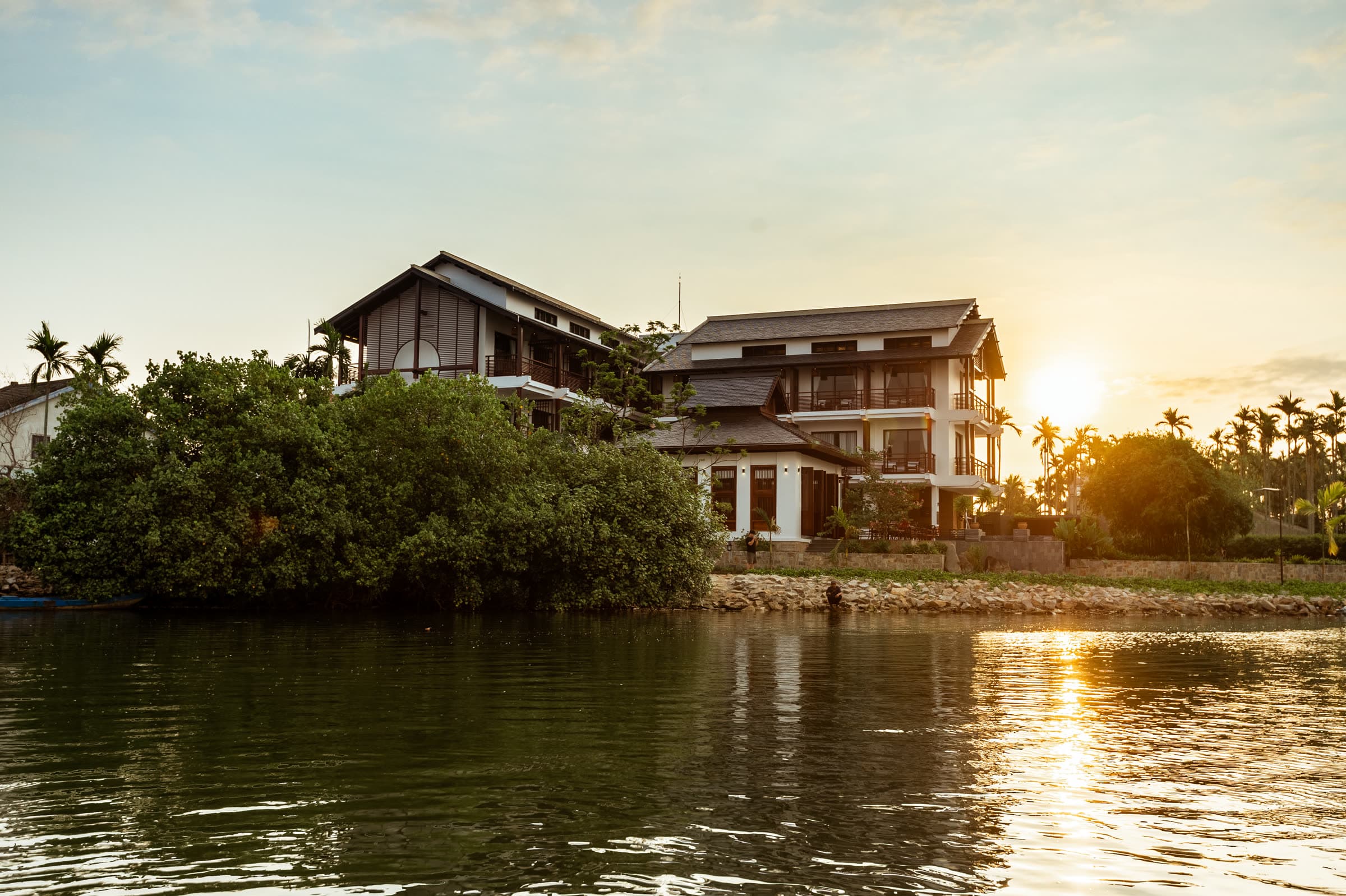
Planning a trip around this? See dates at our quiet riverside hotel on the Thu Bồn. Check availability →
17. Đi đâu? — Where are you going?
Pronounced "dee dow." A friendly greeting in Vietnamese — not actually a request for information. The expected answer is vague: đi chơi ("dee choy") = "going to wander." Older neighbors at the riverside will ask this and a vague friendly answer is all that is needed.
18. Cho tôi xin... — May I have...
Pronounced "chaw toy sin." A softer way to ask for something than tôi muốn. Cho tôi xin một cái này — "May I have one of these, please." More polite at small shops and food stalls. In central Vietnam the ch in cho is closer to tr — you will hear both.
19. Số... — Number...
Pronounced "saw." Followed by the number. Useful for room numbers, addresses, and pointing at items by number on menus. Vietnamese numbers 1–10: một, hai, ba, bốn, năm, sáu, bảy, tám, chín, mười ("mot, hai, ba, bone, nam, sow, bay, tam, cheen, muh-eye"). Learning these is the highest-leverage two hours you can spend.
20. Hẹn gặp lại — See you again
Pronounced "hen gap lai." Literally "appointment meet again." The warm goodbye, used when you have spent real time with someone — a host, a tailor, a cook, a guide. Vietnamese culture does not have a casual "bye"; this is the genuine version. People light up when a foreigner uses it.
Tones — the short version
You do not need to master tones to be understood. You need to:
Be willing to be wrong and let Vietnamese people gently correct you
Listen to the rhythm of how locals say a word and copy that, not what an app says
Accept that the central accent will sound different from your phrasebook (which is usually northern). In Quảng Nam province, dấu hỏi (dipping tone) and dấu ngã (broken-rising tone) often merge, and the r and gi sounds soften
Apps to practise (in order of usefulness for travelers): Duolingo Vietnamese, Drops, Google Translate with voice. None will teach you the central accent, but all will teach the alphabet and basic vocabulary. Once on the ground, listen to the staff at your hotel — every Hội An hotel's reception staff is a free pronunciation tutor.
On regional difference
Vietnamese has three major regional accents: Hanoi (north), Huế / Hội An (central), and Saigon (south). They differ in tone realisation, vowel quality, and some lexical choices. Central Vietnamese is the most distinctive — many northerners say it is the hardest to understand. As a traveler, this is good news: locals are used to dealing with imperfect Vietnamese, and your accent will be no more strange to them than another Vietnamese region's.
The language is one of the layers of Vietnam that becomes richer the longer you stay. Twenty phrases is a starting point. Forty is the threshold where conversations become possible. A hundred is where Vietnamese starts to feel like a living language rather than a list of sounds. The first twenty are these.
Community — the people who staff our reception will teach you their accent
Sources consulted: Vietnamese phonology — Wikipedia; regional accent overview from published Vietnamese linguistics; conversational consensus from Hội An hotel staff for central-accent pronunciation notes.
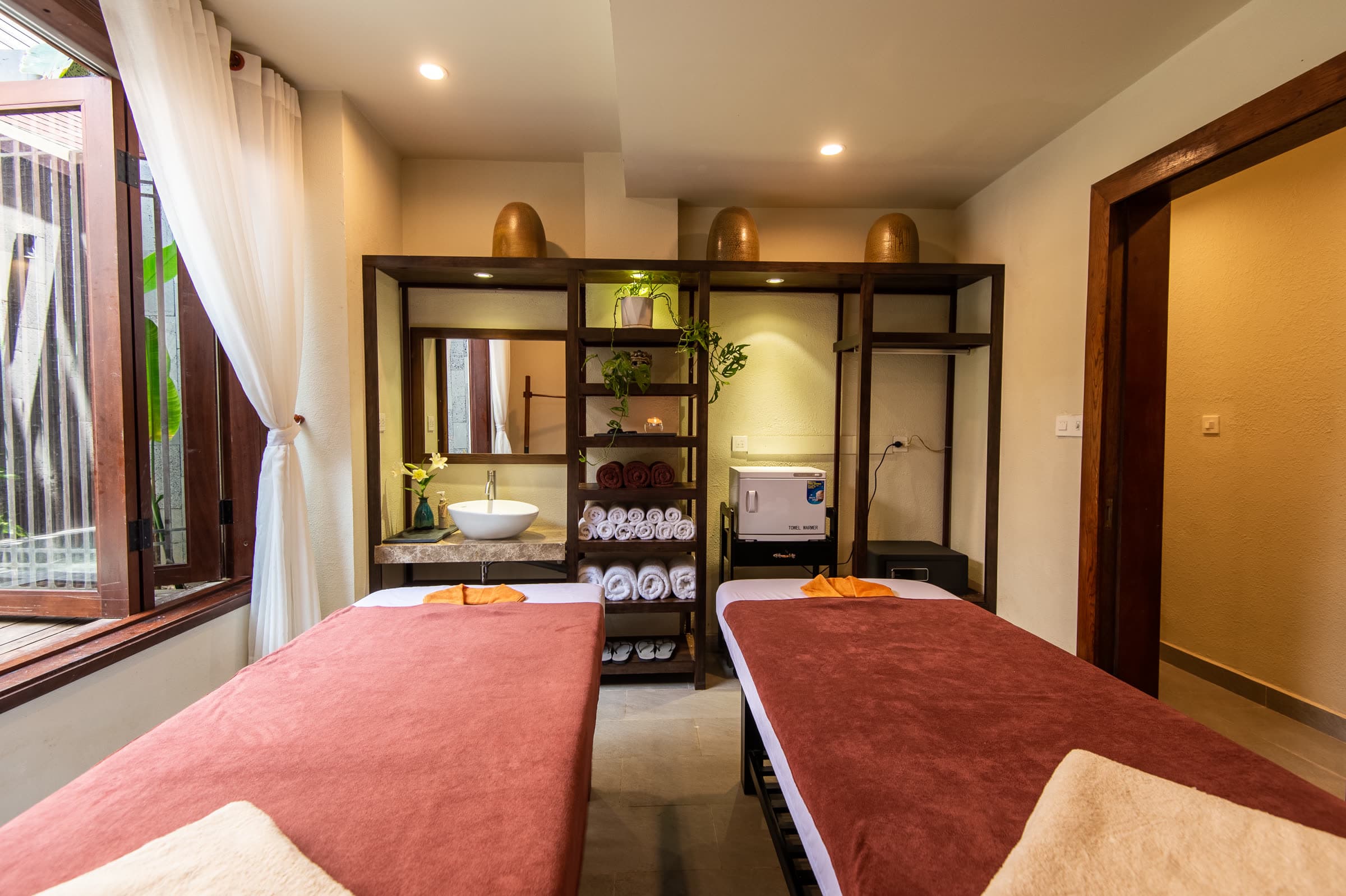
Every room at Nghê Prana is designed around the science of sleep. Blackout curtains, nightly aromatherapy turndown, and riverside quiet — experience what real rest feels like.
Riverside hotel rooms on the Thu Bồn, ten minutes by bicycle from the Ancient Town. Whether it's one night between Hue and Da Nang or a full week of doing nothing — we kept your room quiet.
Free cancellation · Direct from the family who built the hotel


 WhatsApp
 Zalo
Zalo