What "Riverside" Actually Means at Hội An Hotels — A Glossary
Hội An riverside hotel — a practical glossary of "riverside," "river view," and "river access" so you can read listings on Booking.com without guessing.
A Hội An riverside hotel can mean a property that opens directly onto the Thu Bồn — or it can mean a property near a canal a few blocks inland. Both technically use the word, and both will appear when you filter Booking.com or Google Maps for "riverside." This glossary defines the terms hotels actually use in Hội An so you can read a listing once and know what you'll see when you arrive.
Hội An sits on the Thu Bồn River — a 205 km river that drains a 10,350 km² basin and reaches the sea at Cửa Đại — plus a small braid called the Hoài River that fronts the Old Town's lantern walk. There are also a number of canals and irrigation channels through Cẩm Châu and Cẩm Nam. Most hotel listings collapse all of these into a single word: "riverside." The reality is more layered.
Riverside (used strictly)
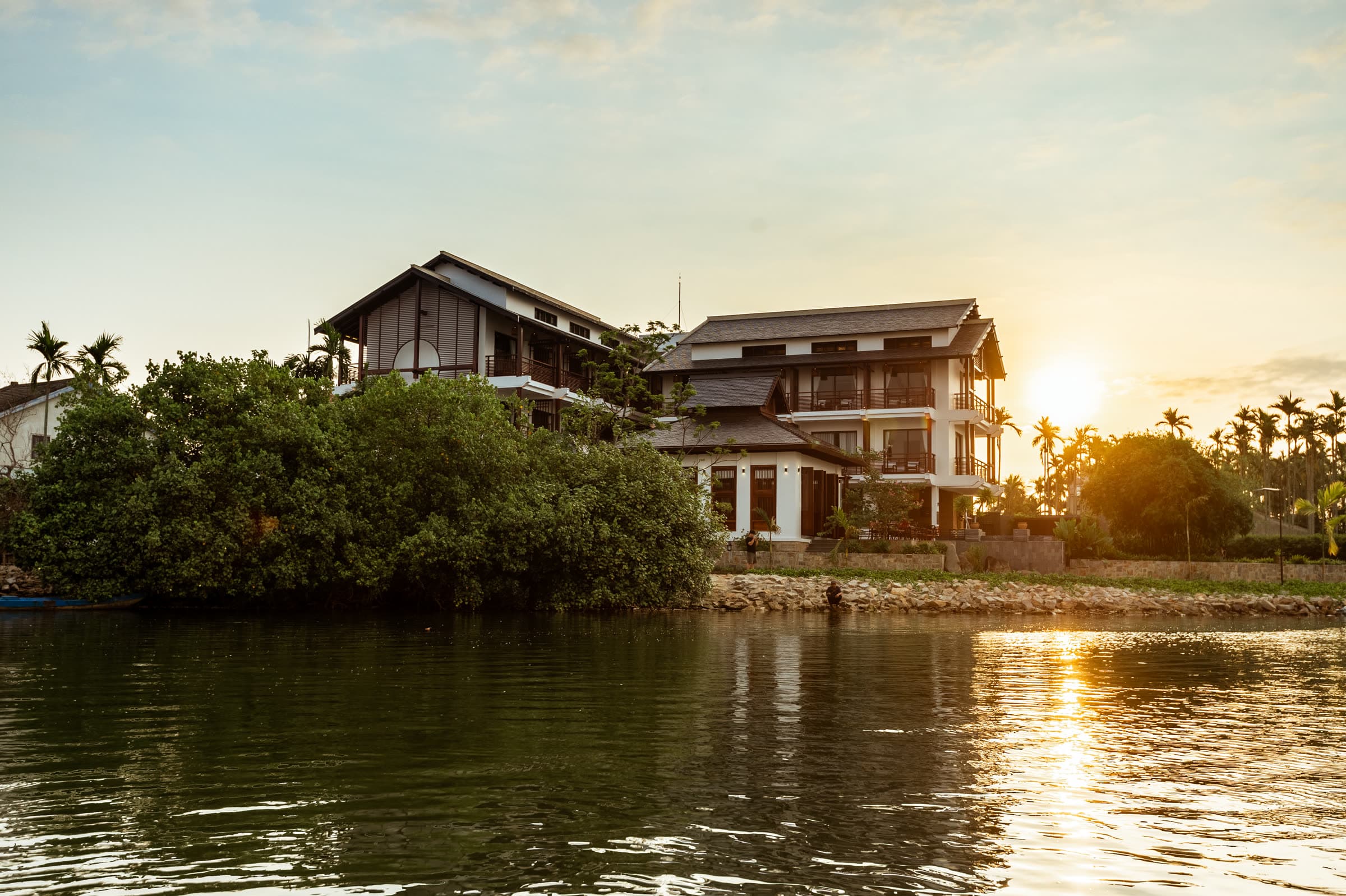
Strictly, a riverside property has its own frontage on the river — a terrace, garden, jetty, or building face that meets the water with no road in between. In Hội An, that's a small set: properties along the south bank of the Thu Bồn (Cẩm Nam), a handful along the Hoài River waterfront (Bạch Đằng and Nguyễn Phúc Chu), and a few further upriver in Cẩm Kim or downriver toward Cẩm Thanh. If a listing claims riverside in the strict sense, you should be able to step from the property to the water in under a minute and watch boats pass at eye level.
The Nghê Prana riverside hotel is on Cẩm Nam, the south-bank island, with a terrace meeting the Thu Bồn and a typical evening sound level around 39 dB(A). The Thu Bồn River pillar covers what the river itself does — the boats, the tides, the daily rhythm — and is a useful baseline before you read any individual listing.
Riverside (used loosely)
Loosely, riverside in a Hội An listing can mean within walking distance of the river, or visible from a high floor, or facing one of the inland canals. None of these are wrong; they're just not the strict sense. If the photos are taken from a rooftop and the ground-floor entrance opens onto a normal urban street with no water in sight, the property is "near the river" rather than on it. That's still a valid match for many trips — a five-minute walk to the Hoài River waterfront is closer than most cities ever get you to water — but you should know which one you're booking.
River view
River view is a room-level claim, not a property-level one. It usually means: from this specific room, on this specific floor, you can see the river. It does not mean the property is on the river. You can have a river-view room in a property whose entrance is two or three blocks inland; the view depends on building height and angle. Always check the listing's photos taken from the room, not from the building's roof. If a hotel offers "river view" as a paid upgrade, it's worth confirming whether the view is full-frontage, partial-frontage, or "you can see a strip of water between two buildings."
Direct river view vs partial river view
Direct river view (sometimes "full river view") means the room's window or balcony looks straight at the water with nothing between. Partial river view means the river is in the field of view but with significant obstruction — buildings, trees, an alley. In Hội An's older buildings, where rooms are deep and windows are small, "river view" honestly is often partial. That's not a bad thing — it's how the architecture works — but it's worth asking.
River access
River access is an operational term, not a marketing one. It means the property has a usable jetty, steps, or gate to the water — somewhere a small boat can pick you up, or where you can launch a paddle. Few hotels actually need or have this, but if you plan to take a sunrise boat trip, it's the variable that matters. Without river access, you walk to a public pier; with it, the boat comes to you.
Canalside
Several Hội An properties sit on the small inland canals that thread through Cẩm Châu and Cẩm Nam. Canalside in Hội An is a real category — calmer water, slower traffic, narrower channels with rice fields visible across — and it's often confused with riverside. The listing photos look similar; the experience is different. Canalside is quieter, smaller in scale, and farther from the boat traffic of the Thu Bồn proper.
Hoài River waterfront vs Thu Bồn waterfront
Planning a trip around this? See dates at our quiet riverside hotel on the Thu Bồn. Check availability →
The Hoài River is the smaller channel that fronts the Old Town — the bank where most of the iconic lantern photos are taken, where the wooden tour boats moor at night, and where the An Hội Bridge crosses to Nguyễn Phúc Chu street. The Thu Bồn is the broader main river, just south of An Hội island. A hotel on the Hoài is in the postcard. A hotel on the Thu Bồn is on the actual river. Both are "riverside Hội An." They give different experiences — one denser and louder, one wider and quieter.
What this means when you read listings
When a Hội An listing uses "riverside," do three checks. First, switch to satellite view in Google Maps and verify whether the building's footprint touches blue. Second, look at the property's own photos taken at street level — not the drone shots — to confirm the frontage. Third, read the most recent reviews for the words "river," "view," "balcony," and "noise" — recent guests describe what's actually true today.
For sleep-focused trips, the additional layer is sound. The Hoài River frontage is bright and active well past 10 p.m. during the Hội An lantern festival and on busy weekends. The south bank of the Thu Bồn — Cẩm Nam — is structurally quieter because the river itself acts as a buffer between the property and the Old Town soundscape. The Hội An hotel noise map breaks down the difference by neighbourhood with measured sound levels.
A short FAQ
Is "riverside" the same as "river view" on Booking.com? No. Riverside is property-level (the building meets the water). River view is room-level (this specific room can see water). A property can have one without the other.
Are Hoài River and Thu Bồn River the same river? They are connected. The Hoài is a smaller channel that fronts the Old Town; the Thu Bồn is the main 205 km river. The An Hội island sits between them. Most "Old Town riverside" listings are on the Hoài; most "south bank" listings are on the Thu Bồn proper.
Why is Cẩm Nam quieter than other riverside zones? Two reasons: first, it's a residential island rather than a hospitality-and-bar strip; second, the Thu Bồn itself separates Cẩm Nam from the Old Town's nightlife, so noise drops with distance over water. See the riverside-hotel guide for the structural reasons.
Does "riverside" cost more? Often, but not always. The price premium is usually for the view (a paid room-class upgrade), not the frontage (which the property either has or doesn't). A small hotel with genuine frontage can cost less than a larger property with marketed "river view" rooms three blocks inland.
Used precisely, "riverside" is one of the most useful words in a Hội An listing — it tells you the property's relationship to the river that defines the town. Used loosely, it tells you very little. Read it carefully and the rest of the booking decision gets simpler.
Every room at Nghê Prana is designed around the science of sleep. Blackout curtains, nightly aromatherapy turndown, and riverside quiet — experience what real rest feels like.
Riverside hotel rooms on the Thu Bồn, ten minutes by bicycle from the Ancient Town. Whether it's one night between Hue and Da Nang or a full week of doing nothing — we kept your room quiet.
Free cancellation · Direct from the family who built the hotel

 WhatsApp
 Zalo
Zalo