Why Vietnamese Coffee Tastes Like That — Phin, Robusta, and Cà Phê Sữa Đá Explained
Vietnamese coffee tastes like that because of three things: highland robusta, the phin filter, and condensed milk. The full explainer — history, kit, and varieties.
Vietnamese coffee tastes the way it does because of three specific choices stacked on top of each other: the bean (highland-grown robusta, not arabica), the brewer (a slow-drip phin filter that produces a syrupy concentrate), and the dairy (sweetened condensed milk, originally a substitute for fresh milk). Each of these decisions has its own history. Together they make a drink that is its own tradition — not a "version" of espresso or filter coffee, but a parallel coffee culture with its own internal logic.
This is the explainer. Geography, kit, math, history. By the end you'll know why a cà phê sữa đá in Hội An tastes the way it does, and you'll be able to read any Vietnamese café menu without guessing.
The geography: Vietnam is a robusta country
Most of the world's specialty-coffee conversation is about arabica — the milder, more aromatic species grown on cool tropical highlands. Vietnam grew up on the other species: robusta (Coffea canephora). It is hardier, higher-yielding, more caffeinated, and tastes denser, more bitter-chocolate, less floral.
The terroir story is straightforward: robusta thrives at lower elevations, in warmer, wetter climates with bigger temperature swings than arabica tolerates. The Central Highlands — Đắk Lắk, Lâm Đồng, Gia Lai, Đắk Nông — sit at 500–800 metres on rich red basalt soils and produce robusta at industrial scale. The provincial capital of Đắk Lắk, Buôn Ma Thuột, is sometimes called the coffee capital of Vietnam.
Why this matters in the cup: robusta has nearly twice the caffeine of arabica and a denser, more bitter, more chocolatey, less acidic flavour. Brewed strong — which is exactly what the phin does — it produces a concentrate that doesn't disappear under sugar or milk. Arabica brewed the same way would taste washed out. The bean and the brewing method co-evolved.
A short history: French plant, Vietnamese drink
Coffee was first introduced to Vietnam by the French in 1857 — initially by missionaries — with the first commercial plantations established around 1888 in Ninh Bình and Quảng Bình. Early plantings were arabica, but the climate and soils suited robusta better, and over the 20th century robusta took over.
The drink the French brought was filter coffee with hot milk. The drink the Vietnamese kept and reshaped was filter coffee with sweetened condensed milk, served over ice. The substitution wasn't aesthetic. Fresh dairy was scarce in Vietnam well into the mid-20th century, and condensed milk — shelf-stable, sweet, fatty — was what was actually available. The Vietnamese household didn't have a refrigerator full of cold milk; it had a tin of sữa đặc on the shelf.
Once the substitution stuck, it became its own thing. Condensed milk paired with robusta is a different drink than fresh milk paired with arabica. The dense bitter coffee meets the dense sweet milk and the result is a balance that neither half would produce alone.
Egg coffee — cà phê trứng — has a parallel origin story. It was invented in 1946 at Café Giảng in Hanoi by Mr Nguyễn Văn Giảng, then a bartender at the Sofitel Legend Metropole, when fresh milk was again unavailable. He whisked egg yolk with sugar and condensed milk to make a foam, floated it on the coffee, and the drink became Hanoi's signature. The café still operates today, run by the founder's son.
The kit: phin filter physics
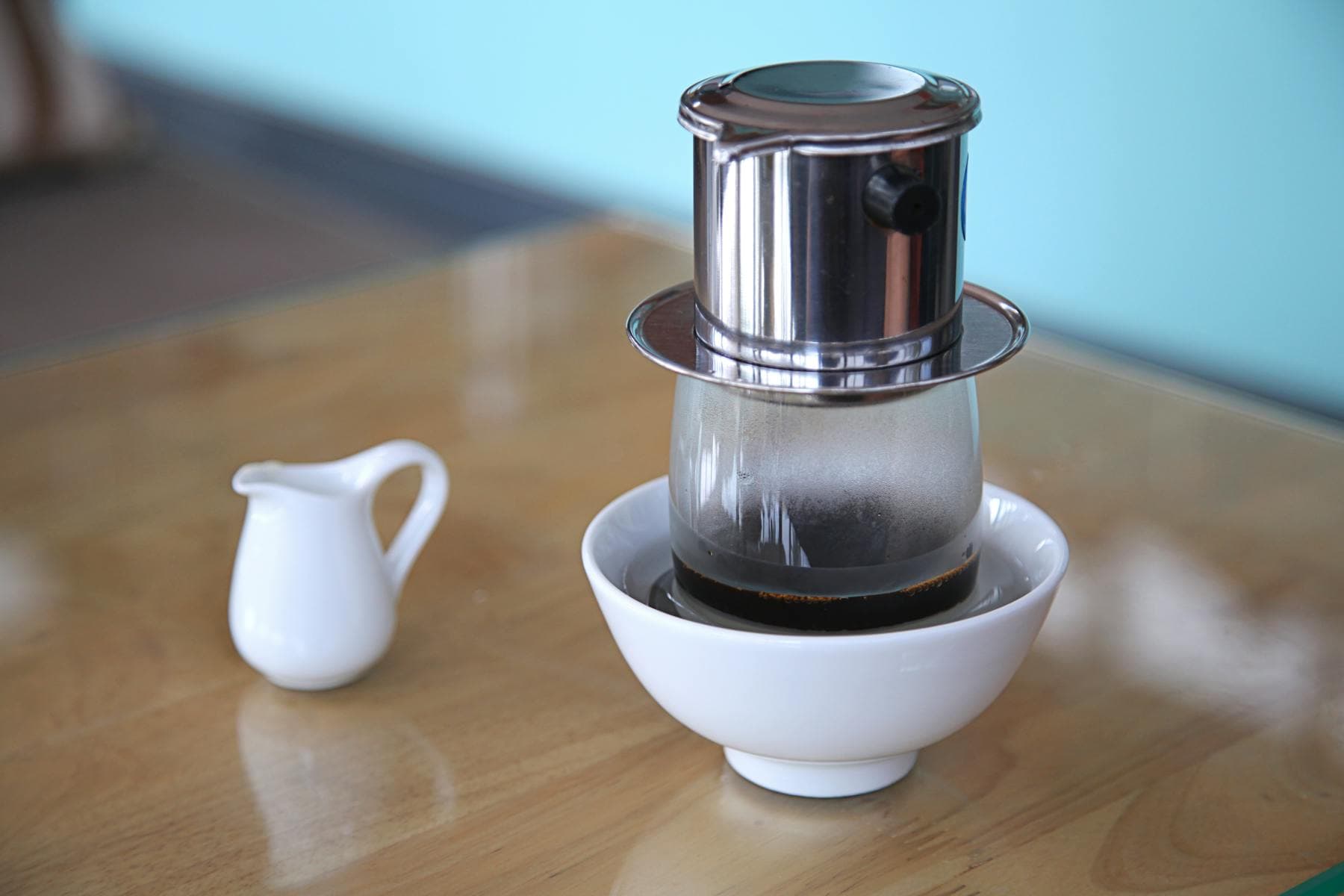
The phin (from the French filtre) is a small metal cylinder — usually aluminium or stainless steel — that sits directly on top of a glass. It has four parts: a base with perforated holes, a chamber that holds the coffee grounds, a press disc that compresses the bed, and a lid that doubles as a saucer.
The brew goes like this:
A heaped tablespoon (or two) of medium-coarse ground robusta goes into the chamber
The press disc is screwed lightly down on the bed — too tight and water won't pass; too loose and the brew rushes through and tastes thin
A splash of near-boiling water goes in first to "bloom" the grounds for thirty seconds
The chamber is then filled with hot water and the lid placed on top
Coffee drips into the glass below, slowly, over four to five minutes
The slow drip is the whole game. Where an espresso pulls in 25 seconds and a French press steeps in four minutes, the phin extracts at low pressure over the same time as a French press but with a far smaller water-to-coffee ratio. The result is a thick, intensely concentrated coffee — closer to a long espresso shot than to filter coffee. That intensity is why robusta works so well in this method: a milder bean would taste burnt; the dense robusta tastes deep and slightly bittersweet.
When you order a phin coffee in Vietnam, the drink arrives unfinished. The phin is still on top of the glass, dripping. Watching the last drops fall into your glass — and then stirring sugar or condensed milk through the concentrate — is part of the ritual. There is no rush.
The drinks: a working menu
Once you understand the bean, the brewer, and the dairy, every Vietnamese coffee on the menu is a small variation. The classics:
Cà phê đen nóng — black coffee, hot. Phin coffee, no sugar, no milk. Served small. Bracingly bitter. The purist's drink.
Cà phê đen đá — black coffee, iced. Same as above, poured over a tall glass of ice. Often with a small spoon of sugar. The everyday Vietnamese morning drink.
Planning a trip around this? See dates at our quiet riverside hotel on the Thu Bồn. Check availability →
Cà phê sữa nóng — coffee with sweetened condensed milk, hot. The condensed milk goes in the glass first; the phin drips on top; you stir it together at the end.
Cà phê sữa đá — the iced version of the above. The international ambassador of Vietnamese coffee. Condensed milk in the glass, phin drips down, stirred, then poured over ice. Sweet, dense, cold, heavily caffeinated. Drunk all day.
Bạc xỉu — Vietnamese for "white drop," from Cantonese. More milk than coffee. A small amount of phin coffee added to a larger pour of condensed milk plus hot water (or evaporated milk and ice for the cold version). The drink for people who like the warmth and sweetness of café-au-lait but want a Vietnamese accent.
Cà phê trứng — egg coffee. Hanoi specialty (see history section above). Whisked egg yolk + sugar + condensed milk floated on hot phin coffee. Tastes like a coffee tiramisu in a cup. The 1946 substitute that became iconic.
Cà phê muối — salt coffee. A modern Vietnamese invention, originated in 2010 in Huế by Hồ Thị Thanh Hương and Trần Nguyễn Hữu Phong. Phin coffee, condensed milk, and a layer of lightly salted whipped cream on top. The salt suppresses bitterness and amplifies sweetness — Vietnamese flavour philosophy in a glass.
Cà phê cốt dừa — coconut coffee. A blended drink popular in the south: phin coffee plus coconut milk, sometimes ice-blended into a slushy. Sweet, tropical, photogenic.
What to order in Hội An
Hội An's coffee culture skews casual. Pavement cafés on plastic stools. Riverside cafés with wooden chairs. Old shophouse cafés with worn tile floors. Most do every drink on the list above competently, and most cost a fraction of what the same drink costs at a chain.
Three suggestions for first-timers:
*Order cà phê sữa đá once.* The default Vietnamese coffee. If you've never had condensed milk in coffee, the texture and sweetness will surprise you. It is meant to be sweet.
*Try cà phê đen a different morning* to taste the bean alone. With or without a small spoon of sugar. This is when you notice the chocolate, the slight bitterness, the long finish that robusta brings.
*Make time for one cà phê trứng or cà phê muối.* These are the inventive Vietnamese coffees. Egg coffee in a quiet café feels like a small ceremony. Salt coffee is the modern surprise.
Our restaurant at Nghê Prana serves all of the above. We use Đắk Lắk robusta and a phin per cup; the drip takes the four minutes it always took. There is no fast version.
A coffee culture, not a lesser version
Vietnamese coffee is sometimes described in Western coffee writing as if it were a rougher cousin of espresso, or a sweeter cousin of pour-over. It is neither. It is a coffee tradition that grew out of a different bean, a different climate, a different brewing tool, and a different dairy supply. Judged on its own terms — a cold, sweet, dense, slow drink built around the local crop — it is one of the most coherent coffee cultures in the world.
The next time someone says Vietnamese coffee is "too strong" or "too sweet," translate it back to its origin: a French filter, a Vietnamese pantry, a tropical climate, and a hundred and seventy years of small adjustments. That is exactly what is in the glass.
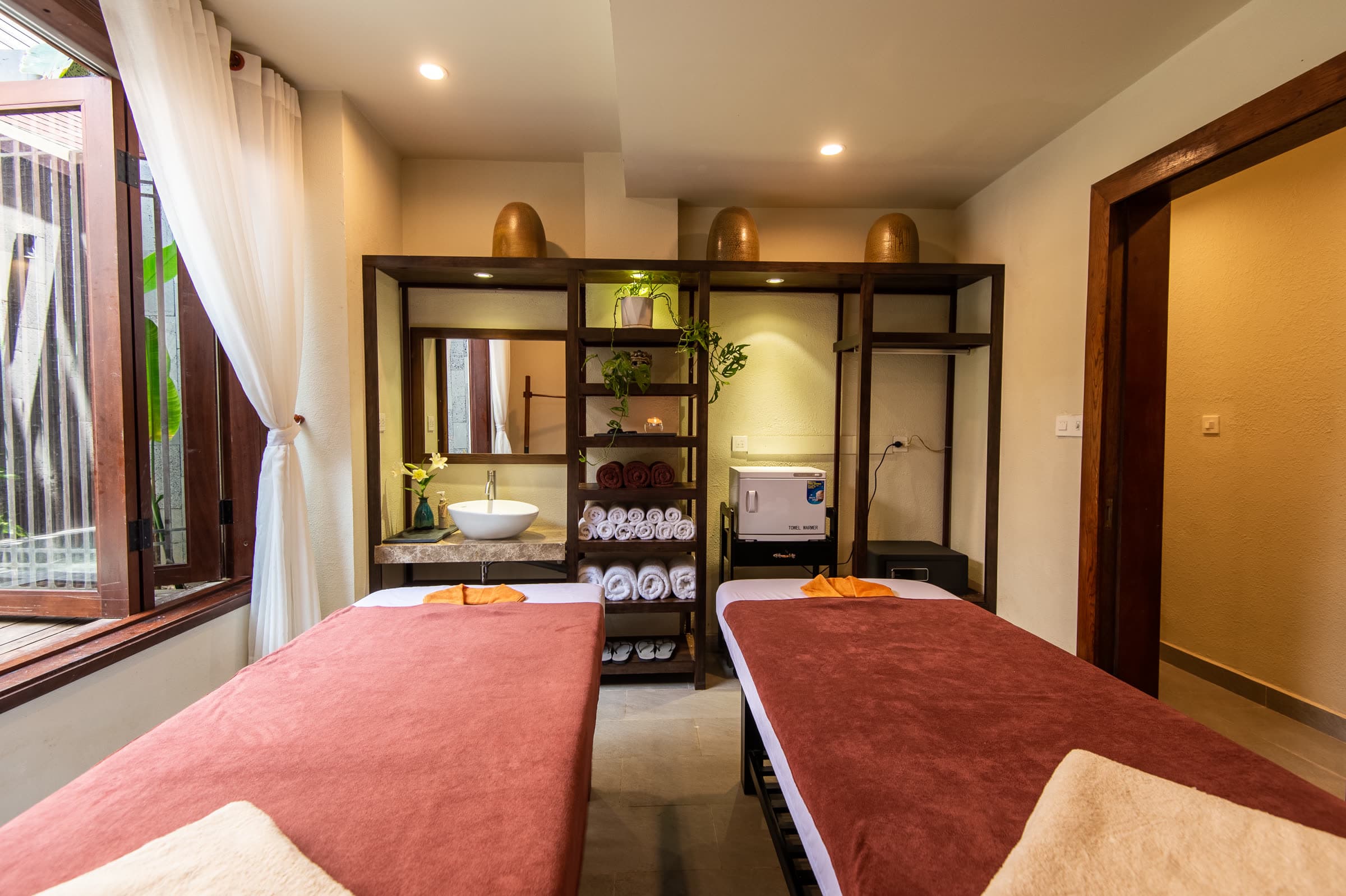
Every room at Nghê Prana is designed around the science of sleep. Blackout curtains, nightly aromatherapy turndown, and riverside quiet — experience what real rest feels like.
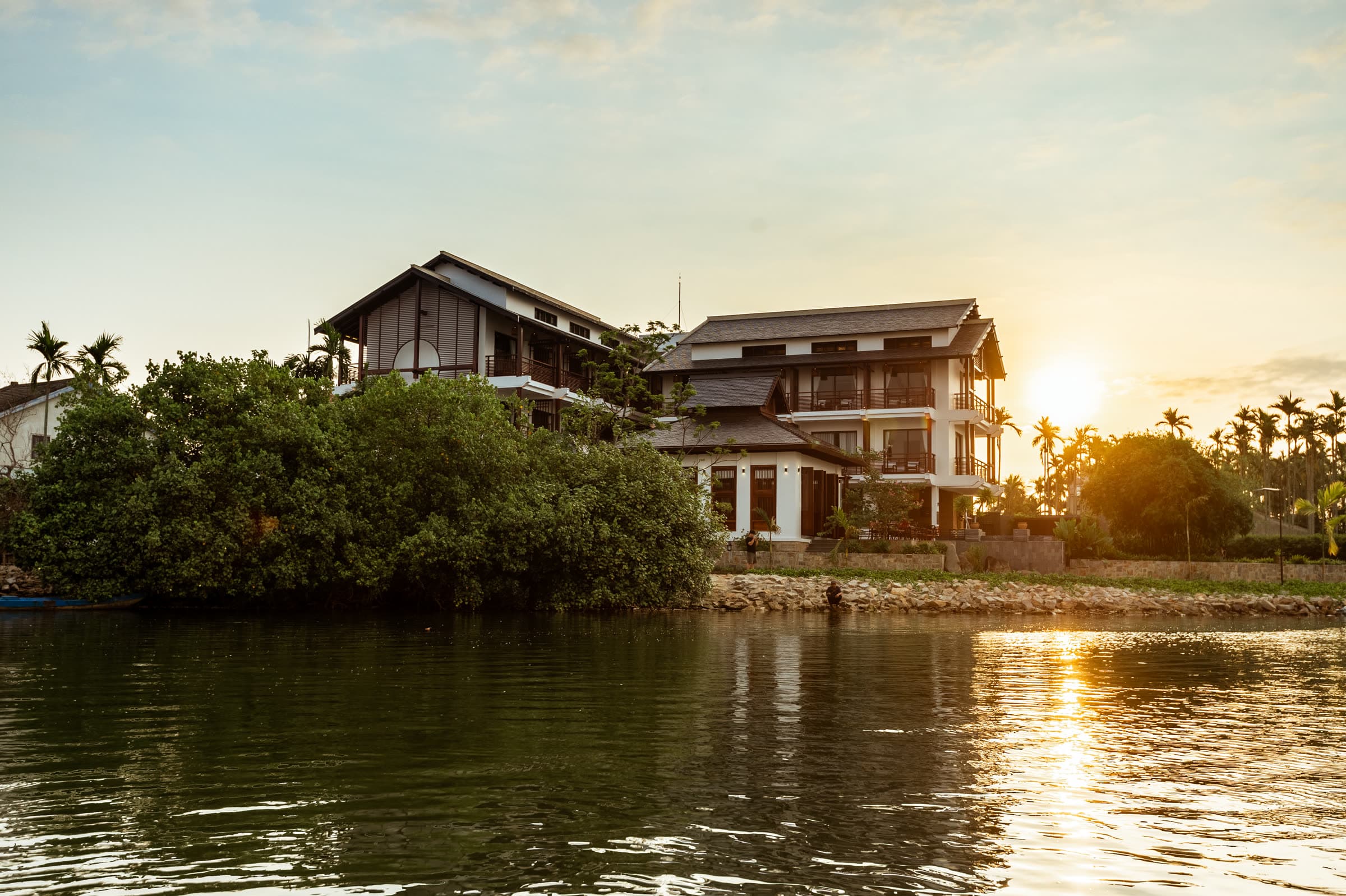
Riverside hotel rooms on the Thu Bồn, ten minutes by bicycle from the Ancient Town. Whether it's one night between Hue and Da Nang or a full week of doing nothing — we kept your room quiet.
Free cancellation · Direct from the family who built the hotel

 WhatsApp
 Zalo
Zalo