The Story of Cao Lầu — Why It Only Works in Hội An (and the Well That Makes It)
Cao lầu is the one Vietnamese noodle dish that genuinely cannot be made anywhere else. The story involves a Cham-era well, wood ash from Cù Lao Chàm, and one family.
Cao lầu is the one Vietnamese noodle dish that genuinely cannot be made anywhere else. The noodles are alkalized with ash from a tree that grows on an offshore island, the water comes from a 10th-century Cham well, and the recipe has been kept by one Hội An family since the late 1800s. Move any one of those elements out of Hội An) and the bowl on your table is not really cao lầu — it is a tribute.
What follows is the long version of that sentence: the history, the chemistry, the well, the family, and what 'authentic' actually means in 2026.
What cao lầu actually is
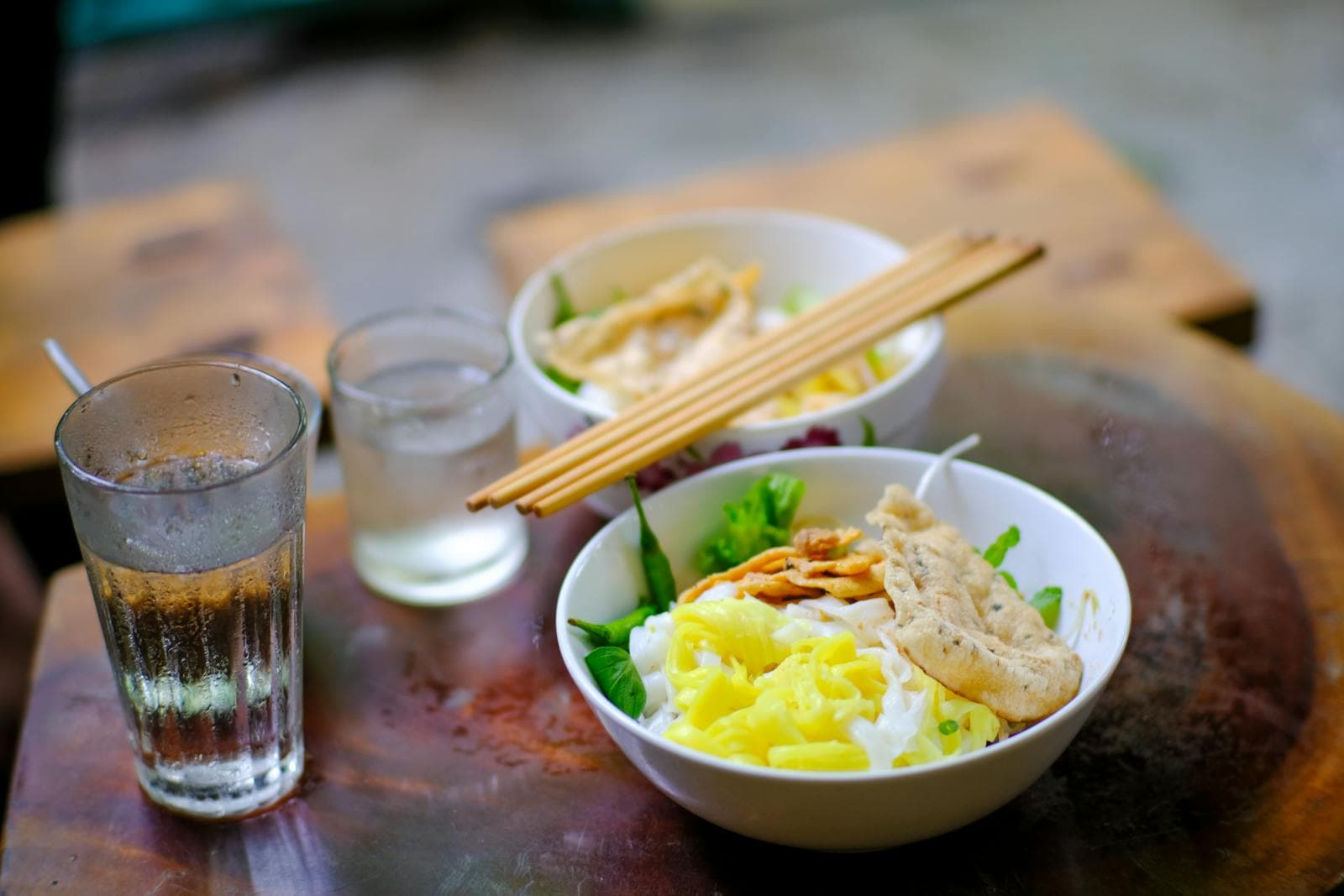
A bowl of cao lầu is a small set of ingredients arranged with almost no broth. At the bottom sit blanched bean sprouts. On top of them go the cao lầu noodles themselves — thick, chewy, faintly yellow-brown, somewhere between Japanese udon and Chinese alkaline noodles in mouthfeel. Over the noodles, the cook lays thin slices of pork marinated in five-spice powder, salt, sugar, garlic and soy sauce in a char-siu style locally called xá xíu. A handful of fresh greens — mint, perilla, Vietnamese coriander, lemon basil — goes on next. Finally, the cook scatters crispy fried noodle squares (made from the same cao lầu dough, deep-fried until they puff and shatter) on top, and pours over two or three tablespoons of dark, salty pork sauce from the xá xíu pan — no more.
The four required components of an authentic noodle — and they are required, not stylistic — are: rice grown in Quảng Nam province, water of a specific mineral profile, lye made from the ash of trees that grow on Cù Lao Chàm island (15 km offshore), and a multi-stage steaming-and-drying process. Subtract any one of those and the noodle changes — usually into something blander, paler, and softer. That is why cao lầu is the rare regional dish that exporters cannot reliably scale.
The Bá Lễ well — the geographic prerequisite
Sitting in a small lane between Trần Hưng Đạo and Phan Châu Trinh streets — formal address 45/17 Trần Hưng Đạo, Minh An ward, Hội An — is a square brick well most visitors walk past without noticing. This is the Bá Lễ well (giếng Bá Lễ), and for most of the past thousand years it was the most important water source in the merchant quarter.
What makes the water special is mineral profile, not folklore. The Bá Lễ aquifer sits on the alluvial fan of the Thu Bồn delta, recharged by both river seepage and freshwater inflow from the limestone hills inland. The water comes out of the well with a higher concentration of dissolved alum and calcium salts than rainwater or municipal supply, and that mineralization is what makes the next step — the alkalinization — work the way it does. Move the noodle-making to Hanoi or Saigon tap water and the chemistry simply does not produce the same result.
The noodle chemistry — why 'ash water' is essential
The technique cao lầu shares with several Asian noodle traditions is alkalinization: soaking rice in a solution of water and wood ash, which raises the pH and changes the way the rice starch behaves.
The dish today — and what 'authentic' means in 2026
The honest situation in 2026: cao lầu is sold everywhere in Hội An and most of what is sold is not made with the canonical noodle.
The Ngọc family's daily output is finite. Their two workshops, working through the night, produce enough fresh traditional noodles to supply a few dozen long-established restaurants and the central markets. The rest of the demand — the lantern-street tourist menus, the resort buffets, the export packets — is met by industrial wheat-or-rice noodles dyed to approximate the colour, sometimes with sodium carbonate added for chew, sometimes not. Many Hội An restaurants now serve cao lầu made with these substitutes; the dish on the plate is recognizably the same idea, but the noodle is doing different chemistry.
How to tell the difference without lifting the bowl into a laboratory:
Planning a trip around this? See dates at our quiet riverside hotel on the Thu Bồn. Check availability →
A canonical cao lầu noodle is thick (roughly 4–5 mm wide), yellow-brown rather than bright yellow, and has a pronounced bite that resists the bite for a fraction of a second before yielding. Industrial versions tend toward a brighter, more uniform yellow and a softer, more wheat-noodle texture.
The crispy noodle croutons should be made from the same dough. If the croutons are clearly fried wonton wrappers or store-bought rice crackers, that is a tell.
The pork should be sliced xá xíu-style — thin, dark-edged, faintly five-spiced. A pile of soft braised pork chunks suggests the kitchen is shortcutting the marinade.
The sauce should be a thin slick at the bottom of the bowl, not a pour-over broth. If the noodles are floating, the kitchen has misread the dish.
The canonical bowls are mostly at small family-run shops that have served the same recipe for decades. Without naming specific competing restaurants — the line between artisanal and industrial is a moving one and our job is not to relitigate every restaurant in town — the rule of thumb is: the more the menu specializes in cao lầu and the older the family running the shop, the more likely the noodle is the real one. The Bá Lễ well itself sits behind several such shops in the alley off Trần Hưng Đạo, which is not an accident.
Cao lầu has been recognized as a signature dish of Quảng Nam province by Vietnam's national tourism authority, and Hội An's heritage authorities have begun discussing whether the noodle-making process should be listed as a provincial intangible cultural heritage element. As of mid-2026, that listing is still informal — there is no UNESCO inscription for the dish itself.
How to eat it — the order matters
Cao lầu is brought to the table with the components stacked: sprouts under noodles under pork under herbs, croutons on top, two spoonfuls of dark sauce already poured. The natural first move — to add more broth — is wrong; there is no more broth. The first move is to mix.
Use chopsticks. Lift the noodles from the bottom of the bowl and turn them through the sauce, the sprouts, and the meat, the way you would dress a salad. The crispy croutons should be left mostly on top — they are texture, not stuffing — and broken into smaller shards as you eat, not stirred under from the start, or they will lose their crunch. Squeeze a wedge of lime over the top after the first mix. If chili sauce is on the table, Hội An's local chili paste is the right one, not Sriracha. A few small slices of fresh bird's-eye chili work too.
Eat the herbs between bites of noodle, not piled in. The perilla and mint are meant to reset the palate between forkfuls of the heavy xá xíu sauce — the dish is built on contrast, and over-mixing the herbs flattens it. Fish sauce on the side is optional; most locals do not add it.
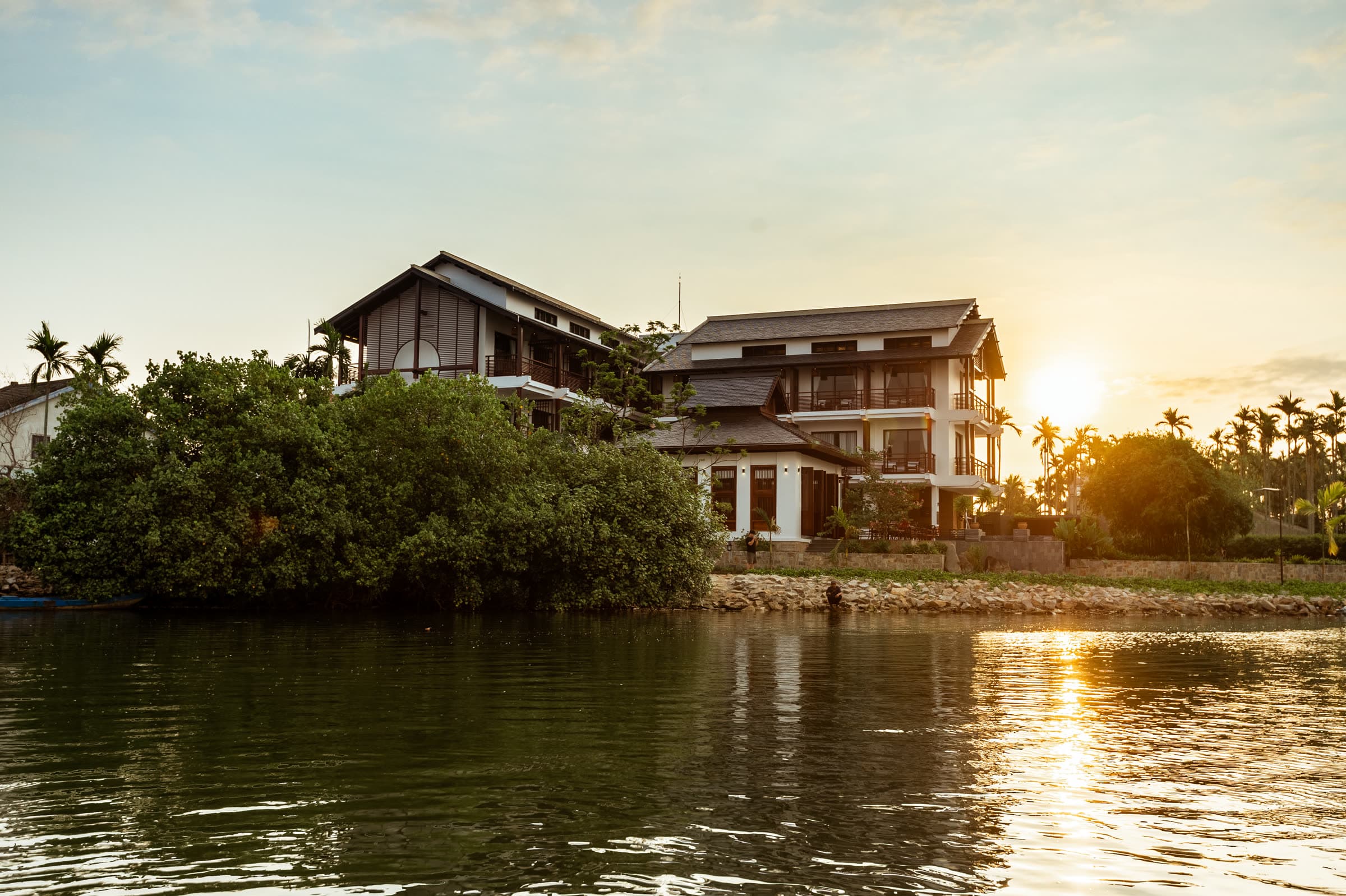
We serve cao lầu on the room-service menu at our riverside hotel on the Thu Bồn for 95,000 ₫, made with the canonical Bá-Lễ-aquifer-water noodle from the Hội An family workshop, xá xíu prepared in the kitchen the morning of service, herbs from Trà Quế village, and crispy croutons cut from the same noodle dough. It is the dish that taught us why some things are worth not industrialising.
If you are staying with us and want to see the noodle in its first life — before it becomes a bowl — the Bá Lễ well is a 15-minute walk into the ancient town. Go before 9 a.m., when the noodle makers' delivery cycles are still finishing and the lane behind the well still smells faintly of wet rice and woodsmoke.
The one thing cao lầu teaches about Hội An
Most of what makes a place worth travelling to is replicable. Beaches can be approximated. Lantern streets can be recreated. Pho and bánh mì have gone global and are arguably better in Melbourne than they are in some parts of Hanoi. Cao lầu is the rare dish that has refused that translation for 400 years and is likely to keep refusing.
The reason is not protectionism or recipe-secrecy, though both exist. The reason is that the dish is bound to a specific aquifer, a specific island's vegetation, a specific microclimate, and a single family's labour cycle — and removing any of those breaks the result in ways the diner notices on the first bite. Cao lầu is a thing of terroir in the strict French wine sense: a product whose character cannot be separated from the geography that produces it.
This is also, for the record, the reason we keep using the word 'riverside' instead of 'boutique' to describe where we are. The Thu Bồn river is the geographic fact under everything that happens here, including the noodle in the bowl in front of you. There is no version of Hội An — and no version of Nghê Prana — that ports cleanly to anywhere else.
Cao lầu is a Hội An noodle dish made of thick chewy noodles tossed with char-siu-style pork, fresh herbs, bean sprouts, crisp rice crackers, and a small amount of dense savoury sauce. It is not a soup — the noodles sit in just a few spoonfuls of liquid. The dish is unique to Hội An and is generally considered the city's signature.
Why can cao lầu only be made in Hội An?
Authentic cao lầu noodles are made using lye water filtered through ash from the trà nâm tree and water drawn from Bá Lễ well — a centuries-old well inside the Old Town. The mineral profile of that well water, combined with the ash treatment, produces the dense chewy texture cao lầu is known for. Versions made elsewhere using regular water and modern noodles do not reproduce the same bite.
Where is Bá Lễ well in Hội An?
Bá Lễ well is in the Old Town on Trần Hưng Đạo street, a few minutes' walk from the Japanese Covered Bridge. The well is set in a small courtyard between two residential buildings and is still in active use — water is drawn daily for cao lầu noodle makers and for the local altars. The well dates to the Chăm era, more than a thousand years old.
Is cao lầu vegetarian?
Cao lầu is not traditionally vegetarian — it is built around char-siu-style pork — but a vegetarian version (cao lầu chay) is served at Hội An's temple kitchens and at chay restaurants on Trần Cao Vân street, especially on the 1st and 15th of the lunar month. The chay version replaces pork with tofu and mushrooms while keeping the same noodles and herbs.
How much does cao lầu cost in Hội An?
A bowl of cao lầu at a local Hội An stall costs 40,000 to 70,000 VND (~$1.60 to $2.80) as of May 2026. Old Town tourist-zone restaurants charge 80,000 to 150,000 VND. The price difference reflects rent, not better cao lầu — the local stalls are generally where the dish is at its best.
Where is the best cao lầu in Hội An?
The cao lầu stalls most cited by Hội An locals are Quán Cao Lầu Thanh on Thái Phiên, Bà Bé on Trần Phú inside the market, and Hùng on Phan Chu Trinh. Each has a slightly different sauce ratio and noodle thickness. Locals generally pick by neighbourhood, not by ranking — every Hội An household has a favourite.
How do you eat cao lầu correctly?
Cao lầu is tossed at the table — mix the noodles, sauce, pork, herbs, and rice crackers thoroughly so the sauce coats everything. A squeeze of lime and a small amount of chili paste are added to taste. Do not add broth; cao lầu is not a soup. Most stalls serve it with a side of fresh greens to refresh the palate between bites.
References & Sources
Wikipedia contributors (2025). Cao lầu. Wikipedia, the free encyclopedia. View source
Wikipedia contributors (2025). Hội An (city). Wikipedia, the free encyclopedia. View source
Wikipedia contributors (2025). Japanese Bridge (Hội An). Wikipedia, the free encyclopedia. View source
Wikipedia contributors (2025). Sakoku Edict of 1635. Wikipedia, the free encyclopedia. View source
Wikipedia contributors (2025). Alkaline noodles. Wikipedia, the free encyclopedia. View source
UNESCO World Heritage Centre (1999). Hội An Ancient Town (inscription file C 948). UNESCO World Heritage List. View source
UNESCO Man and the Biosphere Programme (2009). Cu Lao Cham – Hoi An Biosphere Reserve. UNESCO MAB Programme. View source
Pham, Dan Q. (2012). Vietnam's Bowl of Secrets — the Ba Le well and the family behind cao lau. AFAR Magazine. View source
Atlas Obscura editors (2020). Cao Lầu — Local Well Water Is the Secret to Hội An's Signature Noodles. Atlas Obscura / Gastro Obscura. View source
Lee, Calvin (2017). Meet the Hội An Family Making Cao Lầu Noodles From Scratch. Saigoneer. View source
VnExpress International staff (2024). How to make Hoi An thick noodles cao lau. VnExpress International. View source
Vietnam National Administration of Tourism (2023). Enjoy a bowl of subtle 'Cao lau' and remember Hoi An forever. Vietnam Tourism Information (VNAT). View source
Da Nang City Tourism Information Portal (2023). Cao Lau Hoi An — a traditional noodle specialty of Hoi An, Vietnam. Danang Fantasticity (official city tourism portal). View source
Voice of Vietnam (VOV) (2023). Ancient wells — a vital aspect of Hoi An culture. VOV World. View source
Hoi An Day Trip editorial team (2024). Ba Le Well — Cham-era well in the Hoi An ancient town. hoiandaytrip.com. View source
Hoi An Tourism Department (2024). Bá Lễ Well — heritage profile. Discover Hoi An (Hoi An city government). View source
My Tiger Tour editorial team (2022). What's the difference between Mi Quang and Cao Lau?. My Tiger Tour Blog. View source
Akahori, A. & Yamamoto, M. (2006). Effects of 'Kansui' (Alkaline Solution) on Physical Property of Noodle. Journal of Home Economics of Japan, Vol. 57 No. 7. View source
Noodle Machine Pro technical team (2024). Are Alkaline Noodles Safe? The Science of Kansui and pH Balance. Noodle Machine Pro Technical Review. View source
Discover Nikkei editors (2014). Japanese Diaspora — Vietnam. Discover Nikkei (Japanese American National Museum). View source
Vinpearl editorial (2024). Cao Lau — the taste of Hoi An and Vietnam in a dish. Vinpearl. View source
Royal Hoi An Villas editorial (2024). Where to Eat the Best and Most Authentic Cao Lau Hoi An. Royal Hoi An Villas. View source
Vietnam.vn editorial (2024). Cao Lau Hoi An — the 35,000 ₫ noodle dish (visitor reception report). vietnam.vn (state news portal). View source
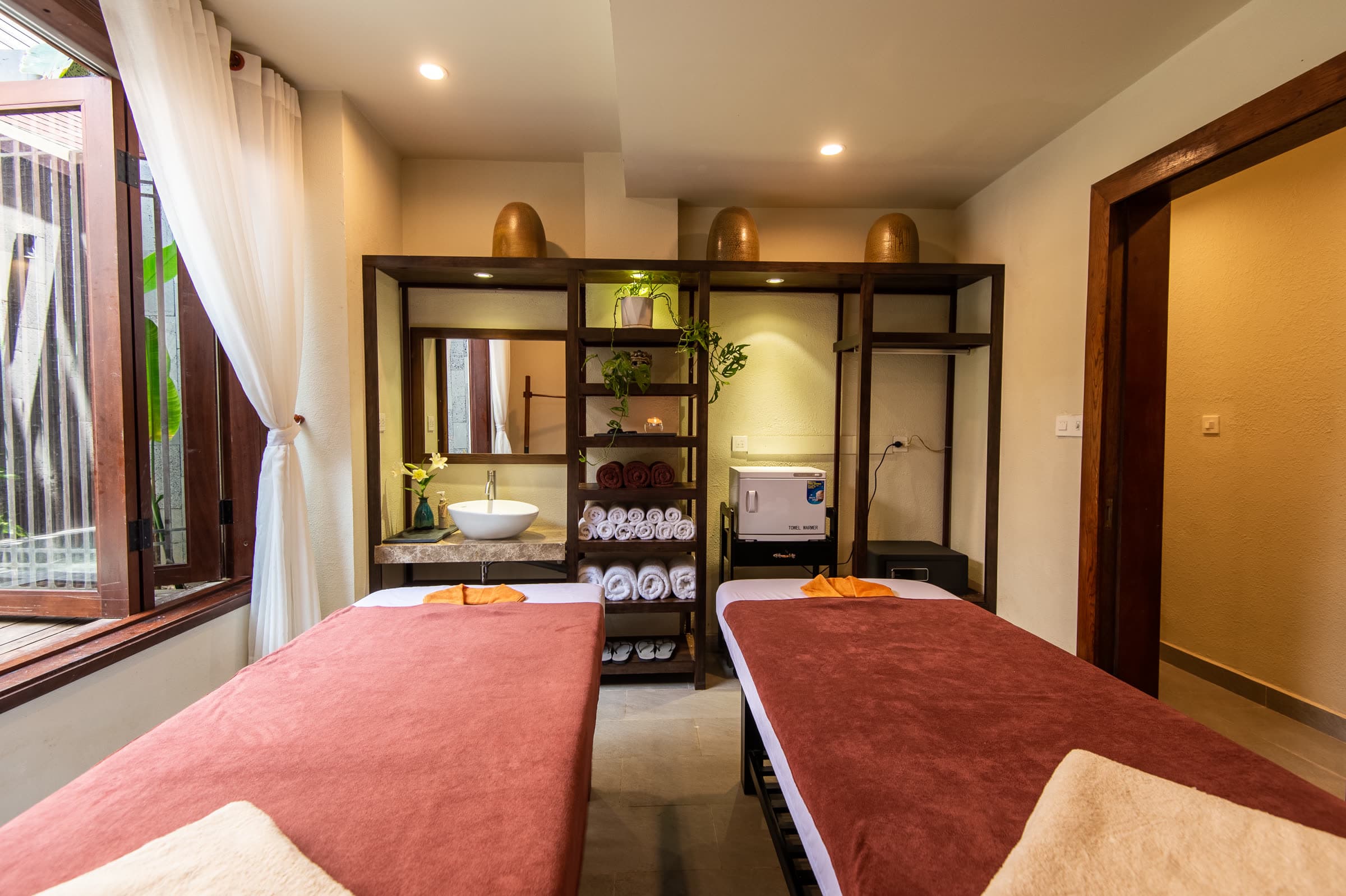
Every room at Nghê Prana is designed around the science of sleep. Blackout curtains, nightly aromatherapy turndown, and riverside quiet — experience what real rest feels like.
Riverside hotel rooms on the Thu Bồn, ten minutes by bicycle from the Ancient Town. Whether it's one night between Hue and Da Nang or a full week of doing nothing — we kept your room quiet.
Free cancellation · Direct from the family who built the hotel

 WhatsApp
 Zalo
Zalo