Sauna or Steam With a Cold: What the Trials Found, Where the Fever Line Is, and Why Our Own Menu Line Says Too Much
With a mild cold and no fever, a short, gentle sauna or steam is a comfort choice, not a treatment: a Cochrane review of six trials found no clear benefit from heated, humid air, and a Berlin trial of 157 people with a new cold found no difference in overall symptoms. With a fever, the flu or chest symptoms, every source we read that addresses them says no. A shared sauna can pass the cold on to others, and burns centres report scalds from bowls of hot water, many of them in children.
Is a sauna or a steam room good for a cold? With a mild cold, no fever and no feeling of being properly ill, a short, gentle session is a comfort choice, not a treatment; with a fever, the flu, chest symptoms, or a body that already feels drained, the answer is no. Here is what the trials found. A Cochrane review of six trials with 387 people concluded that "The current evidence does not show any benefits or harms" from breathing heated, humidified air for a cold, and graded the evidence as low quality. In the one trial we found that put people with a fresh cold in a sauna, in Berlin, 157 patients were split: the 80 breathing hot sauna air through a mask did no better on overall symptoms over a week than the 77 breathing room-temperature air in the same hot sauna. A UK trial of 889 people with respiratory infections found that advice to inhale steam did not ease their symptoms, and mild scalds were recorded in four of them. The prevention evidence is thinner still: one small trial from 1990, 25 people taking regular saunas against 25 who did not, found fewer colds over six months in the sauna group but colds that were no shorter and no milder, and a Finnish study of 2,210 middle-aged men linked frequent saunas with less pneumonia, an association, not proof. On the fever line the German and Austrian sources agree: an Austrian hospital's head of internal medicine says "Wer Fieber hat oder an schweren Erkältungssymptomen leidet, gehört ins Bett und nicht in die Sauna" (anyone with a fever or severe cold symptoms belongs in bed, not in the sauna), and Vietnamese hospital and vaccination-clinic pages say not to xông hơi with a high fever, which the Medlatec hospital group puts at above 38.5°C. A shared sauna can also pass the cold on to other bathers. Said against our own interest: our spa menu describes our private herbal steam (listed as Sauna on the menu; we have no dry sauna) as "lemongrass and local herbs in hot steam to open airways and loosen muscles"; the trials we found do not show that steam clears a blocked nose or shortens a cold, so read that line as how it feels, not as a treatment. Below are the trials with their numbers, the fever line in German, Vietnamese and English sources, the risk to others, home steam and burns, and what our riverside hotel spa on the Thu Bồn in Hội An can and cannot offer on a cold, wet December day.
Sauna or steam with a cold: the short answer
Question
What the sources say
Verdict
Does a sauna or steam ease a cold?
Cochrane (6 trials, 387 people): symptom relief "uncertain"; the evidence does not show benefits or harms, low quality. Berlin sauna trial (157 people): no difference in overall symptoms over 7 days
No clear benefit; comfort at most
Does breathing steam help a blocked nose?
The NHS suggests steam from a hot shower "to ease a blocked nose"; the trials Cochrane pooled found nasal airflow worse in one and better in another
Mixed; it may feel easier
Can you sweat out a cold?
Techniker Krankenkasse: viruses cannot be removed by sweating; the one trial that measured virus in the nose found no difference
No
Does regular sauna prevent colds?
One 1990 trial of 50 people: fewer colds over six months, no shorter or milder ones. Finnish cohorts of men: less pneumonia with frequent saunas (an association)
Possibly, for regular healthy users; not proven
Sauna or steam with a fever?
An Austrian internist, a German insurer's doctor and the insurer TK: no; Vietnamese pages: no xông hơi with a high fever (Medlatec: above 38.5°C)
No
With flu, chest pain or breathlessness?
NHS: flu leaves you "too unwell to carry on as normal"; chest pain or breathlessness is a doctor's matter
No; see a doctor
Sauna or steam with a sore throat or a runny nose?
An Austrian internist: if you go, choose mild heat such as a steam bath, and only if you are a regular sauna user; TK: newcomers should skip it
Only mild, short, if you feel well
A shared sauna with a cold?
TK and R+V: cold viruses can spread to other bathers; NHS: you are infectious until your symptoms have gone
Keep away from shared rooms
A bowl of boiling water at home?
Burns centres in the Netherlands, the UK, Australia and France report scalds, many of them in children
Never for children
Does our spa treat colds?
No. Our herbal steam is warmth; the menu's "to open airways" is not a finding
No
Is a sauna good for a cold? What the treatment trials found
No trial we found shows that a sauna or steam makes a cold shorter or milder overall. The best summary is Cochrane's review of heated, humidified air for the common cold, by Singh and colleagues. It starts from the idea behind the remedy: "The theoretical basis is that steam may help congested mucus drain better and that heat may destroy the cold virus as it does in vitro", in a laboratory dish. It found six randomised trials, from five publications, with 387 participants, people with a natural cold or one given to them experimentally. On whether the air relieved symptoms, the review is plain that "It was uncertain": one way of pooling two trials with 149 people "showed evidence of an effect (odds ratio (OR) 0.30, 95% confidence interval (CI) 0.16 to 0.56; 2 studies, 149 participants), but the random-effects analysis showed no significant difference in the results (OR 0.22, 95% CI 0.03 to 1.95)", and the authors add, "There is an argument for using either form of analysis." The number of people who said their symptoms had resolved "was not significantly higher in the heated humidified group" (2 trials, 124 people), and one trial that measured virus in nasal washings found "no significant difference between treatment and placebo groups". Because the results pointed different ways on different outcomes, "we graded the quality of the evidence as low"; "Some studies reported minor adverse events (including discomfort or irritation of the nose)" (Cochrane Database of Systematic Reviews, 2017). One detail matters for anyone reading the review as a verdict on saunas: its conclusion is about air "delivered via the RhinoTherm device", a nasal device, not a sauna or a steam room. The closest thing to a sauna trial is from Berlin. Between November 2007 and April 2009, at a sauna in the city, "157 patients with symptoms of the common cold were randomly assigned to an intervention group (n=80) and a control group (n=77)". Both groups sat in a hot sauna in a winter coat; the difference was the air they breathed, "hot dry air" for one group and "dry air at room temperature" for the other, for three days, with follow-up to day 7 (Pach and colleagues, Medical Journal of Australia, 2010). A 2018 review describes the set-up in more detail: "Face mask breathing hot dry air at 90°C, 20% RH in treatment group; Face mask breathing cool, dry air at 24°C, 20% RH in control group", and people "sitting for 3 minutes fully winter-dressed in a Finnish sauna daily over 3 days" (Hussain and Cohen, 2018). The result: symptom scores over the week, added up, were 31.2 in the hot-air group against 35.1 in the control group, a difference of "-3.9 [95% CI, -9.7 to 1.9]; P=0.19", and the authors concluded that "Inhaling hot air while in a sauna has no significant impact on overall symptom severity of the common cold." The hot-air group did score lower on day 2 and took less cold medicine on day 1, 3% against 15% in the review's account, and rated the treatment more effective on day 7. So this trial tested breathing hot air, with both groups getting the body heat, and on the main measure it found no difference.
Two large UK trials tested advice to breathe steam at home, and neither found it worked on its main measure. In the first, "889 patients were randomised", people aged 3 and over with an acute respiratory tract infection seen by their family doctor, to advice on painkillers and to steam inhalation or none; the main measure was symptom severity on days 2 to 4, and "Neither advice on dosing nor on steam inhalation was significantly associated with changes in outcomes." "Mild thermal injury with steam was documented for four patients (2%) who returned full diaries, but no reconsultations with scalding were documented" (Little and colleagues, BMJ, 2013). In the second, adults with chronic or recurrent sinus trouble were advised to use nasal salt-water rinses, steam, both or neither; 871 returned their first questionnaires, 232 of them in the steam group, and were followed for 6 months. "Steam inhalation reduced headache but had no significant effect on other outcomes", and the authors' verdict was that "Advice to use steam inhalation for chronic or recurrent sinus symptoms in primary care was not effective" (Little and colleagues, CMAJ, 2016). Against these, the NHS tells people with a cold to "breathe in steam to ease a blocked nose – try sitting in the bathroom with a hot shower running" (NHS, last reviewed 22 March 2024). They are not quite in conflict. The NHS line is self-care advice for comfort, with the scalding risk taken out by using a shower rather than a bowl; the trials asked whether steam changes symptom scores enough to measure, and mostly it did not. So why do sauna sellers tell a different story? Because what they cite is not a trial of people with a cold in a sauna. They cite the prevention studies below, in regular, healthy users; laboratory reasoning about heat and viruses; or blood tests: in a 2026 Finnish study, 51 adults sat in a 73°C sauna for 30 minutes and their white blood cell counts rose, a change in a blood count, not an outcome in anyone with a cold (Heinonen and colleagues, Temperature, 2026).
Study
Who
Compared with
When measured
What it found
Cochrane review, Singh 2017
6 trials, 387 people with a natural or induced cold
Placebo air (nasal device)
During and after treatment
"uncertain" symptom relief; no benefits or harms shown; low-quality evidence
Pach 2010, Berlin
157 adults with a new cold, all in a hot sauna
Room-temperature air through the same mask
Days 2, 3, 5 and 7
No difference in overall symptoms; symptom score lower on day 2 only
Little 2013, UK (BMJ)
889 people aged 3 and over with a respiratory infection
No advice to inhale steam
Days 2 to 4
Steam advice did not help; mild scalds in 4 (2% of full diaries)
Little 2016, UK (CMAJ)
871 adults with chronic or recurrent sinus symptoms
No advice to inhale steam
3 and 6 months
Steam advice "not effective"; less headache only
Ernst 1990 (prevention)
50 people, 25 taking saunas
25 not taking saunas
Over six months
Fewer colds, roughly half in the last three months; not shorter or milder
Kunutsor 2017, Finland (prevention)
2,210 men aged 42 to 61, followed a median 25.6 years
Men taking one sauna a week or fewer
Over a median 25.6 years
Fewer hospital-diagnosed pneumonias with frequent saunas; an observational association
A sauna or steam session for people with a fever or flu
None found
None
None
We found no trial
Do regular saunas prevent colds? The prevention evidence
Possibly, for healthy people who take saunas regularly over months, but the evidence is one small trial and studies of Finnish men, and none of it is about a session taken once you are already ill. The trial most often cited is from 1990: "Twenty-five volunteers were submitted to sauna bathing, with 25 controls abstaining from this or comparable procedures", and "In both groups the frequency, duration and severity of common colds were recorded for six months." The sauna group had "significantly fewer episodes of common cold", "particularly during the last three months of the study period when the incidence was roughly halved compared to controls", but "The mean duration and average severity of common colds did not differ significantly between the groups", and the authors' own conclusion is cautious: "regular sauna bathing probably reduces the incidence of common colds, but further studies are needed to prove this" (Ernst and colleagues, Annals of Medicine, 1990). The abstract does not say how people were put into the two groups. That one study is what a "research shows" link on the Cleveland Clinic's sauna page points to, beside the line "Saunas may also help prevent the common cold and other viral infections" (Cleveland Clinic, 12 August 2024). The larger studies are observational. In Finland, the KIHD cohort study asked 2,210 men aged 42 to 61 how often they took a sauna and followed them for a median 25.6 years, during which 375 were diagnosed with pneumonia in hospital. Against men who took one sauna a week or fewer, the risk after full adjustment was "0.72 (0.57-0.90) and 0.63 (0.39-1.00)" for two to three and four or more saunas a week, and the authors wrote that frequent sauna bathing "is associated with reduced pneumonia risk in a middle-aged male Caucasian population" (Kunutsor and colleagues, Respiratory Medicine, 2017); the upper end of the second range reaches 1.00, no difference. A companion analysis of 1,935 men from the same study found the same pattern for respiratory disease as a whole, asthma, chronic lung disease and pneumonia together, and said frequent saunas "may be associated with a reduced risk" (Kunutsor and colleagues, European Journal of Epidemiology, 2017). Men who take saunas four times a week may differ in many ways from men who take them once, which is why these are associations, not proof. A 2018 systematic review of regular dry sauna found that "Forty clinical studies involving a total of 3855 participants met the inclusion criteria. Only 13 studies were randomized controlled trials and most studies were small", and asked for "More data of higher quality" on side effects (Hussain and Cohen, Evidence-Based Complementary and Alternative Medicine, 2018). The German health insurer Techniker Krankenkasse goes further than the studies do, writing that "Vorbeugend kann also Sauna sehr gut gegen Erkältung und Grippe schützen" (so, as prevention, sauna can protect very well against colds and flu), but it scopes its advice in the same paragraph: "Dies gilt allerdings nur für gesunde Menschen" (this applies only to healthy people) (TK, 10 April 2025). All of this is about dry Finnish saunas taken by healthy adults week after week; none of it tells you what one steam session does to a cold you already have.
Sauna with a fever, the flu or a chest infection: where the line is
With a fever, every source we read that addresses it says no sauna and no steam; where they differ is on a mild cold without fever, and they differ because they are talking about different people and different heat. The strictest is Harvard Health: "Don't take a sauna when you are ill, and if you feel unwell during your sauna, head for the door" (Harvard Health Publishing, 14 May 2020). R+V, a German health insurer, quotes its advisory doctor: "Aber Kranke haben in der Sauna nichts verloren – nicht nur wegen der Ansteckungsgefahr für andere Saunagänger" (people who are ill have no business in the sauna, not only because of the risk of infecting other bathers), and "Und bei Fieber ist die Sauna absolut tabu" (and with a fever the sauna is absolutely off limits) (R+V Infocenter, 31 January 2020). Techniker Krankenkasse grades its answer by who you are: for people who do not take saunas regularly, "ist es ratsam, bei ersten Anzeichen einer Erkältung auf die Sauna zu verzichten" (it is advisable to skip the sauna at the first signs of a cold); "Für regelmäßige Saunagänger:innen kann ein leichter Saunadurchgang bei leichten Erkältungssymptomen in Ordnung sein" (for regular sauna users, one light round with mild cold symptoms can be fine), as long as they leave at the first sign of feeling unwell; and "Bei schwerer Erkältung oder Fieber: In diesem Fall ist von Saunagängen dringend abzuraten" (with a severe cold or fever, saunas are strongly advised against) (TK, 10 April 2025). Dr Hans Jörg Neumann, head of internal medicine at the Elisabethinen hospital in Klagenfurt, Austria, goes furthest the other way: "Ein Saunabesuch kann dabei helfen, eine beginnende Erkältung im Keim zu ersticken" (a sauna visit can help nip a starting cold in the bud), but, the hospital's article adds, "Dies gelte jedoch nur für Menschen, die regelmäßig in die Sauna gehen und die wissen, dass sie die Sauna gut vertragen" (this applies only to people who go to the sauna regularly and know they tolerate it well), and "Grundsätzlich rät Neumann davon ab, als Neuling verkühlt in die Sauna zu gehen" (in principle, Neumann advises newcomers against going into the sauna with a chill). On fever he is as firm as anyone: "Auf keinen Fall sollten Menschen mit Fieber oder mit schweren Erkältungssymptomen in die Sauna gehen" (people with a fever or severe cold symptoms should on no account go into the sauna), because of the risk of "Kreislaufkollaps", a circulatory collapse (Barmherzige Brüder Österreich, undated; read 27 November 2026). His claim that a sauna can stop a starting cold is his opinion, not a trial finding; the Berlin trial above, run on people with a new cold, found no difference in overall symptoms. Vietnamese sources, written about xông hơi giải cảm (steaming for a cold) rather than a Finnish sauna, draw the same line at fever. Vinmec, a private hospital group, says that people with a high fever, fits, thirst or heavy sweating "không nên tùy tiện xông hơi mà phải đi khám ở cơ sở y tế" (should not steam on their own initiative but should see a doctor), and adds people who are weak or frail, older people and small children, pregnant women and new mothers, women during their period, people dehydrated by diarrhoea, "người đang bị sốt xuất huyết giai đoạn thoát dịch" (people in the plasma-leakage phase of dengue fever), and people with skin disease, high blood pressure, heart disease or mental illness (Vinmec, 11 July 2024). The vaccination chain VNVC: "Không nên xông hơi trong các trường hợp sốt cao, ra nhiều mồ hôi, cơ địa suy nhược, mệt mỏi hoặc có các bệnh lý nền nghiêm trọng như tim mạch, bệnh phổi tắc nghẽn mạn tính (COPD), trẻ nhỏ, phụ nữ mang thai hay vừa sinh con" (do not steam with a high fever, heavy sweating, a weak constitution, exhaustion or serious underlying illness such as heart disease or COPD, nor small children, pregnant women or women who have just given birth) (VNVC, updated 7 November 2026). The Medlatec hospital group gives a number: "Không xông khi đang sốt cao >38,5°C hoặc mất nước" (do not steam with a high fever above 38.5°C or when dehydrated) (Medlatec, 14 August 2025). The disagreement, then, is narrow. Everyone says no with a fever, a severe cold or feeling ill; the German and Austrian sources allow a light, mild session for experienced sauna users with a sniffle; Harvard and R+V say no whenever you are ill.
A 30-minute session in a 73°C sauna raised adults' body temperature to about this reading in a 2026 Finnish study; add a fever to that and you are past the line, so move the booking.
Heat puts its own load on the body, and that is the reason behind the line. A dry sauna raises the heart rate and drains water: "The average person will pour out a pint of sweat during a short stint in a sauna. The pulse rate jumps by 30% or more, allowing the heart to nearly double the amount of blood it pumps each minute" (Harvard Health Publishing, 2020; a US pint is about half a litre). It also raises body temperature, in the 2026 Finnish study "from 36.4 ± 0.5°C to 38.4 ± 0.7°C" in 51 adults after 30 minutes at 73°C, one tenth of a degree below the 38.5°C that Medlatec calls a high fever. VNVC explains the consequence for someone who already has one: "Ở người sốt cao, nhiệt độ từ hơi nước không mang lại tác dụng hỗ trợ giải cảm, cúm mà còn có thể làm tăng thân nhiệt, dẫn đến tình trạng mất nước khiến người bệnh mệt mỏi hơn" (in people with a high fever, the heat of the steam does not help the cold or flu, and can raise body temperature further and lead to dehydration that leaves them more exhausted). The NHS's self-care for flu points the same way, to rest and fluids: "drink plenty of water to avoid dehydration (your pee should be light yellow or clear)" (NHS, last reviewed 3 February 2026). The Cleveland Clinic's family doctor puts the fluid point bluntly for healthy users: what the scales show after a sauna "is not weight loss, that is dehydration". So the signs that make a sauna or steam a bad idea today are these:
A fever or a high temperature. Every source above says no; Medlatec puts the line at above 38.5°C. The NHS says to see a doctor if "you have a high temperature for more than 3 days".
Flu rather than a cold. The NHS tells them apart: flu brings "a sudden high temperature" and leaves you "exhausted and too unwell to carry on as normal", while a cold "Makes you feel unwell, but you're OK to carry on as normal".
Chest pain or breathlessness. With a cold, see a doctor if "you feel short of breath or have chest pain"; with flu, the NHS says to call the emergency number for "sudden chest pain" or "severe difficulty breathing". In Vietnam that number is 115.
Dehydration, vomiting or diarrhoea. Vinmec rules out steam for people dehydrated by diarrhoea, Medlatec for anyone dehydrated, and the NHS lists "peeing less than usual or dark, strong-smelling pee" as signs of dehydration.
A fever that could be dengue. In Vietnam, Vinmec excludes people in the leakage phase of dengue fever; a fever here is a reason to see a doctor, not to steam.
Feeling faint or unwell once you are in. Vinmec: "Trong quá trình xông, nếu thấy choáng váng, bủn rủn, khó thở, hồi hộp, tức ngực thì cần ngừng ngay" (while steaming, if you feel dizzy, weak, short of breath, a racing heart or a tight chest, stop at once).
Heart disease, high blood pressure or pregnancy. Vinmec lists all three, and VNVC heart disease and pregnancy, for steam even without a cold; our steam room vs sauna page has the cardiology sources.
Not being a regular sauna user. TK and the Klagenfurt internist both say people who do not take saunas regularly should not start with a cold.
Sharing a sauna or steam room with a cold
Illustrative photo, not our spa. In a crowded shared sauna, a cold is shared too.
Going into a shared sauna or steam room with a cold puts the other bathers at risk, and the German sources count that among the reasons to stay away. Techniker Krankenkasse lists "Ansteckungsgefahr: In der Sauna können sich Erkältungsviren leichter verbreiten, was ein Risiko für andere Saunagänger darstellt" (risk of infection: cold viruses can spread more easily in the sauna, which is a risk for other bathers), and R+V's advisory doctor names the risk to other bathers too. The NHS explains how long it lasts: "You're infectious until all your symptoms have gone. This usually takes 1 to 2 weeks", and "If you have a high temperature or do not feel well enough to do your normal activities, try to stay at home and avoid contact with other people until you feel better." Neither German source gives a number for how often colds pass in saunas, and we found no study that counted. What our menu says about ours: the one-person booking is a "Private Vietnamese herbal steam session", so with a mild cold you would not be sharing the air with strangers, and the two-or-more booking is priced per person to "Share the herbal steam (xông hơi) together", which means sharing it with the people you came with. The menu does not say whether a shared booking is only ever your own party, or how the room is cleaned and aired between bookings; ask when you book. If you are travelling as two and one of you has a cold, the NHS's advice not to share "towels or household items" with someone who has a cold is worth keeping in a steam room too.
Xông nồi at home: the bowl of hot water and the burns
Illustrative photo. Burns centres in four countries report scalds from steam inhalation over hot water, many of them in young children.
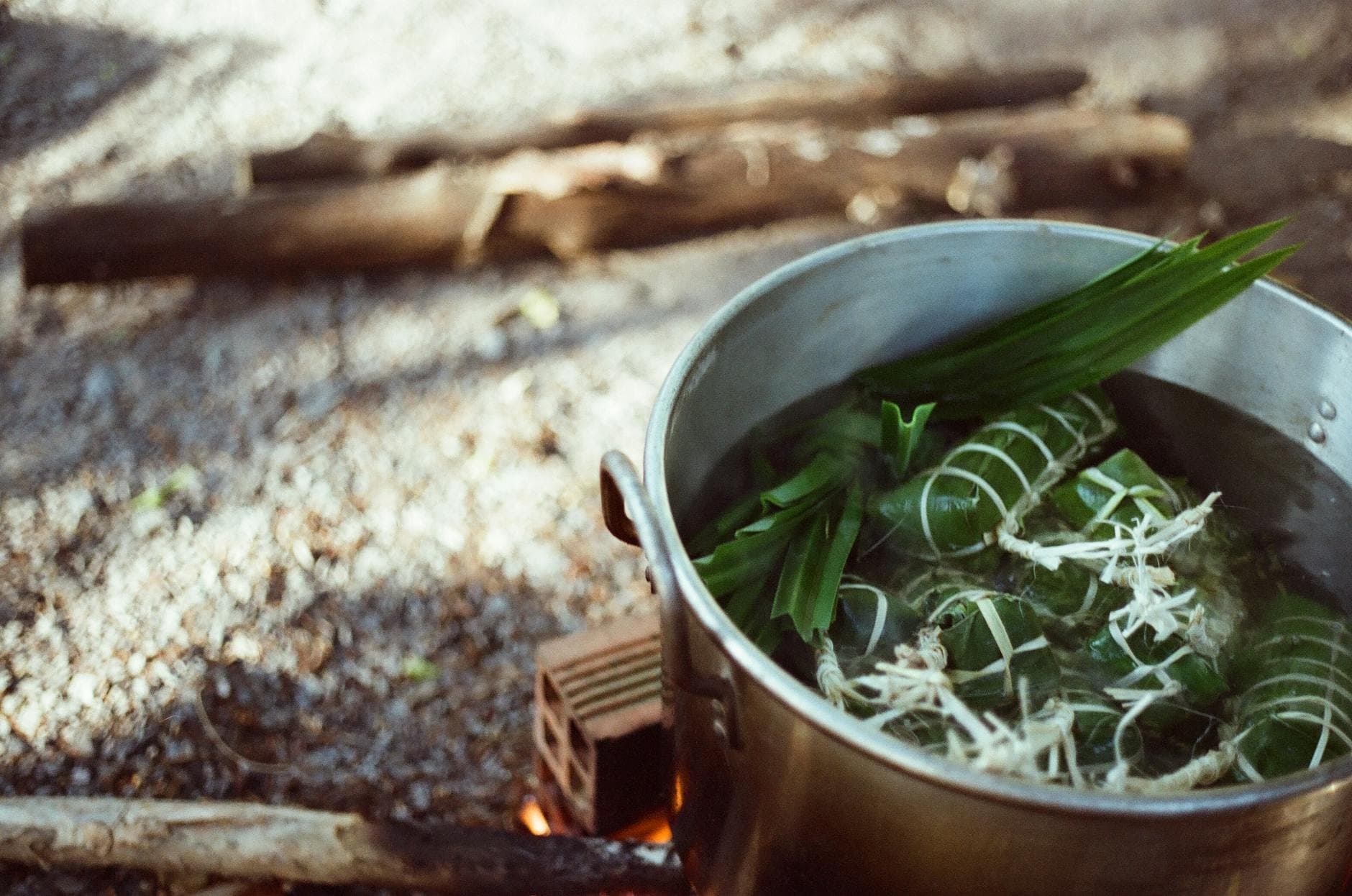
The main documented harm of steaming for a cold is not the steam but the hot water, and many of the people burned are children. In Vietnam the home version is xông nồi: a pot of leaves boiled and set in front of you under a blanket (our xông hơi page describes the herbs and the tradition). VNVC warns that "Nhiệt độ hơi nước có thể gây bỏng" (the heat of the steam can burn) and says not to steam for more than 30 minutes. Burns centres keep count. In the Netherlands, "on average three people are admitted to in one of the Dutch burn centres for burns resulting from steam inhalation therapy" each year, and "Most victims were children, and they needed skin grafting more often than adults"; the authors called for steam inhalation to be dropped from professional guidelines (Baartmans and colleagues, British Journal of General Practice, 2012). At one London burns centre, "19 adult and paediatric patients were identified in our centre over a 2-year period", 16 of them with burns to the lower body, and "Nationally, 201 cases were identified between Jan 2018-Dec 2019" (Scarborough and colleagues, Burns, 2021). At a children's hospital in New South Wales, Australia, "A total of 308 patients were identified with burns caused by using steam inhalation for treating URTIs" between 2010 and 2024, most of them aged 0 to 5, and "23.1% of the cohort underwent surgical grafting" (Sheikh and colleagues, Burns, 2026). At a Paris children's burn unit, 33 children over five years, of whom "Surgery was needed for 51.5% of children" (Tobalem and colleagues, Journal of Burn Care & Research, 2026). Vietnam saw such cases during COVID-19. In March 2022 the National Children's Hospital in Hà Nội treated a six-month-old boy, "bé trai G.B (6 tháng tuổi, Hà Nội) nhập viện trong tình trạng sốt cao, nhiễm trùng huyết" (admitted with a high fever and blood poisoning), after his family used a nose-and-throat steamer to ward off COVID-19 and he suffered a third-degree burn to the top of his left foot, which became infected (VietNamNet, 4 March 2022), and Children's Hospital 1 in Hồ Chí Minh City "đã tiếp nhận 4 trường hợp trẻ bị bỏng vì cha mẹ cho xông hơi" (took in four children burned because their parents had them steam) (Sài Gòn Giải Phóng, 5 March 2022). The same reports say what the Ministry of Health's interim guidance on traditional medicine for COVID-19 actually meant by steaming: according to Dr Nguyễn Hồng Minh, head of traditional medicine at the National Children's Hospital, it was for fumigating rooms and workplaces, and "xông hơi chỉ là một biện pháp hỗ trợ chứ không phải là phương pháp chính điều trị Covid-19" (steaming is only a supporting measure, not a main treatment for COVID-19). Doctors in those reports advise "Không được xông trực tiếp vào người trẻ, đặc biệt là trẻ nhỏ dưới 30 tháng tuổi" (do not steam children directly, especially those under 30 months). The NHS says the same for any age of child: "do not let children breathe in steam from a bowl of hot water because of the risk of scalding". For adults, a shower or a steam room takes the boiling water out of reach; nothing makes it safe to have a small child near a pot of it.
Cold, wet weeks in Hội An: colds, xông hơi and the floods
Late November and December in Hội An are mild but damp. After days of rain and wet clothes many people reach for xông hơi, and this year the weather itself needs watching first. Our guide to Hội An in December has the numbers: at Đà Nẵng airport, "some rain on a median of 21.5 days out of 31 (about two days in three)" over the Decembers of 2014 to 2024, and, from model data for the hotel's own grid point, "an average daytime high of 24.5 °C and an average night low of 21.1 °C". Medlatec describes the leaves for steaming as a folk remedy "được áp dụng phổ biến khi cơ thể bắt đầu có dấu hiệu cảm lạnh" (widely used when the body starts to show signs of a cold). For the last days of November 2026 the national forecasters expected a second spell of heavy rain "from November 27 to 30, when strengthening cold air combines with the intertropical convergence zone and easterly wind disturbances", and "areas from Hue to eastern Da Nang could receive 200-300mm of rain, with localized totals exceeding 500mm" (VietNamNet, 24 November 2026). On the morning we wrote this, 27 November 2026, the National Center for Hydro-Meteorological Forecasting at nchmf.gov.vn carried a heavy-rain forecast and a bulletin headed "TIN CẢNH BÁO LŨ TRÊN CÁC SÔNG TỪ THÀNH PHỐ HUẾ ĐẾN KHÁNH HÒA" (flood warning for the rivers from Huế to Khánh Hòa), and another for the reservoirs of the Vu Gia–Thu Bồn basin, the river the hotel stands on. Official warnings come first: follow nchmf.gov.vn and the Đà Nẵng city authorities, stay out of floodwater, and see our rainy-season flood guide for how floods work in town. If a cold, wet day has you feeling trúng gió, struck by the wind, our page on cạo gió and trúng gió explains that name and the stroke signs it must never cover. On flood days we cannot promise here whether the spa is open, whether the pickup runs or whether the road to us is passable: message us on WhatsApp or Zalo before you set out, and never walk or ride through floodwater to reach us.
What our spa menu offers, and what it does not
On our menu
Price
The menu's own words
With a cold
Herbal steam (xông hơi), private, one person; listed as Sauna on the menu
300,000₫ (20 min); 350,000₫ (30 min)
"Private Vietnamese herbal steam session (xông hơi) — lemongrass and local herbs in hot steam to open airways and loosen muscles"
Warmth and comfort with a mild cold and no fever; the trials we found do not show steam opens airways or shortens a cold
Herbal steam shared by two or more
250,000₫ (20 min); 300,000₫ (30 min), per person
"Share the herbal steam (xông hơi) together"
You share the air with whoever comes with you
Herbal steam inside a package
Package 1 (1,350,000₫) and Package 2 (1,500,000₫); the Nghê Special (1,890,000₫)
"Complimentary 20 min sauna for 2 pax"; "Sauna (30 min)"
The same herbal steam; with a cold, the massage and scrubs in a package are the part to postpone
A dry (Finnish) sauna
Not on our menu
None
We have none; the German sauna advice above is written for one
Jacuzzi
400,000₫ (30 min) or 540,000₫ (45 min) for one; 300,000₫ (30 min) or 400,000₫ (45 min) each for two or more
"Includes drinks & fruit cuts"
Booked and paid for on its own, never included in a massage or package; not with a fever
Massage
From 450,000₫ (60 min)
None quoted here
With a cold or fever, see our page on massage when you are sick
Anything for a fever, flu or a chest infection
Not on our menu
None
See a doctor; in an emergency in Vietnam, call 115
Prices are per person, VAT is included and there is no service charge; treatments starting from 19:00 carry a 20% evening surcharge, so a 300,000₫ steam becomes 360,000₫. At the 26,000₫ rate we use across the site, the private herbal steam is about US$12 for 20 minutes and US$13 for 30, the shared steam about US$10 and US$12 each, and the jacuzzi US$15 or US$21 for one. Prices are from our live spa menu, read on 27 November 2026, and the quoted words are the menu's descriptions, not findings. Said against our own interest: our own menu says the steam is there "to open airways". The trials we found do not support that as a treatment claim: Cochrane found nasal airflow worse in one trial and better in another and no clear symptom relief, and the Berlin sauna trial found no difference in overall cold symptoms. So read our menu line as how warm, herb-scented steam feels, not as something it does to a cold. We are a hotel spa: there is no doctor on the premises, and nothing on the menu is a medical treatment. The menu does not say how hot or humid the steam room runs, which local herbs go in besides lemongrass, whether you can step out and go back in during your booking, how the room is cleaned and aired between guests, or whether there is any charge for moving a booking if you wake up with a fever; ask when you book. If you book online, write in the consultation form's "Anything else" box that you have a cold. With a fever, the flu or chest symptoms, please move the booking rather than come in. Massage with a cold or fever is covered on our page on massage when you are sick, and whether to take the steam before or after a massage on sauna before or after massage.
What we could not find
Planning a trip around this? See dates at our quiet riverside hotel on the Thu Bồn. Check availability →
A trial of a steam room in people with a cold. The Berlin trial used a dry Finnish sauna, and the trials in the Cochrane review used a nasal device.
A trial of any sauna or steam in people with a fever, the flu or a chest infection. We found none; the advice to stay away rests on physiology and on doctors' guidance.
Evidence that a session shortens a cold. The Berlin trial followed people to day 7 and found no overall difference; the 1990 prevention trial found colds no shorter in regular sauna users.
Prevention evidence beyond Finnish men and one small trial. The Finnish cohorts are men aged 42 to 61 at the start; the 1990 trial had 50 people.
A trial of herbal steam against plain steam for colds. The only herbal-steam trial we know of, in allergic rhinitis, is on our steam room vs sauna page and had no group without steam.
How often colds spread in saunas. TK and R+V state the risk; neither gives a number, and we found no study that counted.
A count of steam burns in Vietnam. We found hospital reports from 2022, not national figures.
Anything on our guests. We have measured nothing on the people who use our steam, so we claim nothing for them.
Questions people ask before booking
Is a sauna good for a cold?
Not as a treatment. In the Berlin trial, 157 people with a new cold, the 80 who breathed hot sauna air did no better on overall symptoms over a week than the 77 breathing room-temperature air in the same sauna, and Cochrane's review of six trials with 387 people found the evidence "does not show any benefits or harms" from heated, humidified air. Some people simply feel better in the warmth, and with a mild cold, no fever and a body that feels well, a short session is a comfort choice. With a fever, the flu, chest symptoms or feeling properly ill, skip it.
Can you sweat out a cold?
No. Techniker Krankenkasse: "Denn Viren, die meist für Erkältungen verantwortlich sind, lassen sich nicht einfach durch heftiges Schwitzen aus dem Körper entfernen" (the viruses behind most colds cannot simply be removed from the body by heavy sweating). The idea that heat kills the virus comes from the laboratory: Cochrane's review notes that heat "may destroy the cold virus as it does in vitro", but the one trial in the review that measured virus in nasal washings found no significant difference. TK even claims the opposite, that pathogens can multiply faster at high temperatures, without a source for it; we found no trial of either claim in people in a sauna. Some Vietnamese pages say sweating clears "độc tố" (toxins) through the skin (VNVC); we found no trial behind that. What sweating does do is lose water, so drink.
Steam room or sauna with a cold?
If you go at all, the Austrian internist advises milder heat, such as a steam room (Dampfbad), over a hot Finnish sauna, and TK finds a steam bath as soothing as a bio-sauna, though we found no trial comparing the two in people with a cold. The Klagenfurt internist: "Wer mit einem Schnupfen in die Sauna geht, sollte eine milde Saunaform wie etwa eine Kräutersauna oder ein Dampfbad wählen" (anyone going to the sauna with a runny nose should choose a mild form such as a herbal sauna or a steam bath). TK says that "Dampfbäder: Aufgrund der höheren Luftfeuchtigkeit können Dampfbäder bei Erkältungen ebenso wohltuend sein wie eine Bio-Sauna" (steam baths, thanks to the higher humidity, can be as soothing with a cold as a bio-sauna) and gives their temperature as 45 to 60°C; the humidity it gives, 40 to 55%, is far lower than the near-100% that the sources on our steam room vs sauna page give for a steam room, so it may be describing a different kind of room. Milder air is not the same as less strain: that page also explains why a steam room can feel as hard going as a hotter sauna. Ours is a herbal steam room; we have no dry sauna.
Sauna with a sore throat?
With a mild sore throat at the start or end of a cold, and no fever, an Austrian internist thinks mild, moist heat is fine; with a bad throat, trouble swallowing or a high temperature, the NHS sends you to a doctor, not to the steam. Dr Neumann: "Bei den leichten Halsschmerzen eines beginnenden oder abklingenden Virusinfekts kann die warme, feuchte Luft einer milden Sauna die lokale Immunabwehr stärken" (with the mild sore throat of a starting or fading viral infection, the warm, moist air of a mild sauna can strengthen local immune defences), with plenty to drink before and after; that is his view, and we found no trial of it. The NHS's own self-care for a sore throat does not mention steam, and says sore throats "normally get better by themselves within a week". It also lists when it is a doctor's matter: "a very high temperature, or you feel hot, cold or shivery", signs of dehydration, and, for emergency care, difficulty breathing or being "unable to swallow" (NHS, last reviewed 8 April 2024).
Can I use your steam if I have a cold?
With a mild cold, no fever, and feeling well enough to go about your day, yes, as a comfort, not a cure: book the private herbal steam for one, so you are not sharing the air with other guests, choose the shorter 20 minutes, drink water before and after, and leave the moment you feel dizzy or unwell. Tell us about the cold when you book. If you are coming as two and one of you has the cold, the shared steam means sharing it. With a fever, the flu, chest symptoms, vomiting or diarrhoea, please do not come in; move the booking. Whether the steam can be run cooler, and how the room is cleaned between guests, the menu does not say; ask when you book.
What about a fever?
No sauna and no steam, and we would skip the hot jacuzzi too, for the same reason. Every source we read that addresses fever agrees, from R+V ("bei Fieber ist die Sauna absolut tabu") to Vinmec, VNVC and Medlatec, which sets the line at a fever above 38.5°C. Harvard goes further: "Don't take a sauna when you are ill". With a high fever, VNVC warns, steam can push body temperature higher and dehydrate you. Rest, drink and see a doctor if it lasts: the NHS says to see one for "a high temperature for more than 3 days". In Vietnam a fever can also be dengue, which Vinmec names among the reasons not to steam, so have it checked rather than steamed. Come back for the steam when you are well.
How to book
Nghê Prana Riverside Hotel & Spa, Hẻm 384 Nguyễn Tri Phương, Cẩm Nam, Hội An, on the Thu Bồn, 3.2 km from the Old Town. The spa is open from 9:00 to 21:00 every day and takes visitors as well as hotel guests. Book on the online form or by phone or WhatsApp on +84 896 687 961; an hour's notice is enough, and if you have a cold, say so when you book. Coming as two? The couple spa page shows the private room for two. Free pickup to the spa from anywhere within 5 km of us in a straight line, which takes in the Old Town, hotel guest or not: send your location to +84 896 687 961 on WhatsApp or Zalo and we reply within 15 minutes (9:00–21:00). On days of heavy rain or flood warnings, message us before you set out.
How we checked: on 27 November 2026 we read the abstracts of the Cochrane review on heated, humidified air for the common cold (Singh 2017), the Berlin sauna trial (Pach 2010, Medical Journal of Australia), the two UK steam trials (Little 2013, BMJ; Little 2016, CMAJ), the 1990 sauna and colds trial (Ernst, Annals of Medicine), the two Finnish cohort analyses (Kunutsor 2017, Respiratory Medicine and European Journal of Epidemiology), the 2026 Finnish sauna and blood-count study (Heinonen, Temperature) and the steam-burn studies from the Netherlands (Baartmans 2012), London (Scarborough 2021), New South Wales (Sheikh 2026) and Paris (Tobalem 2026), all through Europe PMC; the abstract and full text of the 2018 systematic review of dry sauna (Hussain and Cohen); the NHS pages on the common cold (last reviewed 22 March 2024), flu (3 February 2026) and sore throat (8 April 2024); Harvard Health's page on saunas (14 May 2020) and the Cleveland Clinic's (12 August 2024); in German, Techniker Krankenkasse's page on sauna with a cold (10 April 2025), the Klagenfurt Elisabethinen hospital's interview with Dr Hans Jörg Neumann on the Barmherzige Brüder Österreich site (undated) and the R+V Infocenter (31 January 2020); in Vietnamese, Vinmec (11 July 2024), VNVC (updated 7 November 2026), Medlatec (14 August 2025), VietNamNet (4 March 2022) and Sài Gòn Giải Phóng (5 March 2022); VietNamNet's forecast report (24 November 2026), the bulletins page of the National Center for Hydro-Meteorological Forecasting (27 November 2026), and our own guide to Hội An in December. We also read our live spa menu. Our translations from German and Vietnamese are our own. We are a hotel spa, not a clinic; nothing here is medical advice.
Singh M, Singh M, Jaiswal N, Chauhan A (2017). Heated, humidified air for the common cold (abstract read 27 November 2026). Cochrane Database of Systematic Reviews. View source
Pach D, Knöchel B, Lüdtke R, et al. (2010). Visiting a sauna: does inhaling hot dry air reduce common cold symptoms? A randomised controlled trial (abstract read 27 November 2026). The Medical Journal of Australia. View source
Little P, Moore M, Kelly J, et al. (2013). Ibuprofen, paracetamol, and steam for patients with respiratory tract infections in primary care: pragmatic randomised factorial trial (abstract read 27 November 2026). BMJ. View source
Little P, Stuart B, Mullee M, et al. (2016). Effectiveness of steam inhalation and nasal irrigation for chronic or recurrent sinus symptoms in primary care: a pragmatic randomized controlled trial (abstract read 27 November 2026). CMAJ. View source
Ernst E, Pecho E, Wirz P, Saradeth T (1990). Regular sauna bathing and the incidence of common colds (abstract read 27 November 2026). Annals of Medicine. View source
Kunutsor SK, Laukkanen T, Laukkanen JA (2017). Frequent sauna bathing may reduce the risk of pneumonia in middle-aged Caucasian men: The KIHD prospective cohort study (abstract read 27 November 2026). Respiratory Medicine. View source
Kunutsor SK, Laukkanen T, Laukkanen JA (2017). Sauna bathing reduces the risk of respiratory diseases: a long-term prospective cohort study (abstract read 27 November 2026). European Journal of Epidemiology. View source
Hussain J, Cohen M (2018). Clinical effects of regular dry sauna bathing: a systematic review (abstract and full text read 27 November 2026). Evidence-Based Complementary and Alternative Medicine. View source
Heinonen IHA, Koivula T, Hollmén M, et al. (2026). Acute Finnish sauna heat exposure induces stronger immune cell than cytokine responses (abstract read 27 November 2026). Temperature. View source
Baartmans M, Kerkhof E, Vloemans J, et al. (2012). Steam inhalation therapy: severe scalds as an adverse side effect (abstract read 27 November 2026). British Journal of General Practice. View source
Scarborough A, Scarborough O, Abdi H, Atkins J (2021). Steam inhalation: more harm than good? Perspective from a UK burns centre (abstract read 27 November 2026). Burns. View source
Sheikh RH, Vella C, D'Cruz R, et al. (2026). Upper respiratory tract infections and scald burns: risks and insights on home remedies (abstract read 27 November 2026). Burns. View source
Tobalem B, Serror K, Chatard M, et al. (2026). Homemade steam inhalation therapy devices: a neglected cause of severe pediatric burns (abstract read 27 November 2026). Journal of Burn Care & Research. View source
NHS (2024). Common cold (page last reviewed 22 March 2024; read 27 November 2026). NHS website. View source
NHS (2026). Flu (page last reviewed 3 February 2026; read 27 November 2026). NHS website. View source
NHS (2024). Sore throat (page last reviewed 8 April 2024; read 27 November 2026). NHS website. View source
Harvard Health Publishing (2020). Saunas and your health (14 May 2020; read 27 November 2026). Harvard Medical School. View source
Cleveland Clinic (2024). Get your sweat on: the benefits of a sauna (12 August 2024; read 27 November 2026). Cleveland Clinic Health Essentials. View source
Techniker Krankenkasse (2025). Sauna bei Erkältung: Gesund oder riskant? (10 April 2025; read 27 November 2026). tk.de. View source
Barmherzige Brüder Österreich; Neumann HJ (Elisabethinen-Krankenhaus Klagenfurt) (2026). Sauna bei Erkältung? (undated; read 27 November 2026). barmherzige-brueder.at. View source
R+V Infocenter (2020). Sauna bei Fieber und Erkältung tabu (31 January 2020; read 27 November 2026). R+V Versicherung. View source
Vinmec (2024). Cảm cúm có nên xông lá? (11 July 2024; read 27 November 2026). Vinmec International Hospital. View source
VNVC (2026). Cách xông hơi giải cảm cúm tại nhà hiệu quả, đúng cách và nhanh khỏi (updated 7 November 2026; read 27 November 2026). VNVC. View source
Medlatec (2025). Tổng hợp các loại lá xông giải cảm hiệu quả, dễ tìm tại nhà (14 August 2025; read 27 November 2026). Medlatec. View source
VietNamNet (2022). Xông phòng Covid-19, bé 6 tháng tuổi ở Hà Nội nhiễm trùng máu (4 March 2022; read 27 November 2026). VietNamNet. View source
Sài Gòn Giải Phóng (2022). Không lạm dụng xông hơi trị Covid-19 (5 March 2022; read 27 November 2026). SGGP. View source
VietNamNet (2026). Central Vietnam faces back-to-back heavy rains and worsening flood risks (24 November 2026; read 27 November 2026). VietNamNet. View source
National Center for Hydro-Meteorological Forecasting (2026). Warning bulletins page (bulletins of 27 November 2026; read 27 November 2026). nchmf.gov.vn. View source
Every room at Nghê Prana is designed around the science of sleep. Blackout curtains, nightly aromatherapy turndown, and riverside quiet — experience what real rest feels like.
Riverside hotel rooms on the Thu Bồn, ten minutes by bicycle from the Ancient Town. Whether it's one night between Hue and Da Nang or a full week of doing nothing — we kept your room quiet.
Free cancellation · Direct from the family who built the hotel




 WhatsApp
 Zalo