Hội An's sun comes up between about 5:15 a.m. in early June and 6:19 a.m. around 21 January — the latest sunrise lands in mid-to-late January, not at the December solstice (whose sunrise is already about 6:10 a.m.) — rising over the South China Sea about 65° east-northeast in June and 114° east-southeast in December (timeanddate.com — Hội An sunrise calendar; NOAA Solar Position Calculator). The best places to watch it are An Bàng beach, the Cửa Đại estuary, the south side of Cẩm Nam bridge, the Cẩm Kim ferry pier, and Bạch Đằng quay in the empty Old Town. The single structural reason sunrise beats sunset here: in Hội An, sunrise rises over open water, while sunset falls behind the lantern-lit Old Town — east-facing geometry is simply kinder to a camera and to a slow morning.
Hội An sits at 15.88° N, 108.34° E (latitude.to GPS database; Wikipedia — Hội An). At this near-tropical latitude, sunrise drifts by only about 54 minutes across the year — from roughly 5:11 a.m. in June to about 6:05 a.m. in January — far less than London (≈ 3.5 hours) or Sapporo (≈ 1 h 45 min). The astronomical reason: the further you are from the equator, the wider the seasonal swing.
Sunrise direction (azimuth, measured clockwise from true north) also shifts. We computed the solstice azimuths from the standard formula cos(A) = sin(δ)/cos(φ) — where δ is solar declination (±23.44°) and φ is observer latitude — using the spherical-astronomy methodology of Jean Meeus, Astronomical Algorithms (2nd ed., 1998), the same equations that drive the NOAA Solar Position Calculator (Meeus algorithms reference, NOAA GML). The output is accurate to within roughly a minute for our latitude band.
The June solstice — the longest day of 2026 — falls on Sunday 21 June at 3:24 p.m. Indochina Time (timeanddate — June solstice 2026). The December solstice is the inverse, falling at 3:50 a.m. on 22 December Indochina Time (20:50 UTC on 21 December). Both bookend the table above.
Why sunrise beats sunset in Hội An
Most travel writing assumes sunset is the default magic hour. In Hội An, that is structurally wrong, and four reasons explain it.
1. The horizon faces the right way. Hội An's Old Town sits on the north bank of the Thu Bồn (Wikipedia — Hội An Old Town; UNESCO inscription #948). The river flows east into the South China Sea at Cửa Đại estuary, and An Bàng beach lies due east of town — meaning at dawn, the sun rises over open water, not behind anything. At sunset, the sun sets behind the Old Town roofline, into the lantern-lit western glare. East-facing water is rare on Vietnam's central coast and Hội An has it on both the river and the beach.
2. No lantern-streetlight contamination. Hội An's signature yellow lantern lights stay on through dusk and most of the night. At sunset they brighten as ambient light fades, contaminating the sky's blue gradient. At sunrise the opposite happens — most lanterns are off by 4 a.m. and the sky becomes the only light source for thirty minutes. The "blue hour" — that intense saturated blue when the sun is between 4° and 6° below the horizon — is structurally cleaner at dawn (Pexels reference: civil twilight & photography).
3. The working river is most alive. This is the cultural argument, and the strongest one. The basket-boat fleet at Cửa Đại and the nearby Duy Hải fishing village returns from overnight runs around 4:30–5:30 a.m., with the dawn fish-market action peaking shortly after (Duy Hải fishing village & market guide, HoiAnDayTrip; Duy Hải morning market profile, 63stravel). Local sunrise tour operators recommend arriving before 5 a.m. to catch the moment. This is not staged for tourists — it is the actual rhythm of a working coast. Sunset is leisure; sunrise is labour, and labour photographs honestly.
4. The Old Town is empty. Hội An's pedestrian-only restriction operates from 9 a.m. to 11 a.m. and 3 p.m. to 10 p.m. (Hoi An Old Town pedestrian hours, Central Vietnam Guide; walking street guide, VinWonders) — which means at dawn, motorbikes can still pass through, but tourists have not yet arrived. You will share the streets with the locals heading to market and the lantern-shop owners sweeping their thresholds. By 7:30 a.m. the first tour buses appear; before that, Bạch Đằng quay is genuinely empty.
Five named sunrise spots in Hội An
1. An Bàng Beach — east-facing horizon, sand-level frame
GPS: 15.91° N, 108.34° E · Distance from Old Town: 3 km north-east
An Bàng faces due east (An Bàng Beach overview, Hoi An Day Trip; LaSiesta sunrise & sunset spots guide). The sun rises over the South China Sea with no land obstruction, framed only by the line of round basket boats that locals beach above the high-tide mark. Between 5 a.m. and 6 a.m. the beach is genuinely local — joggers, swimmers, a Vietnamese-style soccer game on the firm sand. The roped lifeguard zones are not yet active at dawn; do not swim until lifeguards are on duty, typically from around 7 a.m. (An Bang safety & swim guide, Sharing the Wander). Strong rip currents can develop on the central coast even on calm-looking mornings.
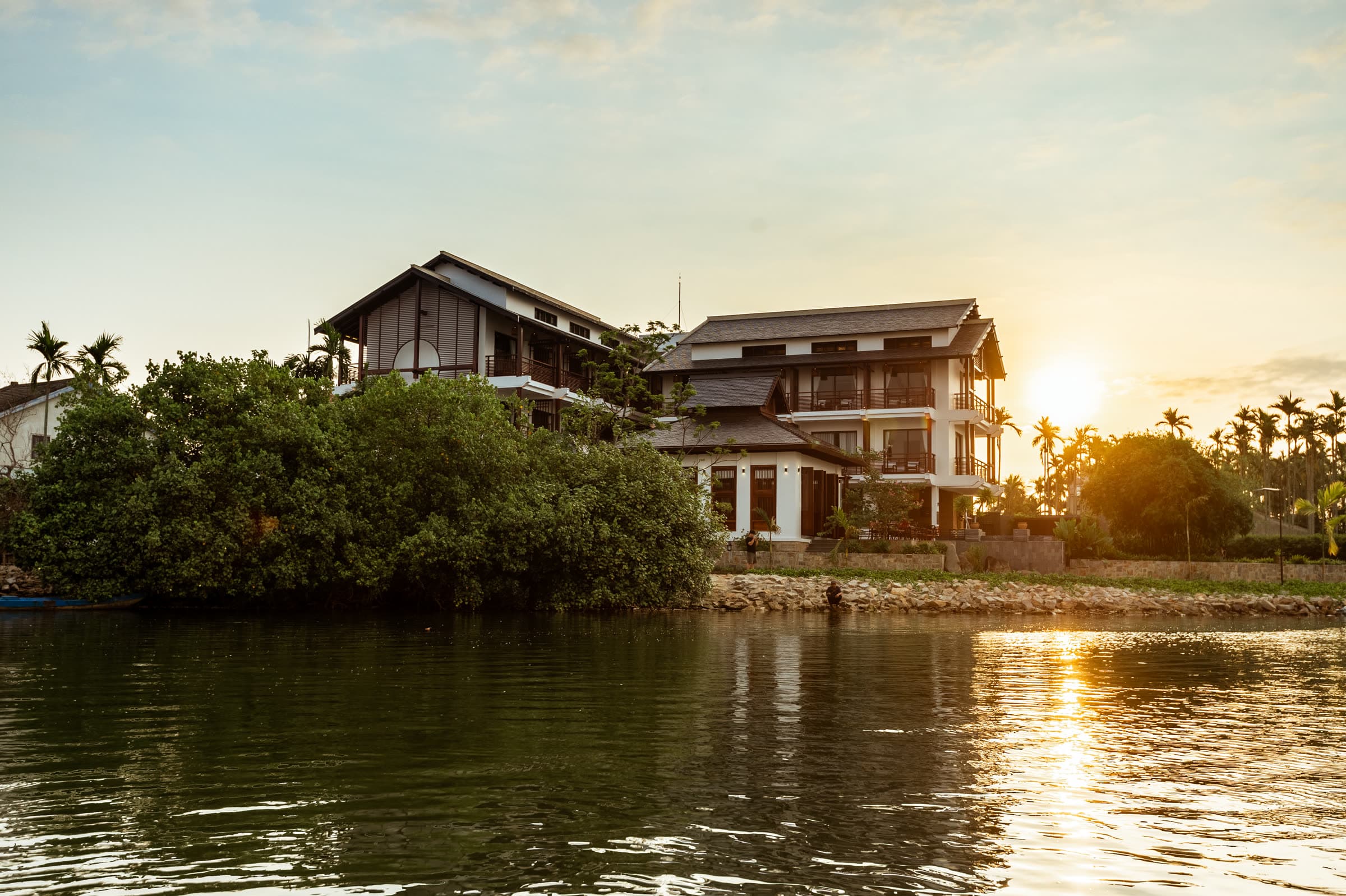
Cycle from town via Hai Bà Trưng street — twelve minutes flat. From Cẩm Nam (where our riverside hotel sits at 39 dB(A), see /cam-nam-hoi-an), it is a fifteen-minute ride.
2. Cửa Đại Estuary — where Thu Bồn meets the sea
GPS: 15.89° N, 108.38° E · Distance from Old Town: 5 km east
The Thu Bồn drains into the South China Sea at Cửa Đại — literally "great estuary" (Thu Bồn River geography, IndochinaVoyages; Wikipedia — Hội An Old Town). Stand on the south bank around 4:45 a.m. and you will see the returning fleet — small wooden boats, basket boats transferring catch from the larger trawlers to shore because the water near the market is too shallow. The light at this hour is the warmest of the day. This is also the working-end of the river that operators use for their sunrise photo tours, which typically depart by boat between 4:30 and 5:00 a.m. (Hoi An sunrise boat tour overview, HoiAnDayTrip; Cua Dai sunrise fishing tour, Life Is Outside).
3. Cẩm Nam Bridge — south side, river bend view
GPS: 15.876° N, 108.331° E · Distance from Old Town: 200 m
The 200-metre concrete bridge from Old Town to Cẩm Nam Island (Cẩm Nam Island geography, VinWonders; Cẩm Nam Bridge entry, TripAdvisor) hands you the river's south-eastward bend. Walk twenty paces past the bridge onto the Cẩm Nam side, turn left, follow the embankment. You will look back across the water with the Old Town on your left and the open river curving east — exactly aligned to where the sun rises in October through February. We sit a few hundred metres into the island; on still mornings our sound floor measures 39 dB(A), quieter than a library, because the bridge buffers traffic. This is the closest serious sunrise spot to coffee.
4. Cẩm Kim Ferry Pier — wooden boat across the river
GPS: 15.876° N, 108.323° E · Distance from Old Town: 600 m (the dock is on Nguyễn Hoàng street, by the night market)
Cẩm Kim Island lies west of the Old Town. The old vehicle ferry was replaced by a bridge in 2021 (New Cẩm Kim Bridge, Ovui), but the wooden passenger ferry from Nguyễn Hoàng wharf still runs every 20–30 minutes, carrying locals and bicycles to Kim Bồng village (Cẩm Kim ferry schedule & fare, RustyCompass). First boats start in the early dawn for the village commute. From the pier looking east, you frame the Old Town roofline against the sunrise sky — a rare composition because most photographers shoot from the opposite bank. Read more on the quiet-islands sister piece at /blog/cam-nam-cam-kim-cam-thanh-quiet-islands-hoi-an.
5. Bạch Đằng Quay — the empty Old Town
Planning a trip around this? See dates at our quiet riverside hotel on the Thu Bồn. Check availability →
GPS: 15.877° N, 108.327° E · Distance from Old Town: zero — this is the Old Town
Bạch Đằng is the 750-metre riverfront promenade built in 1872 during the French colonial period, originally Rue de Fukien (Bạch Đằng Wharf history, HoiAnDayTrip). The protected UNESCO heritage zone occupies just 30 hectares of Old Town, with the Thu Bồn forming the southern boundary (Hội An Old Town UNESCO inscription, World Heritage Centre). At 5 a.m. there are perhaps a dozen people on the entire stretch — a vegetable seller setting up at the central market end, two old men with phin filters, a lantern-shop owner sweeping the front. The Hoài River branch flowing past Bạch Đằng faces roughly south-east, so the actual sun appears low over the river at an oblique angle, but the reflected colour wash on the wooden shopfronts is the photograph here. By 7 a.m. the first tour groups arrive and the moment is gone.
How to plan a sunrise morning
The night before. Check the exact sunrise time for tomorrow on /sunset — our live tool covers both sunrise and sunset and computes the times for our exact GPS, using the same NOAA-Meeus algorithm referenced above. Cross-check against the moon phase at /moon; a waning crescent in the eastern sky an hour before dawn pairs beautifully with the first sunrise light, while a near-full moon will wash out the deep blue hour.
Wake-up time. Set the alarm for 30 minutes before sunrise. That gives you 5–10 minutes to dress, 10 minutes to reach the closest spot from Cẩm Nam, and a full 20-minute civil-twilight window to shoot the blue hour before the sun crests the horizon. The blue hour at this latitude lasts about 20–30 minutes (Hội An blue & golden hour reference) — short. Do not be late.
Coffee. Vietnamese coffee at dawn is not just caffeine; the phin filter drips on its own time, and that time matches the pace of waiting for light. A small phin of robusta will drain in 4–5 minutes — about the gap between civil twilight and the first colour wash. Read why robusta tastes the way it does at /blog/why-vietnamese-coffee-tastes-like-that-phin-robusta. At dawn, takeaway cups are usually available from any open café on Nguyễn Phúc Chu (across the Japanese Bridge) and from a handful of shops on Cẩm Nam itself.
Transport. A bicycle is the right vehicle: silent, slow, no parking. From Cẩm Nam to the Cẩm Nam bridge spot is 90 seconds. To Bạch Đằng — three minutes. To Cửa Đại estuary — twelve minutes (along the south embankment via Cẩm Châu). To An Bàng beach — fifteen minutes (via Hai Bà Trưng, the most direct east-bound road).
Safety. Do not swim at An Bàng or Cửa Đại before lifeguards are on duty. Central-coast rip currents can develop without warning, and the beach is unsupervised at dawn (An Bang safety summary, Sharing the Wander). Wading ankle-deep for the photograph is fine; do not go past your knees.
The civil twilight window — what dawn actually looks like
Astronomers split twilight into three phases. Civil twilight is the brightest, beginning when the sun is 6° below the horizon (timeanddate — civil twilight). Objects on the ground are visible without a torch; the sky is a saturated cobalt blue. This is the "blue hour" in photographer's shorthand, though it lasts roughly 22–25 minutes at Hội An's latitude — closer to a blue half-hour.
The blue hour ends when the upper limb of the sun touches the horizon — that is the moment timeanddate.com reports as "sunrise." For the next 5–10 minutes the sky pivots from cobalt to gold; this is the golden hour proper. By 25 minutes after sunrise the light has hardened, the colour wash has lifted off the river, and the working day has begun: market vendors setting up, motorbike traffic crossing the bridges, the first long-distance tour buses arriving for breakfast at An Bàng.
Civil twilight gives the photographer the longest usable window and the smallest crowd. If you only have one morning in Hội An, this is when to be at the river.
When to choose sunset instead
Three honest cases for sunset over sunrise in Hội An.
You are travelling with people who will not wake at 4:45 a.m. Sunset is the social option. Bạch Đằng at 5:30 p.m. is one of the most photographed scenes in Vietnam for a reason; the lantern glow on the river is its own art form. Our Thu Bồn River sunset vantage points piece covers six options.
You want the lanterns in the frame. Sunrise excludes them by definition. If the photograph in your head includes the warm yellow lantern glow against a fading sky, you want sunset.
There is a typhoon-clearing in the afternoon. October–November fronts often clear westward by 4 p.m., leaving an unusually saturated late sky and a fine sunset — better than the morning of the same day, which will still be overcast. Always check the actual forecast at dawn; if the sky is dull grey at 5 a.m., go back to bed and try sunset.
Otherwise — and this is the structural argument the four sections above made — the river belongs to the morning here. Sunrise is when Hội An is most itself: the working coast doing its work, the lanterns still off, the heritage town empty of everyone except the people who actually live in it. Walk down to the water at 5 a.m. and you are not chasing a tourist photograph. You are simply seeing the town when its locals see it.
Sunrise in Hội An varies between roughly 5:10 a.m. in mid-June (earliest) and 6:10 a.m. in early January (latest). For most of the year, sunrise falls between 5:15 and 5:55 a.m. Plan to be in position 15 to 25 minutes earlier than the listed time to catch the colour shift, which is the most photogenic phase.
Where is the best place to watch sunrise in Hội An?
The five best sunrise spots in Hội An are An Bàng beach (open horizon over the East Sea), Cẩm Nam riverbank (still water reflections), the Japanese Covered Bridge area at first light (no crowds), Cẩm Châu rice paddies (rural foreground), and the Cẩm An coconut basket-boat docks. An Bàng is the most reliable for a clean horizon.
Is sunrise better than sunset in Hội An?
For photography and quietness, sunrise is better than sunset in Hội An. The Old Town is empty at sunrise, the temperature is cool, and the light angle from the east illuminates the river and lantern shops cleanly. Sunset is busier, hazier in the dry season, and faces inland for most riverside spots.
How early should I leave the hotel for sunrise in Hội An?
Leave the hotel 30 to 45 minutes before listed sunrise. The blue-hour and colour-shift phase begins about 25 minutes before the sun crosses the horizon and is generally the most photogenic part of the morning. Cycling from a central Hội An hotel to An Bàng beach takes 15 to 20 minutes.
Do you need a guide for sunrise in Hội An?
You do not need a guide for sunrise in Hội An — the main spots are walkable or cyclable from any central hotel, and the roads are quiet at that hour. Most hotels can arrange a coffee thermos and a bicycle in advance so you can leave silently.
References & Sources
Time and Date AS (2026). Hội An sunrise and sunset times — monthly calendar. timeanddate.com. View source
NOAA Global Monitoring Laboratory (2024). Solar Position Calculator (azimuth & elevation). NOAA GML. View source
NOAA Global Monitoring Laboratory (2024). Solar Calculation Details — implementation of Meeus algorithms. NOAA GML. View source
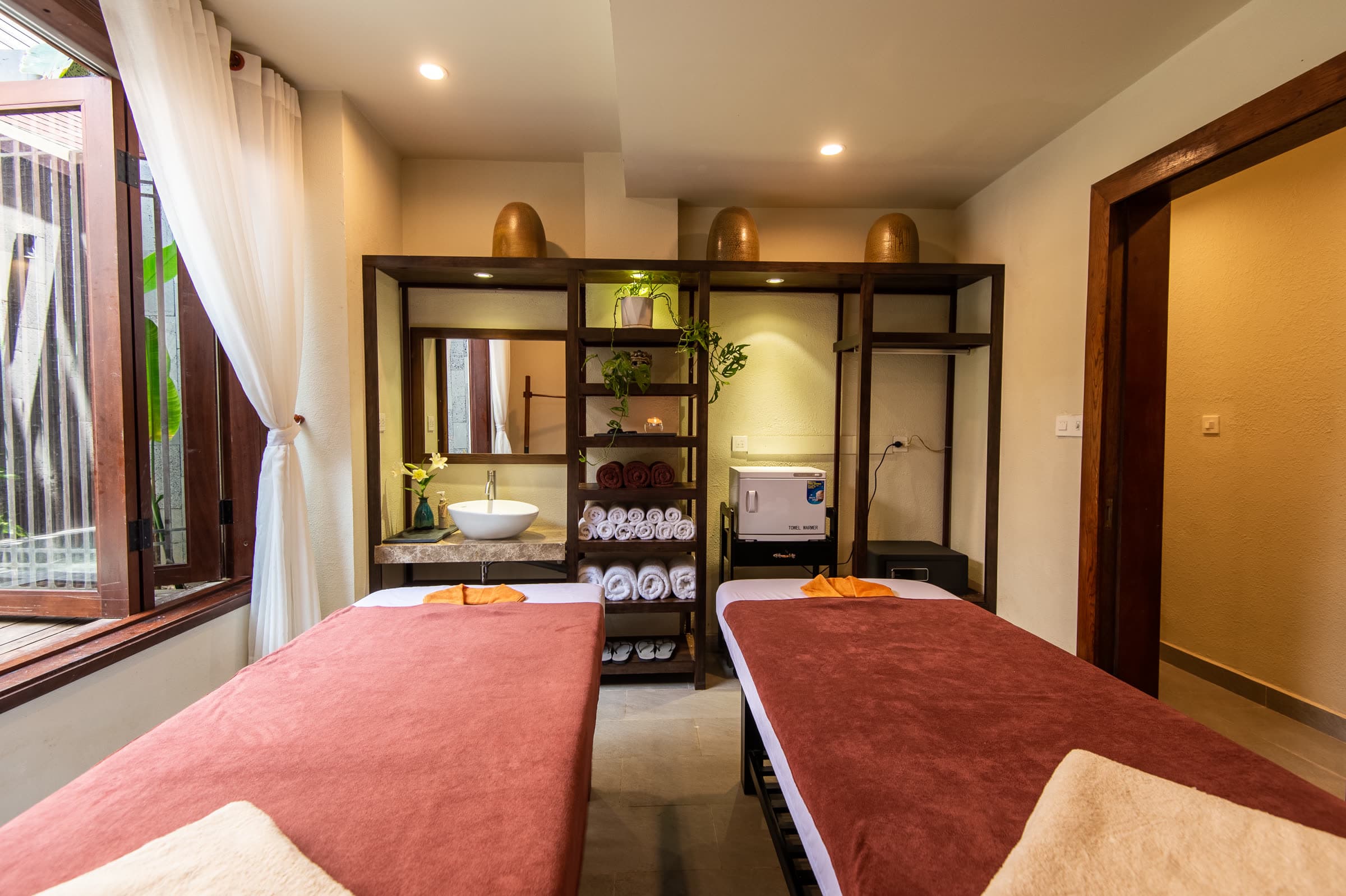
Every room at Nghê Prana is designed around the science of sleep. Blackout curtains, nightly aromatherapy turndown, and riverside quiet — experience what real rest feels like.
Riverside hotel rooms on the Thu Bồn, ten minutes by bicycle from the Ancient Town. Whether it's one night between Hue and Da Nang or a full week of doing nothing — we kept your room quiet.
Free cancellation · Direct from the family who built the hotel


 WhatsApp
 Zalo
Zalo