Vietnam Public Holidays 2027: Every Date, the Tết Block Still Undecided, and the Weeks Worth Avoiding
In 2027 every Vietnamese public holiday falls next to a weekend — New Year's Day, Hùng Kings' Day and Reunification Day are all Fridays, Tết opens on a Saturday, National Day is a Thursday. That turns eleven statutory days into four hard domestic travel peaks. Here are the verified dates, the draft extended blocks the Ministry of Home Affairs put to consultation in August 2026 (including two competing options for Tết), what each wave feels like on the central coast, and the seven-week quiet window most guides never mention.
If you are planning a 2027 trip to Vietnam, the calendar that matters is not the festival calendar. It is the public holiday calendar — the eleven or so statutory days when eighty million people are also travelling. Festivals tell you what you might see. Public holidays tell you what a room will cost, whether the domestic flight you want still exists, and whether the beach you pictured has three hundred people on it. Almost no English-language guide covers them properly, and the ones that do usually list the dates without the one thing that actually decides your trip: which way the days fall.
TL;DR — In 2027, every single Vietnamese public holiday lands next to a weekend. New Year's Day is a Friday, Tết opens on a Saturday, Hùng Kings' Day is a Friday, Reunification Day is a Friday with Labour Day on the Saturday, and National Day is a Thursday. There is no year-splitting midweek holiday to dilute the crowds. A draft schedule from the Ministry of Home Affairs — out for public consultation from 4 to 10 August 2026 — turns these into four extended blocks, with Tết still undecided between a 7-day and a 10-day option. If you want central Vietnam quiet, the windows are late February through March, and the second half of May.
The 2027 dates
These are the statutory holidays fixed in Vietnamese labour law, with the days of the week they fall on in 2027. The lunar-dated entries are converted against mùng 1 tháng Giêng = Saturday 6 February 2027.
Date (2027)
Day
Holiday
Statutory days
1 January
Friday
Tết Dương Lịch — international New Year
1
6 February
Saturday
Tết Nguyên Đán — Lunar New Year (mùng 1)
5
16 April
Friday
Giỗ Tổ Hùng Vương — Hùng Kings' Commemoration (10 tháng Ba)
1
30 April
Friday
Ngày Giải phóng — Reunification Day
1
1 May
Saturday
Quốc tế Lao động — International Labour Day
1
2 September
Thursday
Quốc khánh — National Day, plus one adjacent day
2
That is eleven statutory days. What turns eleven days into roughly three weeks of disrupted travel is the practice of bridging them to the nearest weekend — and in 2027 the bridging is unusually generous, because of where the dates fall.
Public holidays announce themselves before they arrive: flags go up along every lane, days ahead. · Ngày lễ đến trước cả ngày lễ: cờ đỏ treo dọc từng con hẻm.
The part that is still being decided
This is the live piece, and the reason to bookmark this page rather than screenshot it.
Vietnam's statutory holidays are fixed in law, but the actual extended blocks are set year by year and announced by the government. For 2027, the Ministry of Home Affairs put a draft schedule out for public consultation from 4 to 10 August 2026. It proposes:
Tết — two options. Either a seven-day block, 4 to 10 February 2027, or a longer public-sector block of 5 to 14 February 2027.
Hùng Kings' Day — 16 to 18 April 2027, three days.
Reunification and Labour Day — Friday 30 April to Monday 3 May 2027, four days.
National Day — 2 to 5 September 2027, four days.
The same draft carries a change worth knowing about if you plan far ahead: it proposes that holiday schedules be announced by 30 September of the preceding year, rather than whenever the decision happens to be made. If that is adopted, the 2027 schedule should be settled by the end of September 2026 — which is unusually early by recent standards, and good news for anyone booking flights nine months out.
Until then, treat the blocks above as strong signals rather than certainties. The statutory dates in the table will not move; the bridging days might. We will update this page when the final decision is published.
Why 2027 is heavier than a normal year
Run your eye down the day column again. Friday, Saturday, Friday, Friday, Saturday, Thursday. Not one 2027 public holiday falls on a Tuesday or a Wednesday.
That matters more than it sounds. A holiday that lands midweek tends to get taken as a single day off, and domestic travel stays local and short. A holiday that lands on a Friday or a Thursday becomes a three- or four-day block, which is exactly long enough for a family in Hà Nội or Hồ Chí Minh City to fly to the central coast. In 2027 every one of them does that. The result is four hard peaks — early February, mid-April, the turn of April into May, and early September — with very little in between to soften them.
The April–May stretch is the one to watch. Hùng Kings' Day on 16 April and the Reunification block starting 30 April are two weeks apart, which in practice makes the second half of April one long, busy run rather than two separate spikes.
What a holiday actually looks like at street level — flags out, everyone home, everyone moving. · Ngày lễ nhìn từ mặt phố: cờ treo, người người về nhà, đường đông.
What each wave feels like on the central coast
Tết — early February. The strangest of the four, because it runs in two halves. The first days are quieter than usual for international visitors, since many businesses close and foreign arrivals dip; from about the third day of the new year the domestic wave arrives and does not really stop until the first full moon. Our Tết in Hội An 2027 guide covers exactly what closes, when it reopens, and why the fortnight afterwards is the best part.
Hùng Kings' Day — Friday 16 April. A three-day weekend and the traditional opening of the central coast's beach season. Cù Lao Chàm boat services and the beaches at An Bàng and Cửa Đại take their first real crowd of the year. Pleasant, warm, not yet hot.
Reunification and Labour Day — 30 April to 3 May. The biggest domestic travel event in the Vietnamese year, and the one that most surprises foreign visitors. Đà Nẵng's beachfront, the Hải Vân road, Bà Nà, Cù Lao Chàm and every coastal hotel between Huế and Quy Nhơn run at or near capacity. Domestic flights and the north–south trains sell out weeks in advance and prices roughly double. If you are choosing between two possible weeks in spring, this is the one to move away from.
Đà Nẵng's beachfront on an ordinary day. Over the 30 April block, this fills end to end. · Bãi biển Đà Nẵng ngày thường; dịp 30/4 thì kín từ đầu đến cuối.
National Day — 2 to 5 September. A four-day block at the end of the summer holidays, and the last big domestic wave before the rains. It is also the point where central Vietnam's weather starts turning: September sits at the front edge of the wet season, so this block carries a real chance of storms alongside the crowds. Our rainfall-by-month climatology has the numbers.
The quiet windows
This is the useful half of the calendar, and nobody publishes it.
Late February to the end of March. The single best stretch of the year for central Vietnam. The Tết wave has drained away by around the first full moon — 20 February 2027 — and nothing else lands until Hùng Kings' Day on 16 April. The weather is dry and mild, the Old Town is walkable, and the village festivals of the post-Tết fortnight are already over. Roughly 21 February to 14 April 2027 is close to seven uninterrupted weeks.
The second half of May, and June. Once the 3 May block ends, the coast empties out again until the school holidays build through late June. Hot, bright, dry, and noticeably cheaper than the fortnight before.
October and November. The rainy months, with a real flood risk in Hội An — see our flood guide before booking. But domestically dead, and the monthly lantern nights carry on regardless.
The weeks either side of a block. If your dates are near-fixed, shifting by four or five days is often enough. Arriving on 4 May rather than 29 April changes the price and the crowd completely, for the sake of a working week.
The north–south trains are the first thing to sell out around a holiday block, well before the flights do. · Tàu Bắc – Nam là thứ hết vé sớm nhất mỗi dịp lễ, trước cả vé máy bay.
Planning a trip around this? See dates at our quiet riverside hotel on the Thu Bồn. Check availability →
If you are booking from abroad
Book domestic transport before accommodation. This is backwards from how most people plan, but around a Vietnamese holiday block the flights and trains are the genuine bottleneck. Hotel supply in Hội An and Đà Nẵng is large; seats on a Hà Nội–Đà Nẵng flight on 30 April are not.
Watch for the announcement, not the law. The statutory dates are already knowable, but the bridging blocks are what trigger the booking rush. If the 30 September proposal is adopted, that announcement is your starting gun — book in the days after it, not before.
International arrivals are barely affected. Long-haul flights into Đà Nẵng, Hà Nội and Hồ Chí Minh City follow global seasonality, not Vietnamese holidays. It is only once you are inside the country that the calendar bites.
Expect holiday pricing on transport, openly posted. Taxi and ride-hailing surcharges over the holiday blocks are normal and published across Vietnam. Budget for them rather than being surprised by them.
Nothing shuts for the non-Tết holidays. Reunification Day, Hùng Kings' Day and National Day close banks and government offices, but restaurants, hotels and tours all run — busier, not closed. Tết is the only holiday where widespread closure is a real planning factor.
Where this leaves you, if you want quiet
The whole argument of this page is that in 2027 the crowded weeks are unusually easy to identify and therefore unusually easy to avoid. Four blocks, all of them weekend-adjacent, all of them visible nine months out.
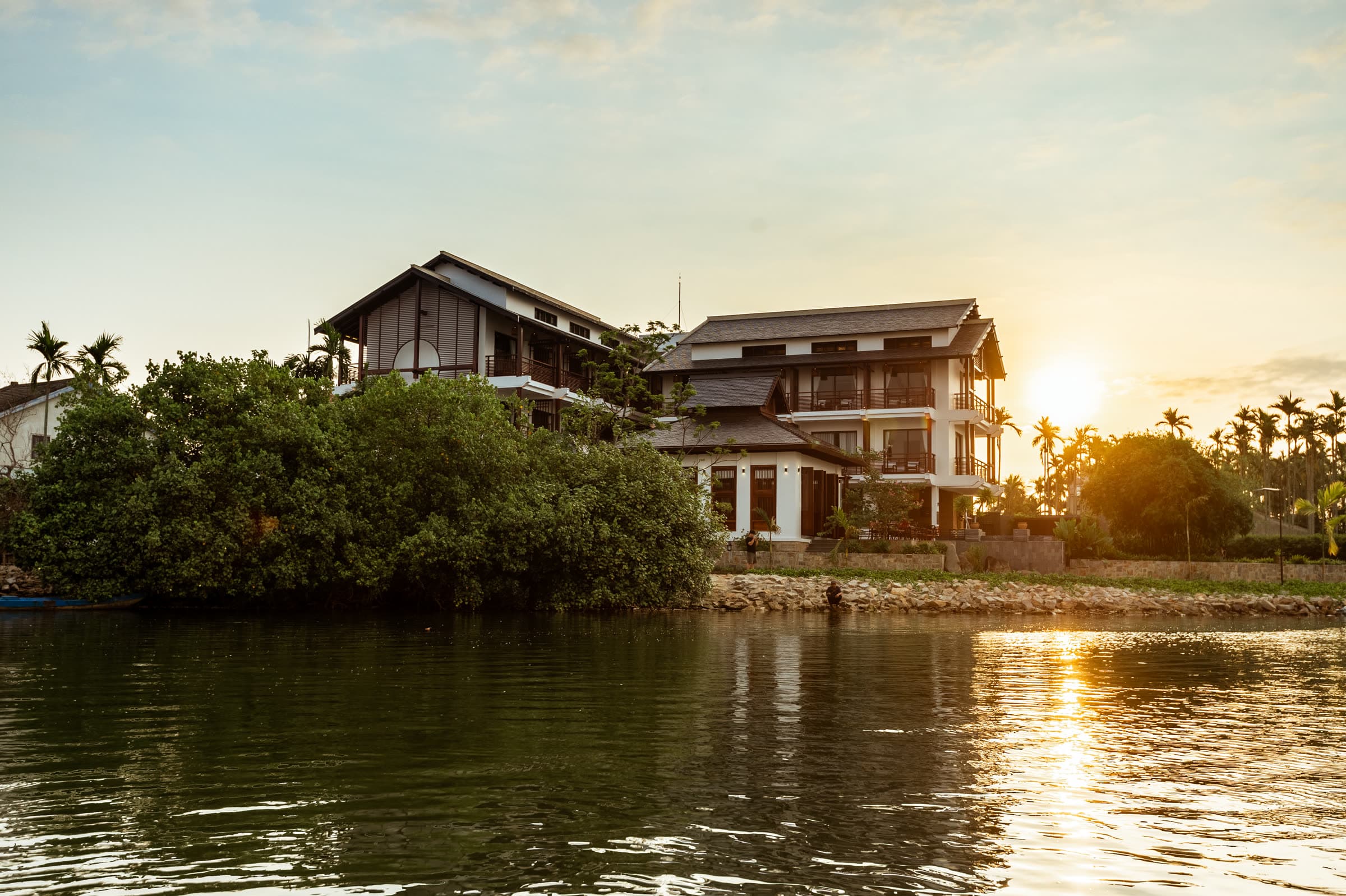
If your dates are flexible, aim for the long window between Tết and mid-April. If they are not, put yourself on the right side of the river. Nghê Prana is a riverside hotel on the Cẩm Nam side of the Thu Bồn, across the water from the Ancient Town — which is a quietness argument in any ordinary week and a considerably stronger one when the domestic wave is in town and the Old Town is at capacity. See our rooms, or read what riverside actually means in a town where a lot of hotels claim it.
The Thu Bồn on an ordinary morning. The holiday calendar is mostly a guide to keeping it looking like this. · Sông Thu Bồn một buổi sáng bình thường — lịch nghỉ lễ chủ yếu để giữ được khung cảnh này.
Frequently Asked Questions
What are the public holidays in Vietnam in 2027?
Vietnam has eleven statutory public holiday days in 2027: New Year's Day on Friday 1 January; Tết Nguyên Đán from Saturday 6 February (five statutory days); Hùng Kings' Commemoration Day on Friday 16 April; Reunification Day on Friday 30 April; International Labour Day on Saturday 1 May; and National Day on Thursday 2 September plus one adjacent day. Extended blocks around these dates are set annually by the government.
When is Tết 2027 and how many days is the holiday?
Tết Nguyên Đán 2027 begins on Saturday 6 February 2027. The statutory entitlement is five days, but the actual block is decided annually. A draft schedule put to public consultation from 4 to 10 August 2026 proposes two options: seven days from 4 to 10 February 2027, or a longer public-sector block from 5 to 14 February 2027. The final decision had not been published at the time of writing.
When is Hùng Kings' Day in 2027?
Giỗ Tổ Hùng Vương falls on the 10th day of the third lunar month, which in 2027 is Friday 16 April 2027. The August 2026 draft schedule proposes a three-day block from 16 to 18 April.
What are the busiest travel weeks in Vietnam in 2027?
Four blocks: Tết in early-to-mid February; the Hùng Kings' weekend of 16–18 April; the Reunification and Labour Day block from Friday 30 April to Monday 3 May, which is the single busiest domestic travel period of the year; and National Day from 2 to 5 September. In 2027 every public holiday falls next to a weekend, so all four become extended blocks.
When is the quietest time to visit Hội An in 2027?
Roughly 21 February to 14 April 2027 — after the Tết wave drains away following the first full moon on 20 February, and before Hùng Kings' Day on 16 April. That is close to seven uninterrupted weeks of dry, mild weather with no domestic holiday block in them. The second half of May is the next best window.
Do shops and restaurants close on Vietnamese public holidays?
Only really for Tết, when many family-run businesses close for roughly the first three days of the lunar year. For Reunification Day, Hùng Kings' Day and National Day, banks and government offices close but restaurants, hotels, tours and transport all operate — they are busier rather than closed.
Should I avoid Vietnam during a public holiday?
Not necessarily, but plan differently. Book domestic flights and trains well ahead, expect posted holiday surcharges on transport, and choose accommodation away from the busiest strips. Shifting your dates by four or five days around a block is usually enough to change both price and crowding substantially.
The statutory holidays in this guide are those fixed in Vietnamese labour law. The extended blocks are from the draft 2027 schedule circulated by the Ministry of Home Affairs for public consultation from 4 to 10 August 2026, as reported by VnExpress and Vietnamese news outlets; they are proposals, not a final decision, and this page will be updated when the decision is published. Lunar dates are converted with mùng 1 tháng Giêng anchored to Saturday 6 February 2027 — the same anchor used across our Tết, Kim Bồng, Trà Quế and 2027 lantern-calendar guides — placing Giỗ Tổ Hùng Vương on Friday 16 April 2027. Crowd patterns on the central coast are reported from Hội An, from the Cẩm Nam riverside across the Thu Bồn from the Ancient Town.
Vietnam has eleven statutory public holiday days in 2027: New Year's Day on Friday 1 January; Tết Nguyên Đán from Saturday 6 February (five statutory days); Hùng Kings' Commemoration Day on Friday 16 April; Reunification Day on Friday 30 April; International Labour Day on Saturday 1 May; and National Day on Thursday 2 September plus one adjacent day. Extended blocks around these dates are set annually by the government.
When is Tết 2027 and how many days is the holiday?
Tết Nguyên Đán 2027 begins on Saturday 6 February 2027. The statutory entitlement is five days, but the actual block is decided annually. A draft schedule put to public consultation from 4 to 10 August 2026 proposes two options: seven days from 4 to 10 February 2027, or a longer public-sector block from 5 to 14 February 2027. On 11 September 2026 the Ministry of Home Affairs submitted the seven-day option to the Government; the Prime Minister's decision had not been published as of 22 September 2026.
When is Hùng Kings' Day in 2027?
Giỗ Tổ Hùng Vương falls on the 10th day of the third lunar month, which in 2027 is Friday 16 April 2027. The August 2026 draft schedule proposes a three-day block from 16 to 18 April.
What are the busiest travel weeks in Vietnam in 2027?
Four blocks: Tết in early-to-mid February; the Hùng Kings' weekend of 16–18 April; the Reunification and Labour Day block from Friday 30 April to Monday 3 May, which is the single busiest domestic travel period of the year; and National Day from 2 to 5 September. In 2027 every public holiday falls next to a weekend, so all four become extended blocks.
When is the quietest time to visit Hội An in 2027?
Roughly 21 February to 14 April 2027 — after the Tết wave drains away following the first full moon on 20 February, and before Hùng Kings' Day on 16 April. That is close to seven uninterrupted weeks of dry, mild weather with no domestic holiday block in them. The second half of May is the next best window.
Do shops and restaurants close on Vietnamese public holidays?
Only really for Tết, when many family-run businesses close for roughly the first three days of the lunar year. For Reunification Day, Hùng Kings' Day and National Day, banks and government offices close but restaurants, hotels, tours and transport all operate — they are busier rather than closed.
Should I avoid Vietnam during a public holiday?
Not necessarily, but plan differently. Book domestic flights and trains well ahead, expect posted holiday surcharges on transport, and choose accommodation away from the busiest strips. Shifting your dates by four or five days around a block is usually enough to change both price and crowding substantially.
Every room at Nghê Prana is designed around the science of sleep. Blackout curtains, nightly aromatherapy turndown, and riverside quiet — experience what real rest feels like.
Riverside hotel rooms on the Thu Bồn, ten minutes by bicycle from the Ancient Town. Whether it's one night between Hue and Da Nang or a full week of doing nothing — we kept your room quiet.
Free cancellation · Direct from the family who built the hotel


 WhatsApp
 Zalo
Zalo